# Design your own assets from templates
Source: https://docs.settlemint.com/docs/changelog/dalp-3-0/asset-templates
Turn a proven asset setup into a reusable template, so the next instrument starts from a standard instead of a blank form. Your institution's configuration knowledge travels with it.
**We shipped a template library in Asset Designer. Clone a proven instrument setup, reshape what you need, and your version lives in the library beside ours.**
Issuing a tokenized security is not just filling in a name and a supply number. Every instrument carries a set of on-chain capabilities that determine how it behaves: whether it pays yield, whether it redeems at maturity, which compliance rules fire on transfer, what metadata a reviewer needs to see. Getting that configuration right on the first launch is a technical problem. Getting it right consistently across dozens of launches is an organizational one. Asset templates solve the organizational problem by making your institution's correct configuration the default, not the goal.
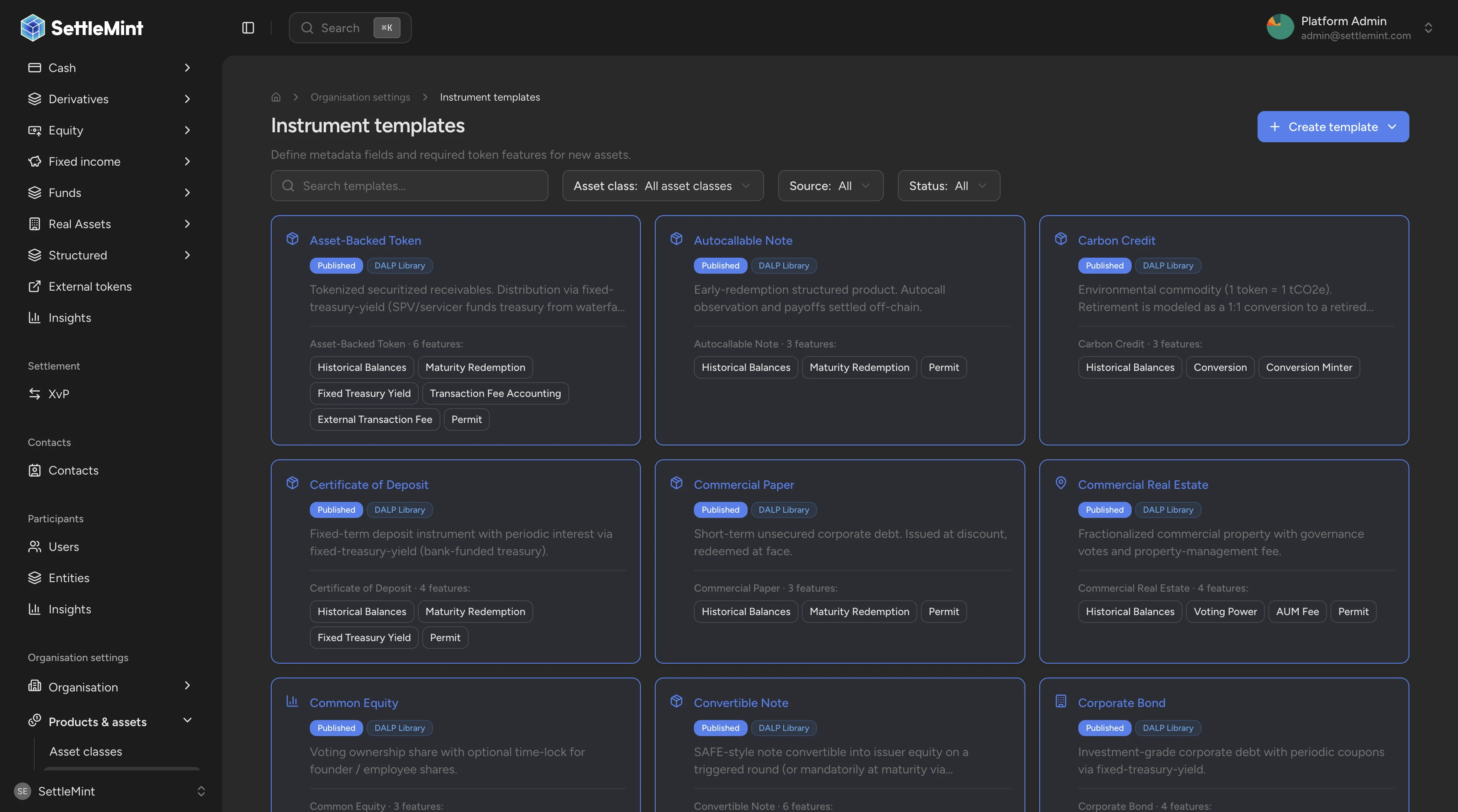
Asset Designer is the guided flow where you configure and launch a tokenized instrument. DALP 3.0 ships twenty-four ready-to-use instrument templates across six asset classes: bonds, equities, funds, real assets, cash instruments, and structured products. Each template carries the full configuration a launch needs: the asset class, the token features, the safe defaults, and the metadata fields to collect at issuance. Your organization's templates sit right beside ours in the same library.
## Twenty-four templates, ready on day one [#twenty-four-templates-ready-on-day-one]
The library is not six empty folders. It ships with twenty-four fully configured instruments, each a proven starting point you clone and reshape.
| Asset class | Templates |
| -------------------- | -------------------------------------------------------------------------------------------------------------- |
| Bonds (fixed income) | Sovereign Bond, Corporate Bond, Treasury Bill, Green Bond, Commercial Paper, Convertible Note, Syndicated Loan |
| Equities | Common Equity, Preferred Equity, Employee Equity Award |
| Funds | ETF, Mutual Fund, Money Market Fund, Private Equity Fund |
| Cash instruments | Certificate of Deposit, Tokenized Bank Deposit, Fiat-Backed Stablecoin |
| Real assets | Commercial Real Estate, Precious Metals, Carbon Credit, Tokenized Art |
| Structured products | Principal-Protected Note, Autocallable Note, Asset-Backed Token |
Each one already carries its asset class, token features, safe defaults, and the metadata fields to collect at issuance. You start from the closest match, never a blank form.
## Why every launch used to start from scratch [#why-every-launch-used-to-start-from-scratch]
## From clone to your own standard [#from-clone-to-your-own-standard]
The real cost of configuration drift is not that a form gets filled in wrong. The error stays invisible until something downstream breaks. A bond that launches without the right fee configuration and compliance hooks will behave correctly on-chain while producing records that do not match what the servicer expects. Templates encode the decision once, at the point where the product team designed it, and propagate it forward to every subsequent issuance.
## What standardization means at volume [#what-standardization-means-at-volume]
Institutions moving from pilot tokenization programs to production issuance at volume run into the same friction: each new instrument type requires rebuilding decisions that were already made for the last one. The yield feature that belongs on a fixed-rate note but not a floating one. The metadata fields a custodian needs to reconcile. The compliance controls that differ between a retail fund and an institutional one. That friction compounds with team size. A single experienced issuer carries those decisions in their head. A team of ten cannot, and the inconsistencies show up in the ledger.
Templates are how that knowledge moves from heads to the platform. The product team that knows exactly how a green bond should be configured defines it once. Every subsequent green bond launch starts from that definition. When the configuration changes, it changes in the template and propagates forward; it does not require tracking down every team member who might remember the old way.
Mature software organizations apply the same logic to infrastructure: you do not provision a database from scratch each time; you start from a baseline that encodes your decisions. Instrument templates bring that baseline discipline to regulated asset issuance.
## The standard under every template [#the-standard-under-every-template]
Every instrument Asset Designer launches, regardless of which template it starts from, is a tokenized security built on ERC-3643: the open Ethereum standard for regulated, permissioned tokens. ERC-3643 extends ERC-20, the foundational fungible-token interface that underpins the on-chain asset economy, by adding the identity verification and programmable compliance rules that ERC-20 alone does not provide. The result is a security that any ERC-20-compatible system can read and hold balances for, while transfer eligibility is governed by on-chain logic rather than off-chain promises.
What ERC-3643 adds over plain ERC-20 is a mandatory identity registry and a modular compliance contract, both linked directly to the token. Before a transfer executes, the standard requires that the recipient address be verified in the registry and that all active rules pass. That check is not a wrapper or a middleware layer: the transfer logic inside the contract enforces it, at the contract level, visible to any party reading the ledger. For tokenized securities across bonds, equities, funds, and structured products, this makes the permissioned model auditable, deterministic, and portable across custodians, exchanges, and secondary-market venues that support the standard.
Our ERC-3643 implementation builds directly on OpenZeppelin's audited ERC-20 primitives, not a third-party token framework or proprietary runtime. The token contract inherits the OpenZeppelin ERC-20 base and adds the ERC-3643 identity and compliance layer on top. No proprietary lock-in exists at the token layer: the on-chain asset conforms to a public Ethereum specification.
When you clone a template and launch an instrument, the resulting tokenized security is portable and independently auditable. A custodian, compliance tool, or secondary-market venue that supports ERC-3643 and ERC-20 can interact with it without a DALP-specific integration. An auditor can verify the identity checks and transfer rules by reading the deployed contracts directly, without translation.
## The standard library and your own [#the-standard-library-and-your-own]
DALP 3.0 ships a catalog of instrument templates across six asset classes. Each one launches a real, fully-configured product today. Your institution's templates live in the same library, so the next team to issue a commercial paper or a private equity fund sees your organization's standard, not a blank page.
Sovereign Bond · Treasury Bill · Green Bond · Commercial Paper · Convertible Note · Syndicated Loan.
Preferred Equity · Employee Equity Award.
ETF · Money Market Fund · Private Equity Fund.
Certificate of Deposit.
Carbon Credit · Tokenized Art.
Principal-Protected Note · Autocallable Note · Asset-Backed Token.
## What a template carries [#what-a-template-carries]
A template is not a saved form in the usual sense: the configuration it holds is an assertion about what the correct instrument setup for an asset class looks like. When an operations team reviews a launch, they review the template's definition, not a memory checklist maintained elsewhere. That difference matters to an auditor: the template is the documented standard, and the launched instrument is evidence that the standard was followed.
A template captures everything Asset Designer needs to launch a class of asset. The asset class determines which token features are available and which are required. The token features set the exact on-chain capabilities the instrument launches with. Default configuration gives the issuer safe starting values for each parameter they control. Metadata fields define what to collect at issuance, scoped to that instrument class.
When you clone a template and reshape it, all four dimensions travel with your version. The next operator who launches from that template gets your standard, not a blank form.
Configurable feature settings are controlled at the individual setting level. A template can keep a fee recipient fixed while allowing an operator to enter the fee value during asset creation. Settings that are not configurable stay on the template as defaults and do not appear as editable inputs in the Asset Designer. The operator only sees the decisions that are still theirs to make.
Asset Designer runs prerequisite and compatibility checks on every launch, regardless of whether it started from a template or a blank form. A conflicting or incomplete configuration is caught before the instrument is created, not after.
[Set up instrument templates →](/docs/operators/asset-creation/instrument-templates)