# Deploy and mint a deposit
Source: https://docs.settlemint.com/docs/developer-guides/runbooks/create-mint-deposits
Create a deposit token, handle queued creation responses, grant token roles,
unpause it, and mint deposit certificates with the DALP TypeScript SDK.
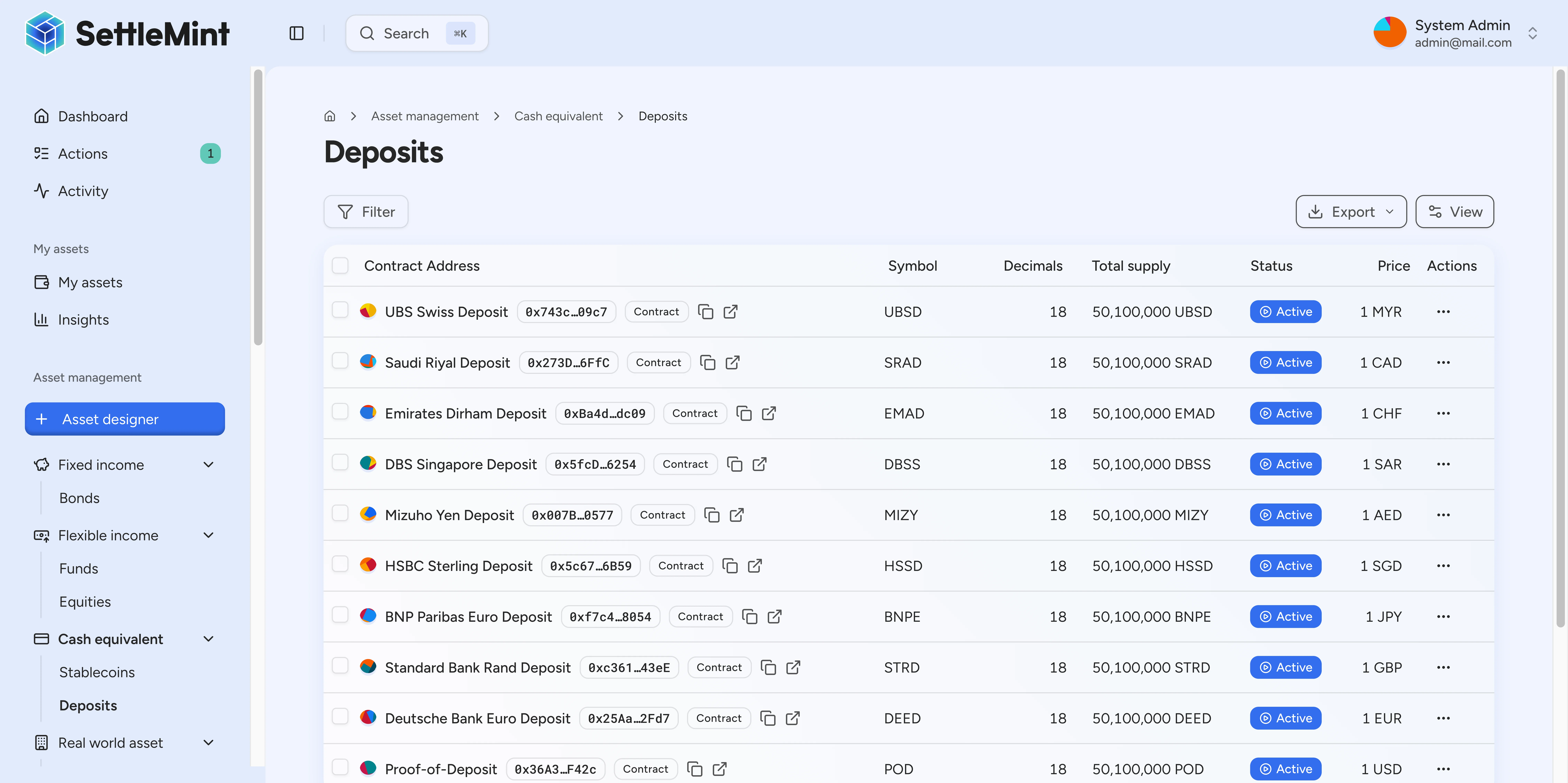
Deposit issuance turns a deposit product into an ERC-3643-style asset workflow: create the token, handle a queued creation response when one is returned, assign the operating roles, unpause the contract, then mint deposit certificates to registered wallets.
## Prerequisites [#prerequisites]
Before running these commands, you need:
1. **Platform URL** - the DALP platform URL, such as `https://your-platform.example.com`.
2. **API key** - an API key for the user that will create and operate the deposit token.
3. **PINCODE** - wallet verification enabled during onboarding. Manage it from **Account → Wallet**.
4. **Admin role** - admin access if you need to grant yourself system roles.
5. **Token manager role** - the `tokenManager` system role before creating the deposit token.
6. **Registered identities** - the issuer wallet and each recipient wallet registered in the identity registry before minting.
7. **Deposit product terms** - denomination asset, decimals, price currency, base price, term length, and any early withdrawal policy you need to operate outside this minting flow.
Your wallet address is returned by `dalp.user.me`. Set `decimals` to match the denomination asset you plan to use for accounting, then provide `priceCurrency` and `basePrice` so treasury and liability views can value the certificates consistently.
***
## Quick reference [#quick-reference]
| Step | What | Method |
| ---- | ------------------------- | --------------------------------------- |
| 1 | Create SDK client | `createDalpClient` |
| 2 | Get wallet address | `dalp.user.me` |
| 3 | Grant system roles | Grant `tokenManager` role |
| 4 | Create deposit token | `dalp.token.create` (type: `"deposit"`) |
| 5 | Grant token roles | `dalp.token.grantRole` |
| 6 | Unpause | `dalp.token.unpause` |
| 7 | Mint deposit certificates | `dalp.token.mint` |
| 8 | Verify holders | `dalp.token.holders` |
***
## Deposit token lifecycle flow [#deposit-token-lifecycle-flow]
The minting flow is intentionally linear. Do not mint until the token exists, the required token roles are granted, and the recipient identity is registered:
**Deposit-specific requirements:**
* **Identity registration** - register the issuer wallet and recipient wallets before minting.
* **Decimals alignment** - match token decimals to the denomination asset you use for accounting.
* **Liability tracking** - set `priceCurrency` and `basePrice` on creation.
* **System role** - hold `tokenManager` before creation.
* **Token roles** - hold `supplyManagement` before minting and `emergency` before unpausing.
* **Queued creation** - resolve a returned `transactionId` before granting token roles.
***
## Step-by-step commands [#step-by-step-commands]
### Step 1: create the SDK client [#step-1-create-the-sdk-client]
Create the DALP SDK client with your platform URL and API key. Keep the PINCODE available for wallet verification on the write calls.
```ts file=/src/examples/create-mint-deposit.ts#L1-L9
import { createDalpClient } from "@settlemint/dalp-sdk";
async function main() {
// Step 1: Create the SDK client
const dalp = createDalpClient({
url: "https://your-platform.example.com",
apiKey: "YOUR_API_KEY",
});
const pincode = "YOUR_PINCODE";
```
Client helper implementation
The shared client helper configures the generated DALP SDK client with your API key. Implementation:
```ts file=/src/examples/client.ts
import { createDalpClient } from "@settlemint/dalp-sdk";
// Create the SDK client — replace with your actual values
const dalp = createDalpClient({
url: "https://your-platform.example.com",
apiKey: "sm_dalp_xxxxxxxxxxxxxxxx",
});
// All methods are fully typed with auto-complete
const me = await dalp.user.me({});
console.log("Wallet:", me.data.wallet);
const tokens = await dalp.token.list({ query: {} });
console.log("Tokens:", tokens.data.length);
```
***
### Step 2: get your wallet address [#step-2-get-your-wallet-address]
```ts file=/src/examples/create-mint-deposit.ts#L11-L17
// Step 2: Get your wallet address
const me = await dalp.user.me({});
const myWallet = me.data.wallet;
if (!myWallet) {
throw new Error("No wallet found. Create a wallet first via the DALP dashboard.");
}
console.log("Wallet:", myWallet);
```
Save your wallet address. You use it for identity registration, token role grants, and the first mint in this example.
***
### Step 3: set up system roles [#step-3-set-up-system-roles]
Complete the role and identity setup before calling `dalp.token.create`.
1. **Grant system roles**:
* `tokenManager` - Required to create tokens
* `claimPolicyManager` or `complianceManager` - Optional, if you plan to automate collateral attestation or custom compliance
2. **Register identity**:
* Register your wallet address in the identity registry before minting.
* Use `dalp.system.identity.create` for the issuer wallet and for any other recipient wallet you mint to.
* If a recipient is not registered, the mint call fails before certificates are issued.
Only users with `admin` role can grant system roles. If you do not have admin access, ask your system administrator to grant `tokenManager` and register the identities before you continue.
***
### Step 4: create deposit token [#step-4-create-deposit-token]
```ts file=/src/examples/create-mint-deposit.ts#L25-L48
// Step 4: Create deposit token
const deposit = await dalp.token.create({
body: {
type: "deposit",
name: "12M USD CD",
symbol: "CD12",
decimals: 18,
countryCode: "840",
priceCurrency: "USD",
basePrice: "1.00",
initialModulePairs: [],
walletVerification: {
secretVerificationCode: pincode,
verificationType: "PINCODE",
},
},
});
if ("transactionId" in deposit) {
console.log("Deposit creation queued:", deposit.transactionId);
return;
}
const tokenAddress = deposit.data.id;
console.log("Deposit created:", tokenAddress);
```
**Parameters:**
* `type`: Must be `"deposit"`
* `name`: Deposit name (e.g., "12M USD CD")
* `symbol`: Deposit symbol (e.g., "CD12")
* `decimals`: Match the denomination asset decimals (guide section "Denomination asset selection")
* `countryCode`: ISO country code (840 = USA, 056 = Belgium, 276 = Germany)
* `priceCurrency`: ISO currency code (e.g., "USD")
* `basePrice`: Fiat value per deposit token in the selected `priceCurrency`, such as `"1.00"`
* `termLengthDays`: Optional term length in days
* `interestRateBps`: Optional annual interest rate in basis points
* `earlyWithdrawalPenaltyBps`: Optional early withdrawal penalty in basis points
* `initialModulePairs`: Compliance modules (empty array `[]` for basic setup)
**Expected:** In synchronous mode, the response includes deposit data with `id`, which is the token contract address. If the create request is queued, the script logs the `transactionId`; poll `dalp.transaction.status` until the transaction completes, then use `dalp.token.list` to retrieve the token address before continuing.
Save the contract address. You need it for every remaining step.
> Vault linking, denomination asset approvals, and early-withdrawal automation continue in the deposit user guide. This API guide covers contract deployment and minting.
***
### Step 5: grant token roles [#step-5-grant-token-roles]
Grant yourself `supplyManagement` for minting and `emergency` for unpausing the deposit contract.
When you create a token, you receive the token `admin` role and can grant additional token roles. Grant these roles before you try to unpause or mint.
```ts file=/src/examples/create-mint-deposit.ts#L50-L72
// Step 5: Grant token roles
await dalp.token.grantRole({
params: { tokenAddress },
body: {
accounts: [myWallet],
role: "supplyManagement",
walletVerification: {
secretVerificationCode: pincode,
verificationType: "PINCODE",
},
},
});
await dalp.token.grantRole({
params: { tokenAddress },
body: {
accounts: [myWallet],
role: "emergency",
walletVerification: {
secretVerificationCode: pincode,
verificationType: "PINCODE",
},
},
});
```
**Expected:** Both role grant transactions complete. Wait for confirmation before Step 6.
***
### Step 6: unpause the deposit [#step-6-unpause-the-deposit]
New tokens start paused. Unpause to enable transfers:
```ts file=/src/examples/create-mint-deposit.ts#L75-L85
// Step 6: Unpause the deposit
await dalp.token.unpause({
params: { tokenAddress },
body: {
walletVerification: {
secretVerificationCode: pincode,
verificationType: "PINCODE",
},
},
});
console.log("Deposit unpaused");
```
This step requires the `emergency` role from Step 5. Make sure both role grants are confirmed before unpausing.
***
### Step 7: mint deposit certificates [#step-7-mint-deposit-certificates]
Register each recipient wallet in the identity registry before minting. For your own wallet, complete Step 3 first. For another recipient, call `dalp.system.identity.create` before adding the address to `recipients`.
```ts file=/src/examples/create-mint-deposit.ts#L87-L100
// Step 7: Mint deposit certificates — 50,000 units
// IMPORTANT: Recipient must be registered in identity registry
await dalp.token.mint({
params: { tokenAddress },
body: {
recipients: [myWallet],
amounts: [50_000_000_000_000_000_000_000n],
walletVerification: {
secretVerificationCode: pincode,
verificationType: "PINCODE",
},
},
});
console.log("Minted deposit certificates");
```
**Parameters:**
* `tokenAddress`: Your deposit contract address (in path)
* `recipients`: Array of recipient wallet address(es) - **must be verified in identity registry**
* `amounts`: Array of token-unit amounts. The example mints 50,000 certificates with 18 decimals.
**Expected:** The mint write completes and the certificates appear in the holder list after the transaction is indexed.
This step requires the `supplyManagement` role from Step 5. If DALP returns `RecipientNotVerified`, register that wallet with `dalp.system.identity.create`. Then retry the mint.
***
### Step 8: verify the mint [#step-8-verify-the-mint]
```ts file=/src/examples/create-mint-deposit.ts#L102-L104
// Step 8: Verify holders
const holders = await dalp.token.holders({ params: { tokenAddress }, query: { limit: 200 } });
console.log("Holders:", holders.data);
```
**Expected:** The holder list shows the recipient and minted balance. Asset views use the same token supply and price fields to show depositor positions and liability values.
***
## Full script [#full-script]
```ts file=/src/examples/create-mint-deposit.ts
import { createDalpClient } from "@settlemint/dalp-sdk";
async function main() {
// Step 1: Create the SDK client
const dalp = createDalpClient({
url: "https://your-platform.example.com",
apiKey: "YOUR_API_KEY",
});
const pincode = "YOUR_PINCODE";
// Step 2: Get your wallet address
const me = await dalp.user.me({});
const myWallet = me.data.wallet;
if (!myWallet) {
throw new Error("No wallet found. Create a wallet first via the DALP dashboard.");
}
console.log("Wallet:", myWallet);
// Step 3: Set up system roles
// Follow the Set Up Roles guide to:
// - Grant yourself 'tokenManager' system role
// - Register your identity (CRITICAL: required before minting)
// See: /docs/developer-guides/runbooks/setup-roles
// Step 4: Create deposit token
const deposit = await dalp.token.create({
body: {
type: "deposit",
name: "12M USD CD",
symbol: "CD12",
decimals: 18,
countryCode: "840",
priceCurrency: "USD",
basePrice: "1.00",
initialModulePairs: [],
walletVerification: {
secretVerificationCode: pincode,
verificationType: "PINCODE",
},
},
});
if ("transactionId" in deposit) {
console.log("Deposit creation queued:", deposit.transactionId);
return;
}
const tokenAddress = deposit.data.id;
console.log("Deposit created:", tokenAddress);
// Step 5: Grant token roles
await dalp.token.grantRole({
params: { tokenAddress },
body: {
accounts: [myWallet],
role: "supplyManagement",
walletVerification: {
secretVerificationCode: pincode,
verificationType: "PINCODE",
},
},
});
await dalp.token.grantRole({
params: { tokenAddress },
body: {
accounts: [myWallet],
role: "emergency",
walletVerification: {
secretVerificationCode: pincode,
verificationType: "PINCODE",
},
},
});
console.log("Roles granted");
// Step 6: Unpause the deposit
await dalp.token.unpause({
params: { tokenAddress },
body: {
walletVerification: {
secretVerificationCode: pincode,
verificationType: "PINCODE",
},
},
});
console.log("Deposit unpaused");
// Step 7: Mint deposit certificates — 50,000 units
// IMPORTANT: Recipient must be registered in identity registry
await dalp.token.mint({
params: { tokenAddress },
body: {
recipients: [myWallet],
amounts: [50_000_000_000_000_000_000_000n],
walletVerification: {
secretVerificationCode: pincode,
verificationType: "PINCODE",
},
},
});
console.log("Minted deposit certificates");
// Step 8: Verify holders
const holders = await dalp.token.holders({ params: { tokenAddress }, query: { limit: 200 } });
console.log("Holders:", holders.data);
}
await main();
```
***
## Troubleshooting [#troubleshooting]
**"Authentication missing"** → Check the API key passed to `createDalpClient`.
**"PINCODE\_INVALID"** → Reconfirm your PINCODE.
**"USER\_NOT\_AUTHORIZED" / "tokenManager required"** → Grant the `tokenManager` role (requires admin access).
**"Permission denied"** → Grant the required token roles (`supplyManagement`, `emergency`).
**"Token is paused"** → Make sure Step 6 (unpause) succeeded and you have `emergency` role.
**"RecipientNotVerified"** → Register the recipient wallet with `dalp.system.identity.create`, then retry the mint.
**Queued token creation** → Poll `dalp.transaction.status` with the returned `transactionId`. Continue only after the queued operation completes and you have resolved the token address.
**"Invalid country code"** → Provide a numeric ISO 3166-1 code (`840`, `056`, `276`, etc.).
**Mismatched decimals vs. denomination asset** → Align `decimals` with the ERC-20 you plan to lock in vaults as described in the deposit guide's "Denomination asset selection."
## Related [#related]
* [Deposit use case](/docs/executive-overview/use-cases/deposits)
* [Token lifecycle API guide](/docs/developer-guides/api-integration/token-lifecycle)
* [Developer runbooks](/docs/developer-guides)