# Platform capabilities
Source: https://docs.settlemint.com/docs/executive-overview/dalp-overview
DALP combines issuance, compliance, custody controls, settlement, servicing, exception handling, and operating evidence in one platform for regulated digital asset operations after launch.
## Key terms [#key-terms]
* **[DALP](/docs/executive-overview/glossary#dalp)** – Digital Asset Lifecycle Platform,
SettleMint's production DALP implementation
* **[ERC-3643](/docs/executive-overview/glossary#erc-3643)** – Token standard
for permissioned securities with embedded compliance
* **[SMART Protocol](/docs/executive-overview/glossary#smart-protocol)** –
SettleMint Adaptable Regulated Token protocol providing unified compliance
* **[Multi-signature wallet](/docs/executive-overview/glossary#multi-signature-wallet)**
– Wallet requiring multiple approvals for transactions
## What the Digital Asset Lifecycle Platform is [#what-the-digital-asset-lifecycle-platform-is]
The SettleMint Digital Asset Lifecycle Platform (DALP) is working software for
regulated digital asset operations after launch. Institutions use it to create
assets, enforce compliance, control approvals, coordinate settlement, service
assets, handle exceptions, and retain operating evidence through the asset
lifecycle.
Issuance is only the starting point. DALP provides the controls institutions need
once an asset is live: compliance checks before transfers execute, role-based
operations, custody-aware approval flows, settlement handling, servicing actions,
emergency controls, and audit-ready records in one integrated platform.
The full-stack includes smart contracts implementing compliance-aware tokens, a
modern web application for issuers, administrators, and investors, backend APIs
and services for integration, blockchain indexing for real-time ownership
registries, database schemas for off-chain data, deployment infrastructure for
production operations, and developer documentation and SDKs for customization.
The platform is opinionated about architecture, unified lifecycle management with
embedded compliance, but flexible about deployment. Run it on-premises, in your
cloud infrastructure, or as dedicated SaaS. Deploy to Ethereum, Polygon,
Hyperledger Besu, Quorum, or any EVM-compatible network. Customize the user
interface, integrate with your systems, and extend the smart contracts for
asset-specific requirements.
## Product and delivery responsibilities [#product-and-delivery-responsibilities]
DALP is the licensed product surface for the asset lifecycle: contracts, console,
APIs, workflow execution, indexing, reporting, and the documented integration
points around custody, compliance, network access, and monitoring. Implementation
and support services help deploy, configure, integrate, and operate that product
inside the client's chosen environment.
| Responsibility area | DALP product provides | Client, partner, or delivery team decides |
| ---------------------- | ------------------------------------------------------------------------------------------------------------------------- | --------------------------------------------------------------------------------------------------- |
| Asset lifecycle | Asset factories, compliance-aware token contracts, servicing actions, settlement workflows, and indexed operating records | Asset terms, business approvals, role assignment, and operating procedures |
| Deployment model | Supported platform components for on-premises, client-cloud, or dedicated SaaS deployment | Hosting choice, environment controls, network access, backup policy, and internal change management |
| Integrations | API and workflow surfaces for custody, compliance providers, EVM RPC access, observability, and downstream systems | Provider selection, contract terms, operating runbooks, credential governance, and escalation model |
| Compliance controls | Technical enforcement points, identity-bound checks, module configuration surfaces, and audit evidence | Legal interpretation, regulatory sign-off, policy ownership, and exception approval |
| Support and operations | Product documentation, platform health surfaces, failure-mode guidance, and supportable integration patterns | Internal incident command, evidence-pack assembly, retention policy, and production support model |
Use this split when evaluating DALP. A feature in the product can still require
implementation work to configure it for a specific institution, provider, network,
or operating policy. That implementation work does not turn the product capability
into a roadmap item, and the product docs should not imply that DALP replaces the
client's legal, custody, network, privacy, or support obligations.
For the detailed responsibility map, read the [architecture overview](/docs/architecture/overview). For runtime
placement and hosting boundaries, read [deployment topology](/docs/architecture/overview/deployment-topology)
and [self-hosting prerequisites](/docs/architecture/self-hosting/prerequisites). For asset-specific operating
responsibilities, read the [use cases overview](/docs/executive-overview/use-cases).
## Key features and capabilities [#key-features-and-capabilities]
### Regulated operations after launch [#regulated-operations-after-launch]
DALP is designed for the operational phase that begins after an asset is issued.
That phase includes transfer approvals, custody-policy boundaries, settlement
coordination, servicing events, exception handling, emergency controls,
production monitoring, and audit evidence. These controls sit in the same
platform as asset configuration and compliance, so operations teams do not have
to reconcile separate systems to understand what happened.
For regulated institutions, this matters because most operating risk appears
after the first asset goes live. The questions are practical: who can approve a
transfer, which compliance rule blocked it, whether every settlement leg was
approved, how an expired settlement is withdrawn, which emergency role paused an
asset, and what evidence remains for compliance and audit review. DALP treats
those as platform workflows, not manual back-office work.
### Complete lifecycle management [#complete-lifecycle-management]
DALP's implementation of DALP principles delivers **integrated lifecycle
management** that competitors can't match. These capabilities aren't add-ons or
integrations, they're architected into the platform from the ground up:
**The asset lifecycle flows through five integrated phases**: Issuance creates
the token with embedded compliance from deployment. Compliance enforces rules at
every transfer, validating identity claims and regulatory requirements. Custody
secures assets in multi-signature vaults with maker-checker workflows.
Settlement executes atomic transfers where cash and tokens move together or both
revert. Servicing automates yield calculations, dividend distributions, and
redemptions. Each phase references the same control plane, no reconciliation
between vendors.
**Delivery versus Payment (DvP)**: Atomic settlement ensures asset and cash
transfer simultaneously or both revert. No settlement risk. No reconciliation.
True T+0 finality. The XvP settlement system coordinates multi-party exchanges
where every leg executes together, if any party's transfer fails, the entire
settlement reverts. This eliminates counterparty risk and the need for trusted
intermediaries.
**Secure Treasury Vaults**: Multi-signature custody with role-based access
control. Configurable quorum requirements ensure no single person can move
assets unilaterally. The vault system provides maker-checker workflows where one
admin proposes transactions and others approve before execution. Emergency pause
capabilities protect against compromised accounts. Full audit trails track every
proposal, approval, and execution.
**Scheduled Yield Management**: Fixed yield schedules calculate dividend,
interest, and coupon entitlements automatically without manual processing.
Configure payment schedules once, and the platform calculates distributions on
payment dates. Token holders claim their yields directly through smart contracts
with cryptographic proof of entitlement. No spreadsheets, no reconciliation, no
manual wire transfers.
These three capabilities, **DvP settlement, vault custody, and scheduled yield
management**, form the operational backbone that separates lifecycle platforms
with DvP, vault custody, and yield management from basic token issuance tools. While competitors offer
pieces through multiple vendors requiring integration, DALP delivers unified
lifecycle management where these capabilities work together.
### Multi-asset support from day one [#multi-asset-support-from-day-one]
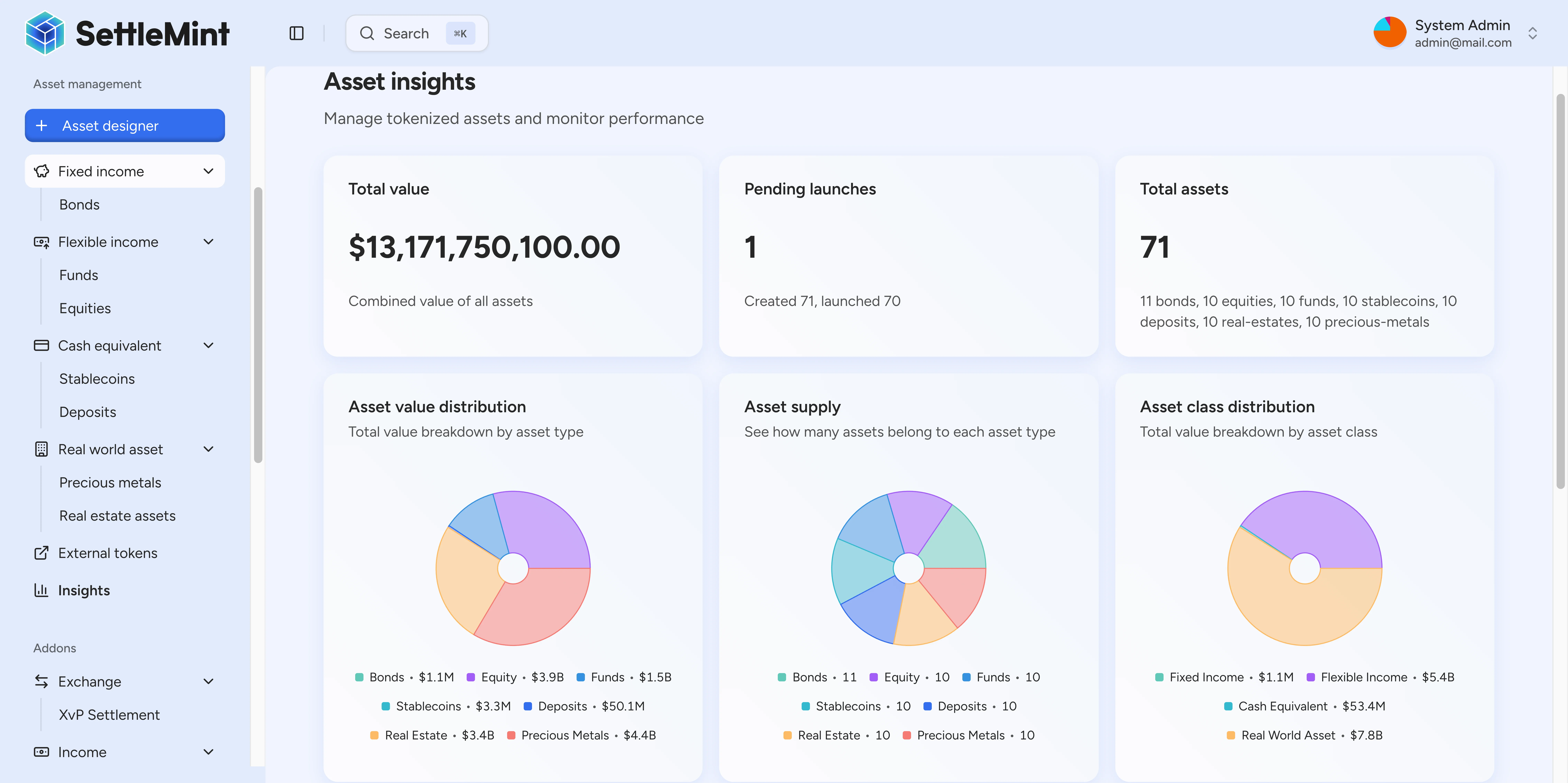
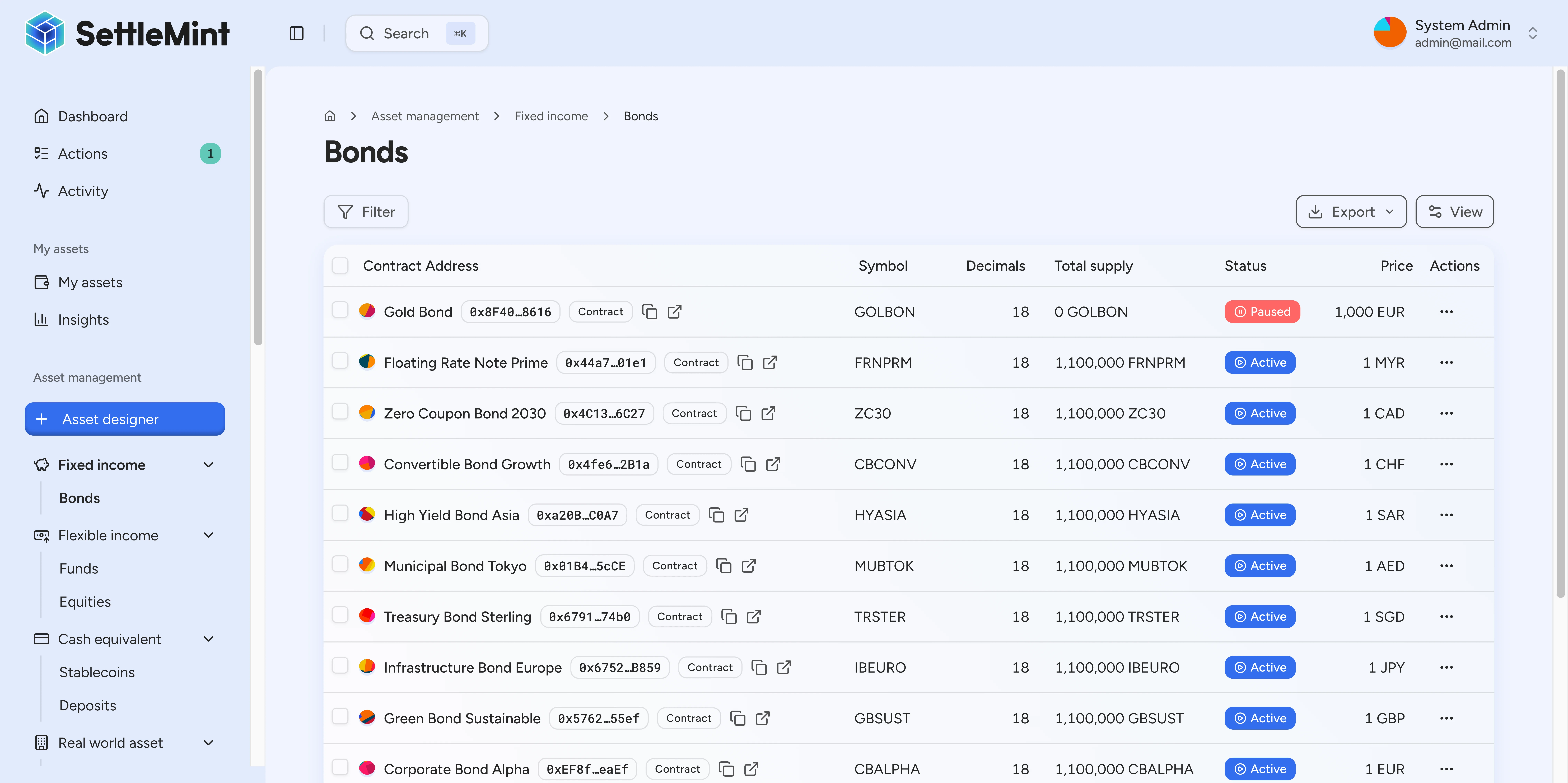

Seven asset classes ship as ready-to-deploy templates, not future roadmap
promises:
**Bonds (Debt Instruments)**: Fixed or floating rate, with maturity dates,
coupon payment schedules, redemption mechanics, and collateral tracking. The
platform calculates interest entitlements on payment dates for token holders to
claim, and handles redemption at maturity without manual reconciliation.
**Equities (Company Shares)**: Common or preferred shares with voting rights,
dividend distributions, cap table management, and shareholder governance. Voting
power automatically derives from token holdings at snapshot blocks, and votes
are tallied on-chain without spreadsheets.
**Funds (Investment Units)**: Open-ended or closed-end fund structures with NAV
tracking, management fee calculation, performance monitoring, subscription
processing, and redemption workflows. The platform maintains real-time holder
registries and automates fund administration that traditionally takes days.
**Stablecoins (Fiat-Pegged Tokens)**: Tokenized representations of fiat
currencies with reserve management, peg maintenance, minting controls tied to
actual deposits, and burning processes for redemptions. Issuers get transparency
into collateral ratios and automated compliance with reserve requirements.
**Deposits (Certificates)**: Time-locked deposit certificates with collateral
verification, maturity tracking, and interest accrual. These bridge traditional
banking products into programmable assets with automated lifecycle management.
Each asset type implements the SMART Protocol (SettleMint Adaptable Regulated
Token), which means they all share compliance infrastructure, custody controls,
and operational tooling despite having different economic terms and lifecycle
events.
**Every asset type gains access to DALP's lifecycle capabilities**:
bonds use DvP for primary issuance and secondary trading, vaults for secure
treasury management, and yield schedules for coupon calculations; equities
use vaults for corporate treasury and yield schedules for dividend
entitlement tracking; funds rely on DvP for subscription/redemption settlement
and vaults for asset custody. The lifecycle management isn't separate, it's how
these assets operate.
### Regulatory compliance embedded in the architecture [#regulatory-compliance-embedded-in-the-architecture]
Compliance isn't a dashboard feature you turn on after deploying tokens. It's in
the token's DNA through the ERC-3643 standard implementation.
The Identity Registry maintains verified investor profiles with KYC/AML status,
accreditation levels, and jurisdictional eligibility. An investor completes
verification once, and their identity travels with them across all assets
they're eligible to hold.
The Compliance Engine evaluates every transfer before execution, checking
whether the sender is verified, whether the recipient meets eligibility
requirements, whether the transfer violates holding limits or lockup periods,
and whether jurisdictional rules permit the transaction. Non-compliant transfers
revert with clear reason codes explaining why.
The Rule Library provides a configurable framework for jurisdiction-specific
compliance. The platform supports templates for Regulation D and Regulation S
(US), MiFID II and MiCA (Europe), MAS frameworks (Singapore), and FCA
requirements (UK). Compliance officers configure rules through UI controls
rather than writing smart contract code.
The Audit Trail captures every decision: which rules were evaluated, which
identity claims were verified, which administrators approved exceptions, with
immutable timestamps and cryptographic proof. Regulators get machine-readable
evidence, not manually compiled spreadsheets.
### Multi-layer security and custody [#multi-layer-security-and-custody]
Multi-signature wallets require configurable quorum approval for treasury
operations. No single person can move assets unilaterally. The platform enforces
maker-checker workflows where one admin proposes a transaction and others
approve before execution.
Custody-aware signing routes let institutions delegate signing and transaction
broadcasting to configured providers instead of relying on a single application
hot wallet. Current DALP integrations cover Fireblocks and DFNS provider-native
broadcasting, approval polling, and signer operations.
Role-Based Access Control (RBAC) defines who can perform which operations: token
creation, compliance approval, treasury transactions, administrative settings.
Permissions map to organizational hierarchies with proper segregation of duties.
Institutions can use those provider-side policy controls while DALP coordinates
asset lifecycle workflows, transaction state, and confirmation tracking in the
platform.
The platform assumes keys will be stolen, employees will make mistakes, and
external attacks will occur. Security is defense in depth: multiple layers that
must all fail before assets are at risk.
### Modern user experience across personas [#modern-user-experience-across-personas]
The **Issuer Portal** walks asset managers through token creation with a
multi-step wizard that handles configuration, compliance setup, legal
documentation uploads, and deployment. Preview every setting before finalizing.
Deploy to testnet first, validate behavior, then promote to mainnet when ready.
The **Investor Portal** gives token holders real-time visibility into their
holdings, transaction history, pending corporate actions, and upcoming events.
No waiting for quarterly statements. No calling customer service to check your
balance. Everything is transparent and current.
The **Admin Console** centralizes operations: pending compliance approvals, KYC
verifications, whitelist management, corporate action scheduling, reporting and
analytics. Compliance officers and operations teams have purpose-built tools for
their workflows.
The **Developer Portal** provides API documentation, SDK downloads, code
examples, sandbox environments for testing, and transaction status guidance for
long-running blockchain operations. Developers can distinguish immediate
responses that include data and transaction hashes from asynchronous responses
that include a transaction ID, current status, and polling URL. Technical teams
can integrate DALP into existing systems without reverse-engineering
undocumented behavior.
The Asset Console theme system lets operators align the browser experience with
their institutional brand while keeping product workflows unchanged. Detailed
branding controls are covered in the [Asset Console customization guidance](/docs/architecture/components/platform/asset-console#customization).
### Scalable architecture for production workloads [#scalable-architecture-for-production-workloads]
The platform uses modern microservices architecture with independent scaling for
each component. The web application, API server, blockchain indexer, and
database tier scale independently based on load.
TanStack-based frontend provides instant navigation and optimistic updates.
Users don't wait for blockchain confirmations to see UI updates; the interface
predicts outcomes and updates immediately while settlement completes in the
background.
Drizzle ORM with PostgreSQL manages off-chain data with strong consistency
guarantees. DALP's native indexer keeps blockchain events queryable within
seconds of on-chain finality.
Redis caching accelerates frequent queries. Expensive operations get cached
aggressively so dashboards load instantly even with thousands of assets and tens
of thousands of holders.
Kubernetes deployment via Helm charts enables cloud-native operations with
autoscaling, rolling updates, health monitoring, and self-healing. Deploy to any
Kubernetes environment: public cloud, private cloud, or on-premises.
### Deployable observability stack [#deployable-observability-stack]
DALP provides a Helm observability chart for deployments that enable and
configure the stack. The chart can deploy VictoriaMetrics for metrics, Loki for
logs, Tempo for traces, and Grafana dashboard configuration for common
self-hosted operations.
When the observability chart and relevant exporters are enabled, dashboards can
show what operations teams need:
* Transaction throughput and success rates
* Compliance check performance and failure reasons
* System availability and response times
* Asset-level activity and holder statistics
Alert notifications and routing depend on the deployment's notification
configuration. Operators can troubleshoot issues by viewing correlated system
behavior across enabled telemetry sources in one interface.
**Cost advantage**: Using deployable open-source telemetry components can reduce
the need for separate monitoring SaaS contracts for common operational views,
while enterprise integrations and retention policies remain deployment choices.
DALP's optional observability chart includes VictoriaMetrics, Loki, Tempo, and Grafana. See [Observability
Architecture](/docs/architecture/operability/observability) for the deployment boundary, retention configuration, and
custom dashboard creation.
### Banking and payment integration [#banking-and-payment-integration]
The platform supports treasury workflows where operators verify fiat deposit
evidence, process tokenized-cash issuance, and coordinate redemptions with the
off-chain payment systems their institution uses. DALP records the on-chain
asset movement and settlement state; payment-file generation and banking-network
connectivity remain integration responsibilities unless a deployment connects
those systems explicitly.
Multi-currency support handles assets denominated in different fiat currencies
with proper tracking. The same platform manages USD bonds, EUR stablecoins, and
SGD deposit certificates without requiring separate deployments.
Payment versus Payment (PvP) settlement coordinates multi-leg transactions where
one token exchanges for another token, with atomicity guarantees ensuring both
legs complete or both revert.
## How DALP delivers value [#how-dalp-delivers-value]
DALP is organized around core business functions rather than technical
components:
**User-facing applications** provide role-specific interfaces:
* Issuer Portal for creating and managing tokenized assets
* Investor Portal for viewing holdings and claiming distributions
* Admin Console for compliance officers and operations teams
* Developer Portal for technical integrations
**Business logic layer** coordinates workflows:
* Asset lifecycle orchestration from issuance through redemption
* Compliance verification before every transaction
* Integration with banking systems, KYC providers, and custody services
**Record-keeping infrastructure** maintains authoritative data:
* Immutable ownership ledger (blockchain-based)
* Fast-access transaction history and reporting database
* Real-time indexing for instant portfolio views
**External system connections** enable end-to-end workflows:
* Banking rails for fiat on/off ramps
* KYC/AML providers for identity verification
* Custody services for HSM-backed key management with insurance and regulatory compliance
* Document storage for offering materials and legal files
The platform is architected so every component contributes to one or more
business outcomes: faster issuance, lower operational costs, regulatory
compliance confidence, or better investor experience.
See the [Platform Overview](/docs/architecture/overview) documentation for detailed component diagrams, API
specifications, smart contract interfaces, and deployment topology options.
## Benefits and tangible outcomes [#benefits-and-tangible-outcomes]
**Faster time to market**: Issuers go from term sheet to live token in days
instead of months. Templates handle compliance structure, factory contracts
deploy tokens automatically, and the platform eliminates most custom
development.
**Reduced operational overhead**: Corporate actions that took teams of people
and multiple days execute with minimal manual work. Dividend entitlements,
coupon calculations, NAV updates, and redemptions happen programmatically
without manual spreadsheet work or reconciliation. Token holders claim their
distributions on-demand.
**Compliance confidence**: Non-compliant transactions don't execute because
eligibility checks happen before execution. Regulators see a platform
architected for control. Risk committees approve deployments faster when the
architecture demonstrates proper controls.
**Better investor experience**: Real-time holdings visibility, instant
settlement, on-demand yield claiming, and transparent audit trails replace
quarterly statements and opaque processes. Investor support tickets drop because
the platform provides self-service transparency.
**Lower total cost of ownership**: One platform replacing multiple vendors means
one contract to negotiate, one security review, one integration project, one
support relationship. Procurement cycles shrink from months to weeks.
## Who's using DALP and for what [#whos-using-dalp-and-for-what]
Production deployments span multiple use cases. Asset managers tokenize private
fund units to automate administration and enable secondary trading. Banks issue
deposit certificates as programmable tokens with automated maturity processing.
Corporations explore tokenized bonds for direct-to-investor capital raising with
embedded compliance.
Geography matters less than regulatory clarity. European institutions leveraging
MiCA frameworks, Singapore financial institutions under MAS oversight, and Gulf
Cooperation Council markets with clear tokenization guidelines are moving
fastest. The US market is more cautious but accelerating as regulatory
frameworks solidify.
Scale varies from pilot programs managing tens of millions to institutional
deployments handling hundreds of millions in tokenized assets. The platform
architecture supports both with the same codebase and operational model.
## What this means for your organization [#what-this-means-for-your-organization]
If you're exploring tokenization, DALP provides a complete platform rather than
forcing you to become a systems integrator. If you're already running a pilot on
separate vendor systems, DALP offers a migration path to unified lifecycle
management with embedded compliance.
If you're a developer, DALP gives you modern APIs, comprehensive documentation,
and working reference implementations. If you're an operator, DALP provides
purpose-built tools for daily workflows rather than generic blockchain
explorers.
If you're a risk officer, DALP demonstrates defense-in-depth security with audit
trails that regulatory frameworks require. If you're a compliance officer, DALP
embeds policy into the enforcement path rather than relying on post-transaction
checks to catch violations.
The platform is specifically architected for regulated financial instruments
with institutional requirements. If you're tokenizing securities, funds, bonds,
or deposits with real compliance obligations, DALP implements what you need.
## Where to next [#where-to-next]
* **[Use cases](/docs/executive-overview/use-cases)** – Real-world scenarios
across asset classes
* **[Compliance & security](/docs/executive-overview/compliance-security)** –
Regulatory and security architecture details
* **[Glossary](/docs/executive-overview/glossary)** – Key terms and definitions