# Corporate bonds
Source: https://docs.settlemint.com/docs/executive-overview/use-cases/corporate-bonds
Corporate bond issuance through DALP combines compliant asset creation, atomic settlement, pull-based coupon claims, and maturity redemption controls for EVM-based fixed-income programmes.
Corporate bond teams use DALP to model an EVM-based bond as a governed asset. The operating model includes transfer eligibility checks, atomic settlement workflows, pull-based coupon claims, treasury readiness views, and maturity redemption controls. This page is for evaluators and implementation leads. It does not replace legal offering documents, investor notices, or custody and payment provider due diligence.
## Business challenge [#business-challenge]
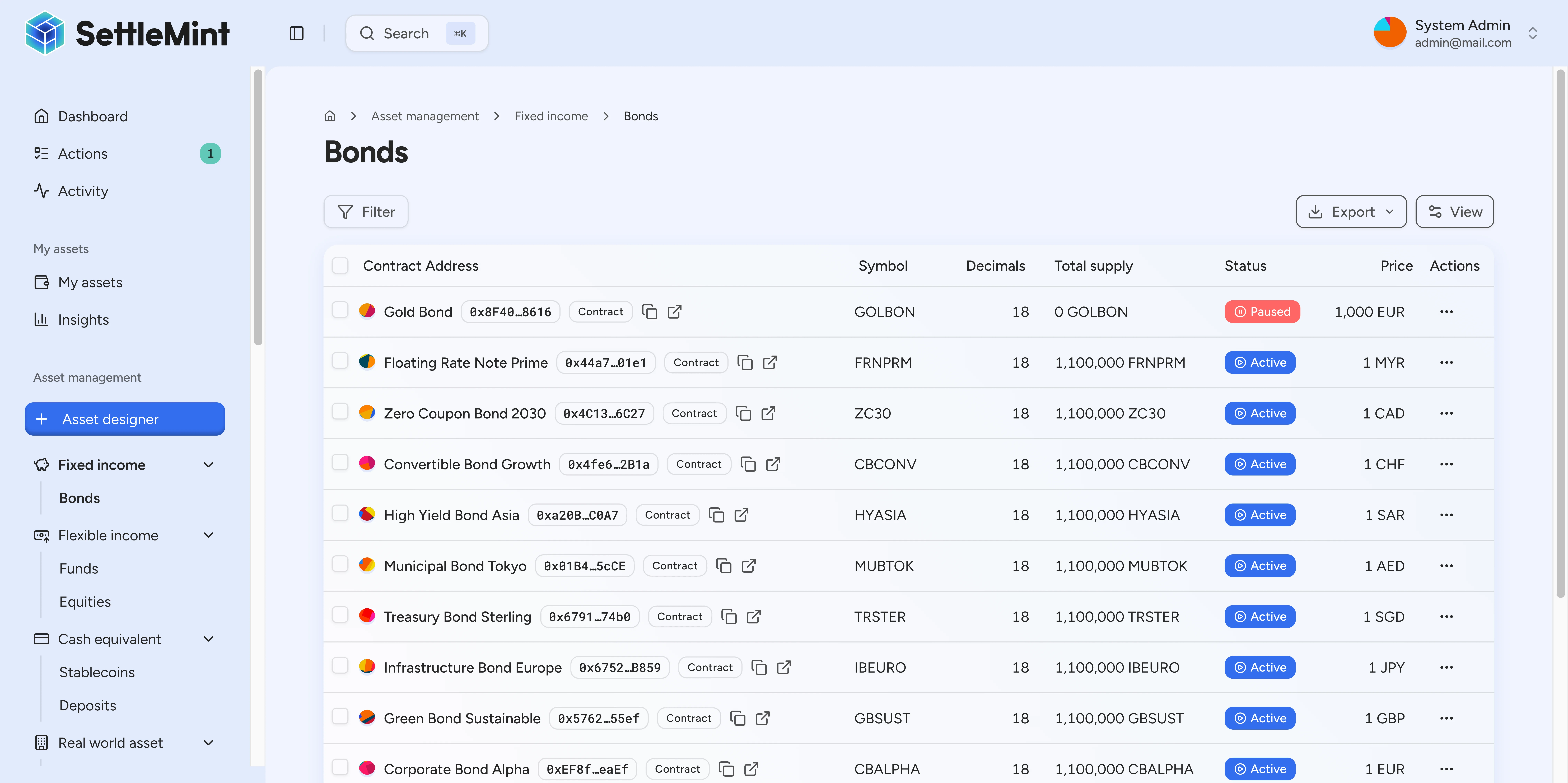
MidCorp Industries needs to raise $50 million through a three-year bond offering. The operating burden is not only issuance. The issuer also needs to control who can hold the bond, settle the payment and token legs safely, fund coupon and principal obligations, monitor holder balances, and prove what happened after each lifecycle action.
### Traditional approach [#traditional-approach]
## How DALP supports the bond lifecycle [#how-dalp-supports-the-bond-lifecycle]
DALP combines asset configuration, compliance modules, token features, and settlement workflows so the issuer can operate the bond from issuance through redemption:
| Lifecycle need | DALP surface | Operator responsibility |
| ---------------------------------- | ----------------------------------------------------------------------------------------------------------------------------- | ------------------------------------------------------------------------------------------- |
| Define the instrument | Asset Designer and token creation APIs capture bond terms, maturity, denomination asset, and selected features. | Approve the economic terms and offering documents before deployment. |
| Control holders | Compliance modules evaluate identity and eligibility claims before token movement. | Decide which claims, jurisdictions, and investor rules apply to the programme. |
| Settle primary or secondary trades | XvP settlement coordinates the payment asset and bond token legs in one workflow. | Choose the payment asset, custody setup, and settlement participants. |
| Service coupons | Fixed Treasury Yield calculates completed-period entitlements from balance snapshots for holder-initiated claims. | Keep the coupon treasury funded and approve feature spending when the treasury is a wallet. |
| Repay principal | Maturity Redemption blocks ordinary transfers after maturity and lets holders redeem against the denomination asset treasury. | Trigger maturity at the correct time, fund the redemption treasury, and monitor coverage. |
### Configuration and deployment [#configuration-and-deployment]
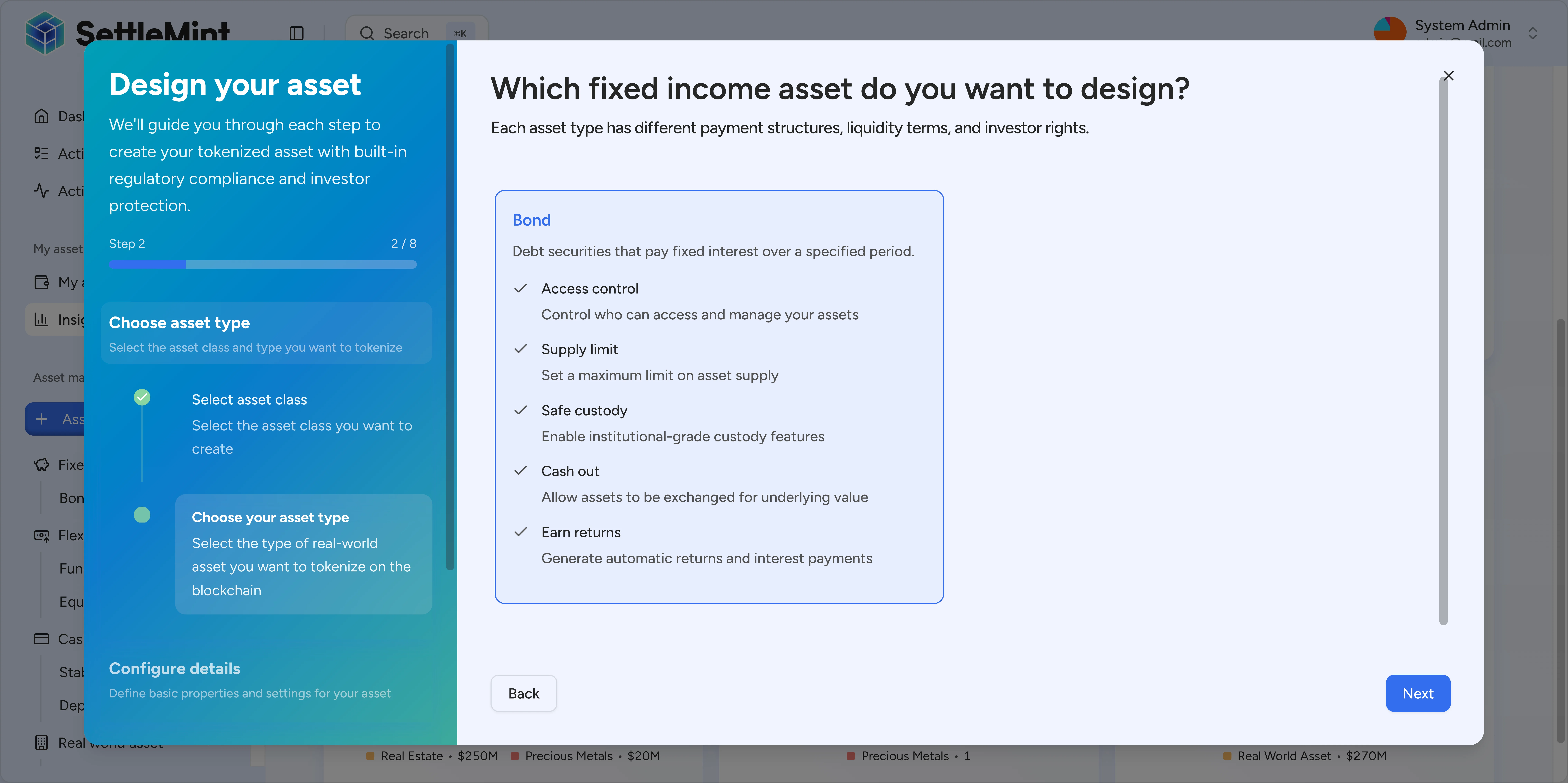
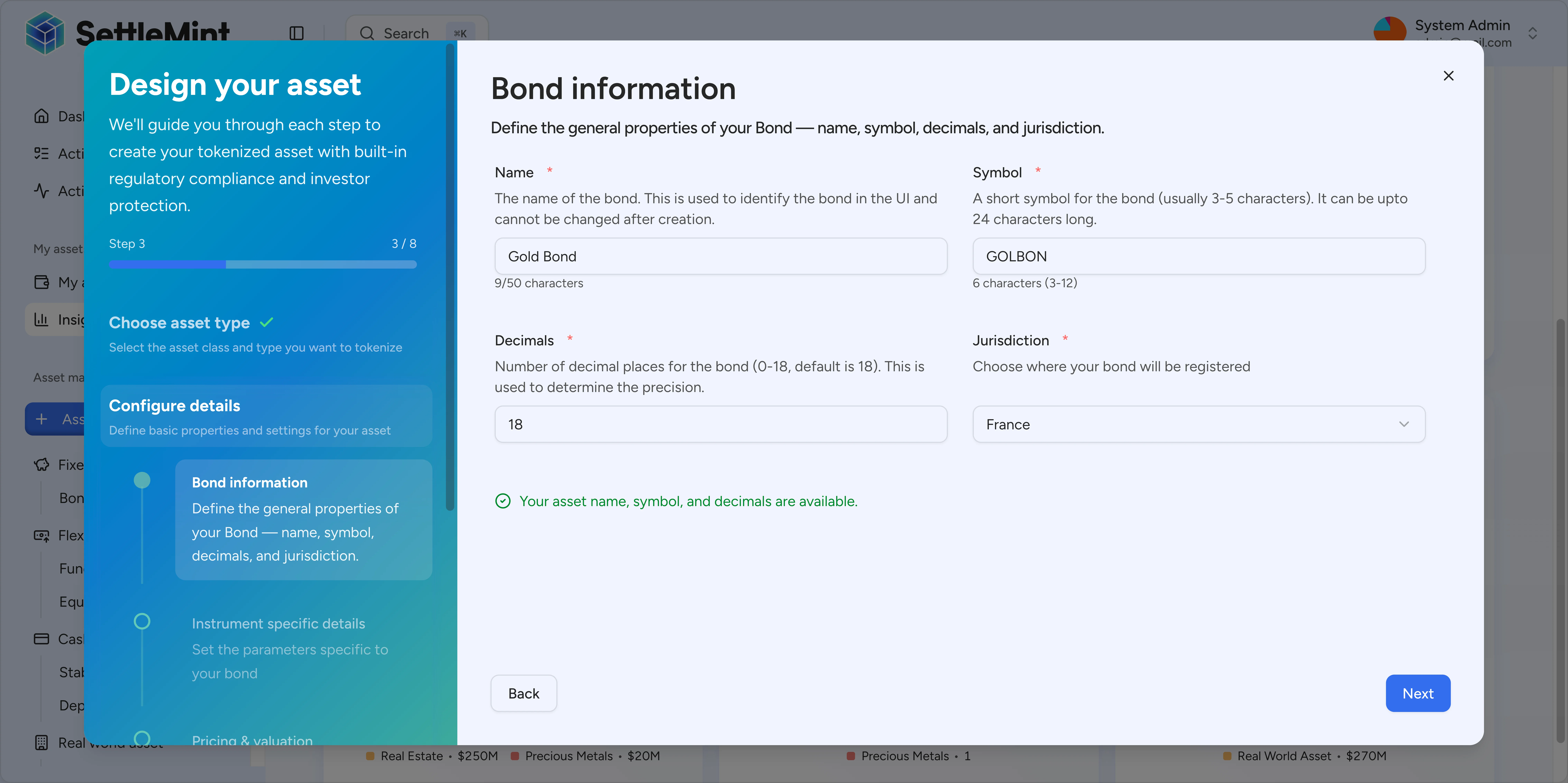
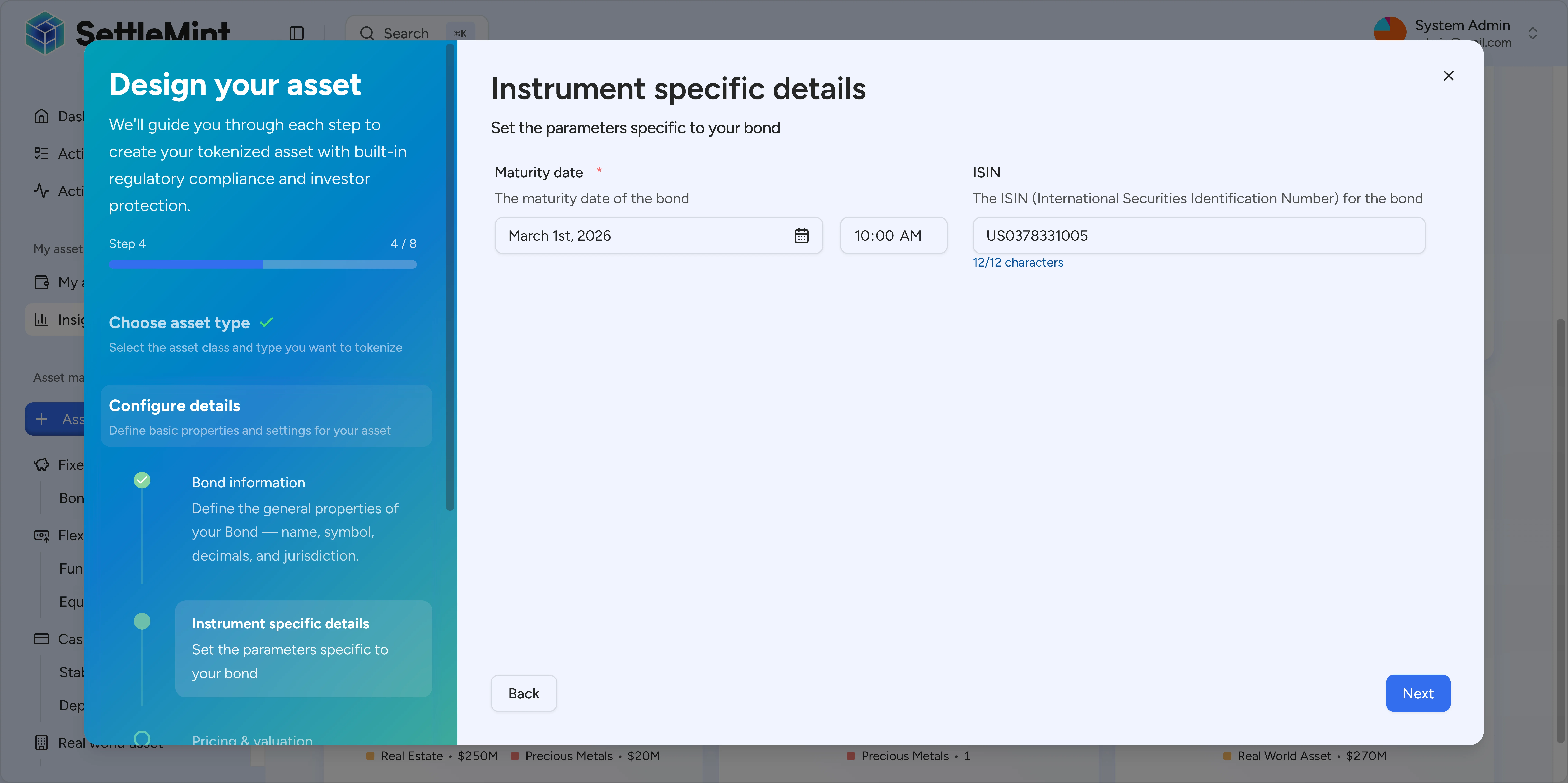
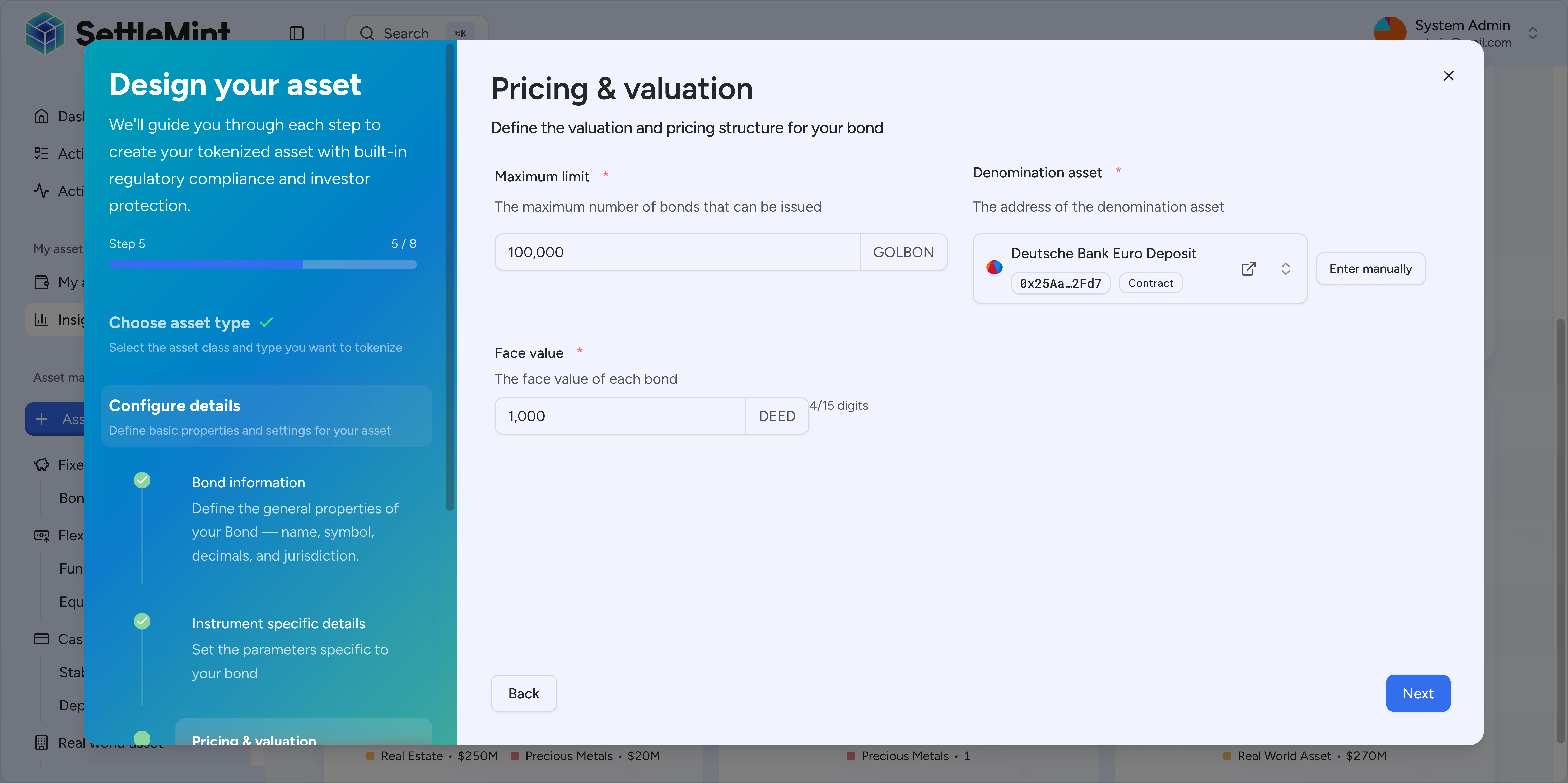
MidCorp's treasury team uses the Asset Designer to configure a bond token: $50
million principal, 5% annual coupon paid quarterly, three-year maturity, USD
denomination. They select a Regulation D compliance template to limit the
offering to accredited US investors.
DALP deploys the asset with the selected compliance and token features. For a
coupon-paying bond, that typically means pairing Maturity Redemption with Fixed
Treasury Yield and the Historical Balances feature that supplies the balance
snapshots used for entitlement calculation. The maturity date also defines the
end of the fixed yield schedule in the Asset Designer summary.
Offering documents can be linked through token metadata so operational teams and
integrations have a consistent asset record. The legal status of those documents
remains governed by the issuer and its advisors.
### Investor onboarding with embedded compliance [#investor-onboarding-with-embedded-compliance]
Accredited investors connect through the Investor Portal and complete KYC
verification via an integrated provider. Their OnchainID receives an
accreditation claim. Only wallet addresses linked to verified, accredited
identities can receive bond tokens. Non-accredited addresses cannot receive
tokens; transfers revert automatically.
### Primary distribution with DvP settlement [#primary-distribution-with-dvp-settlement]
MidCorp allocates tokens to a subscriber list. Using DALP's XvP settlement workflow, investors exchange a payment asset, such as a stablecoin or tokenized deposit, for bond tokens in an atomic transaction. If the payment leg or token leg fails, the transaction reverts instead of leaving one side settled without the other.
Eligibility checks still run before token movement. A recipient that does not satisfy the configured compliance modules cannot receive the bond tokens. Operators should still reconcile the off-chain subscription book, custody records, payment asset records, and investor communications because DALP only controls the on-chain token and configured settlement workflow.
### Scheduled coupon calculations via yield schedules [#scheduled-coupon-calculations-via-yield-schedules]
Fixed Treasury Yield calculates completed-period coupon entitlements from
historical balance snapshots. Holders claim available yield from the configured
denomination asset treasury; the contract does not push payments to every holder
automatically.
The issuer must keep the treasury funded throughout the yield period. If the
treasury is a wallet, that wallet must also approve the yield feature to spend
the denomination asset before holder claims can succeed. DALP exposes yield
coverage statistics so operators can compare treasury balance and wallet
allowance against the required payout amount before inviting claims.
### Treasury operations [#treasury-operations]
Treasury readiness matters twice in the bond lifecycle: during coupon periods
and at maturity. Coupon claims draw from the Fixed Treasury Yield treasury.
Principal redemption draws from the Maturity Redemption treasury. Each treasury
can be a wallet or contract, but wallet treasuries need denomination-asset
allowance in addition to balance coverage.
Operators should review the
[bond lifecycle prerequisites](/docs/user-guides/system-addons/bond-lifecycle-prerequisites)
before opening claim or redemption actions to holders. The prerequisite checks
combine yield coverage, bond status, treasury balance, and wallet allowance so
operators can tell whether coupon and redemption workflows are ready for holders.
### Cap table visibility [#cap-table-visibility]
MidCorp's investor relations team can read holder balances from DALP instead of waiting for a separate transfer-agent export. When investors trade bonds through a configured secondary workflow, the token holder view follows the on-chain transfers after indexing catches up.
### Maturity and redemption [#maturity-and-redemption]
At maturity, an authorized governance action transitions the asset into its
post-maturity state. Ordinary transfers are then blocked and holders redeem bond
tokens against the configured denomination asset treasury. Redemption burns the
redeemed tokens and transfers the principal amount calculated from the feature
configuration.
Maturity does not trigger itself purely because the calendar date has arrived.
The issuer or operator must call the maturity action at the correct time, fund
the redemption treasury, and, for wallet treasuries, approve the maturity
redemption feature to spend the denomination asset.
## Key capabilities [#key-capabilities]
| Capability | Traditional operating model | With DALP |
| ---------------------- | ------------------------------------------------------------------------------------------------------ | ------------------------------------------------------------------------------------------------------------------------------ |
| Issuance setup | Terms, eligibility rules, token records, and settlement rails are coordinated across separate systems. | Bond terms, selected compliance modules, token features, and settlement workflows are configured in one EVM-based asset model. |
| Settlement | Operations teams reconcile the payment and bond-token legs after execution. | XvP settlement coordinates both legs atomically when the configured payment asset and compliance checks pass. |
| Coupon processing | Teams calculate entitlements and run payment operations outside the token workflow. | Fixed Treasury Yield calculates completed-period entitlements and lets holders claim from a funded treasury. |
| Treasury readiness | Funding checks depend on manual balance, allowance, and redemption calculations. | Yield coverage and bond status views expose balance, allowance, and coverage signals before claims or redemption. |
| Compliance enforcement | Eligibility controls can depend on pre-trade checks and post-trade surveillance. | Configured compliance modules validate transfer eligibility before token movement. |
| Maturity handling | Principal repayment and transfer-stop operations are coordinated manually. | Maturity Redemption blocks ordinary transfers after maturity and provides holder redemption against the configured treasury. |
## Measurable outcomes [#measurable-outcomes]
**Operational compression:** Asset design, compliance setup, settlement, yield
configuration, and redemption controls live in one lifecycle model instead of
separate spreadsheets and reconciliation processes.
**Treasury transparency:** Operators can monitor the funding and allowance
coverage needed for coupon claims and principal redemption before holders start
claiming.
**Settlement confidence:** XvP settlement helps participants exchange payment
assets and bond tokens atomically when the configured settlement workflow and
compliance checks pass.
**Compliance gating:** Configured compliance modules evaluate transfer
eligibility before token movement. Issuers still own the legal determination of
which rules and investor claims are required for a programme.
The diagram above shows the DALP bond lifecycle, from configuration through
servicing operations to holder redemption.
## Compliance considerations [#compliance-considerations]
Bond tokens operate under securities regulations requiring:
* **Accredited investor verification** – Enforced via OnchainID claims before
token transfer
* **Transfer restrictions** – configured compliance modules and token features
determine which transfers are allowed
* **Jurisdiction controls** – Geographic restrictions via country allow/block
lists
* **Audit signals** – on-chain events and indexed status views support monitoring
of settlement, yield claims, treasury readiness, and redemption activity
For detailed compliance architecture, see
[Compliance & Security](/docs/executive-overview/compliance-security).
## Implementation checklist [#implementation-checklist]
1. Define bond terms (principal, coupon rate, maturity, currency)
2. Select compliance template (Reg D, Reg S, or custom ruleset)
3. Integrate KYC/AML provider for investor verification
4. Configure Maturity Redemption with denomination asset, face value, maturity
date, and redemption treasury
5. Configure Fixed Treasury Yield, including denomination asset, treasury,
interval, rate, start date, and end date
6. Fund coupon and redemption treasuries and approve feature spend from wallet
treasuries where needed
7. Deploy the asset and conduct primary distribution through the chosen
settlement workflow
8. Monitor yield coverage and bond-status views before coupon claims and
maturity redemption
## What to verify before launch [#what-to-verify-before-launch]
| Decision | Verify in DALP | Verify outside DALP |
| -------------------- | --------------------------------------------------------------------------------------------------------------------- | ------------------------------------------------------------------------------------------ |
| Bond terms | Token name, symbol, cap, face value, maturity date, denomination asset, and attached features. | Final term sheet, legal approvals, investor notices, and required disclosures. |
| Holder eligibility | Compliance modules, identity claims, jurisdiction rules, and transfer validation results. | Whether the selected claims satisfy the issuer's regulatory obligations. |
| Coupon readiness | Fixed Treasury Yield configuration, completed intervals, historical balances, treasury balance, and wallet allowance. | Funding process, bank or payment provider movement, and investor communication timing. |
| Maturity readiness | Maturity status, redemption treasury balance, wallet allowance, and bond status coverage values. | Off-chain maturity notice, cash management, and operations sign-off. |
| Settlement readiness | XvP configuration, participating assets, eligible recipients, and transaction state. | Custody, payment asset risk, subscription-book reconciliation, and participant onboarding. |
## Next steps [#next-steps]
* Check [bond lifecycle prerequisites](/docs/user-guides/system-addons/bond-lifecycle-prerequisites)
before opening coupon claims, maturity actions, or holder redemption workflows
* Configure operator-managed coupon and maturity settings in the
[Yield schedule console guide](/docs/user-guides/system-addons/yield-schedule)
* Review [Maturity Redemption](/docs/architecture/components/token-features/maturity-redemption)
for the redemption state machine and treasury requirements
* Review [Fixed Treasury Yield](/docs/architecture/components/token-features/fixed-treasury-yield)
for coupon entitlement calculation and claim behavior
* Use [Yield coverage statistics](/docs/developer-guides/api-integration/yield-coverage-statistics)
and the bond status view before opening holder claim or redemption workflows
* Connect lifecycle monitoring to the [webhook events reference](/docs/events)