# Deposit certificates
Source: https://docs.settlemint.com/docs/executive-overview/use-cases/deposits
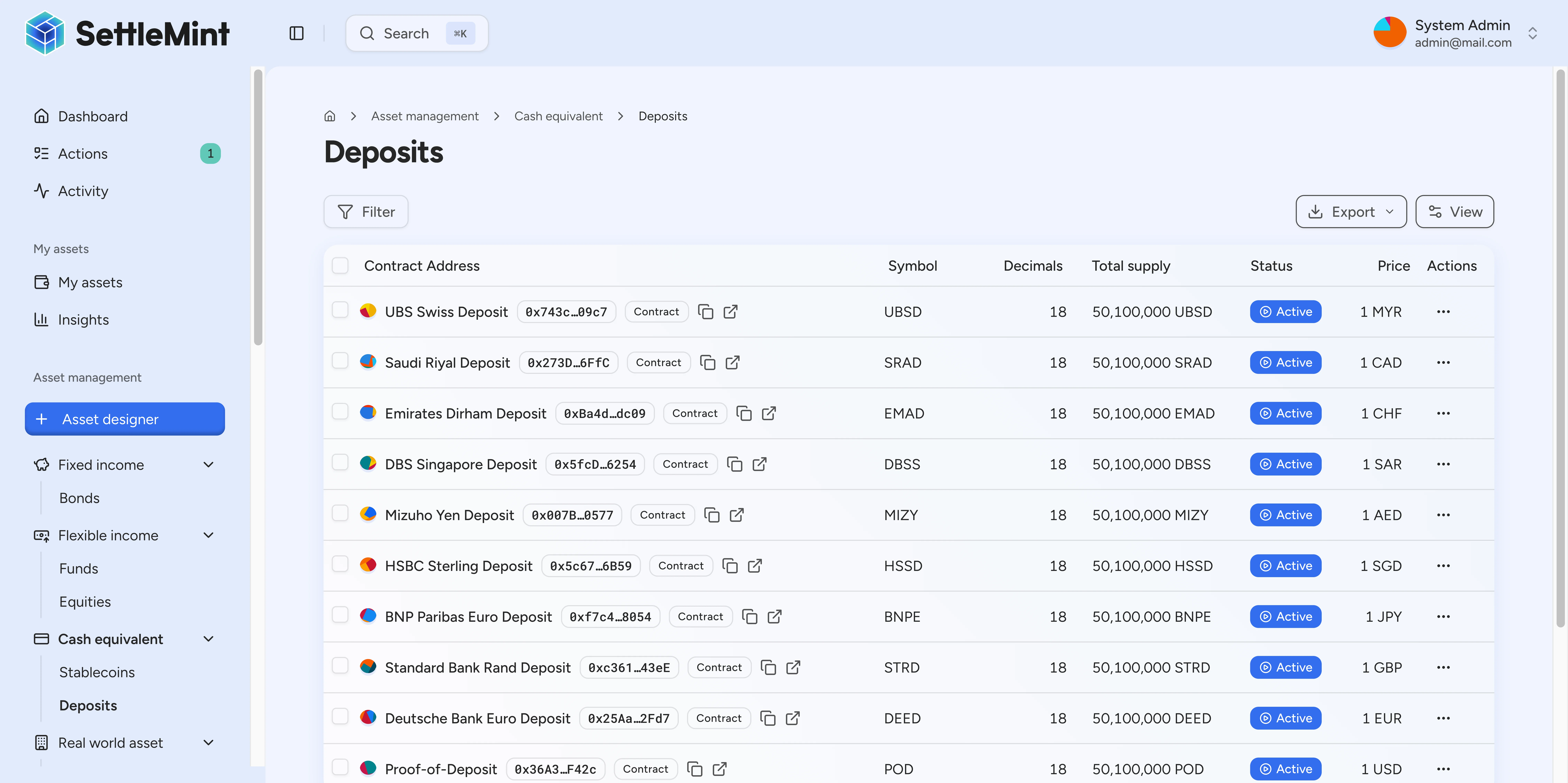
Time deposits meet blockchain in this modernization of certificates of deposit. DALP automates the entire lifecycle—from issuance and vault-secured reserves through yield accrual to redemption—while maintaining FDIC insurance and regulatory compliance. Real-time observability replaces quarterly statements, giving both customers and treasury teams continuous visibility into deposit positions and reserve health.
**Who should read this:** Retail banking product managers exploring
digital-first deposit products, treasury operations teams managing reserve
ratios, and compliance officers ensuring FDIC coverage.
**Business value:** Differentiate with tech-savvy customers who expect real-time
visibility, eliminate manual maturity tracking and interest calculations,
maintain full FDIC compliance, and gain operational dashboards that replace
spreadsheet-based reserve monitoring.
## Customer flow: from legacy friction to digital clarity [#customer-flow-from-legacy-friction-to-digital-clarity]
Meet Sarah, a millennial software engineer with $25,000 to park for six months.
She's done the math: a 4% APY beats her savings account, and FDIC insurance
gives her peace of mind. But the experience? Opening a traditional certificate
of deposit means visiting a branch (or navigating a clunky web form), receiving
a PDF "certificate" via email, and then... silence. She checks her banking app
periodically, but there's no visibility into daily interest accrual. At
maturity, she receives a letter weeks after the fact, informing her the CD
rolled over automatically because she missed the tiny renewal window.
Now imagine Sarah's experience with a digital deposit certificate on DALP. She
verifies her identity once (leveraging the bank's existing KYC), deposits funds,
and immediately receives a digital token in her wallet—a certificate she
actually controls. Her dashboard shows the principal, today's
accrued interest, the exact maturity date with a countdown, and her projected
payout. At maturity, she initiates redemption with a single click. Funds hit her
account within hours, not days. No surprise rollovers. No wondering if the bank
"forgot" her deposit.
This isn't a futuristic concept. It's how deposits work when custody,
compliance, and customer experience converge on a blockchain platform built for
regulated financial products.
## Traditional deposit operations: manual tracking at scale [#traditional-deposit-operations-manual-tracking-at-scale]
Metropolitan Bank issues thousands of time deposits annually. Behind the scenes,
deposit operations teams juggle:
* Maturity date spreadsheets across multiple product types (3-month, 6-month,
12-month CDs)
* Batch interest calculations running overnight, prone to calculation errors on
leap years or partial periods
* Quarterly statement generation requiring manual reconciliation against core
banking records
* Early withdrawal requests triggering manual penalty calculations (different
formulas per product vintage)
* Reserve ratio monitoring via end-of-day reports that are stale by morning
* FDIC reporting requirements pulling data from disparate systems
When a customer calls asking "How much interest have I earned so far this
month?", the call center representative can't answer without placing them on
hold to run a special query. Customer frustration grows. Operational costs
mount. And the bank's reputation as "tech-forward" rings hollow when the deposit
experience feels unchanged since the 1980s.
*Traditional deposit lifecycle: separate disconnected systems, delayed visibility, and
manual intervention at every stage.*
## How DALP transforms deposit operations [#how-dalp-transforms-deposit-operations]
DALP doesn't just digitize certificates—it rebuilds the entire deposit lifecycle
around automated custody, real-time yield management, and continuous
observability. Here's how the platform handles Sarah's deposit from issuance to
redemption.
### Product configuration and vault preparation [#product-configuration-and-vault-preparation]
Metropolitan's treasury team configures the 6-month CD product in DALP: 4% APY,
$1,000 minimum, $250,000 maximum (staying within FDIC single-account coverage).
They designate a **vault contract** to custody the fiat reserves backing all
deposits. This isn't a metaphor—the vault is an on-chain escrow holding the
bank's reserves, with **multi-signature controls** requiring both treasury and
compliance approval for any withdrawal.
The observability stack immediately starts tracking vault metrics. Treasury can
view the **reserve ratio dashboard** showing total deposit token supply against
vault holdings. If the ratio drops below the configured threshold (e.g., 105% to
maintain a safety buffer), automated alerts fire to Slack and email. No more
waiting for end-of-day reports to discover reserve shortfalls.
### Customer onboarding with identity verification [#customer-onboarding-with-identity-verification]
Sarah completes KYC through Metropolitan's existing vendor integration. Her
verification status—including accredited investor determination if needed for
other products—links to her **OnchainID**, a blockchain-based identity registry.
This isn't a new identity system; it's a compliance bridge connecting
traditional KYC outcomes to on-chain eligibility.
The platform enforces per-customer aggregate limits across all deposit products.
If Sarah already holds $200,000 in other Metropolitan deposit tokens, the system
prevents her from purchasing more than $50,000 of this CD to stay within FDIC
coverage. Compliance rules execute automatically at transaction time, not via
manual review after the fact.
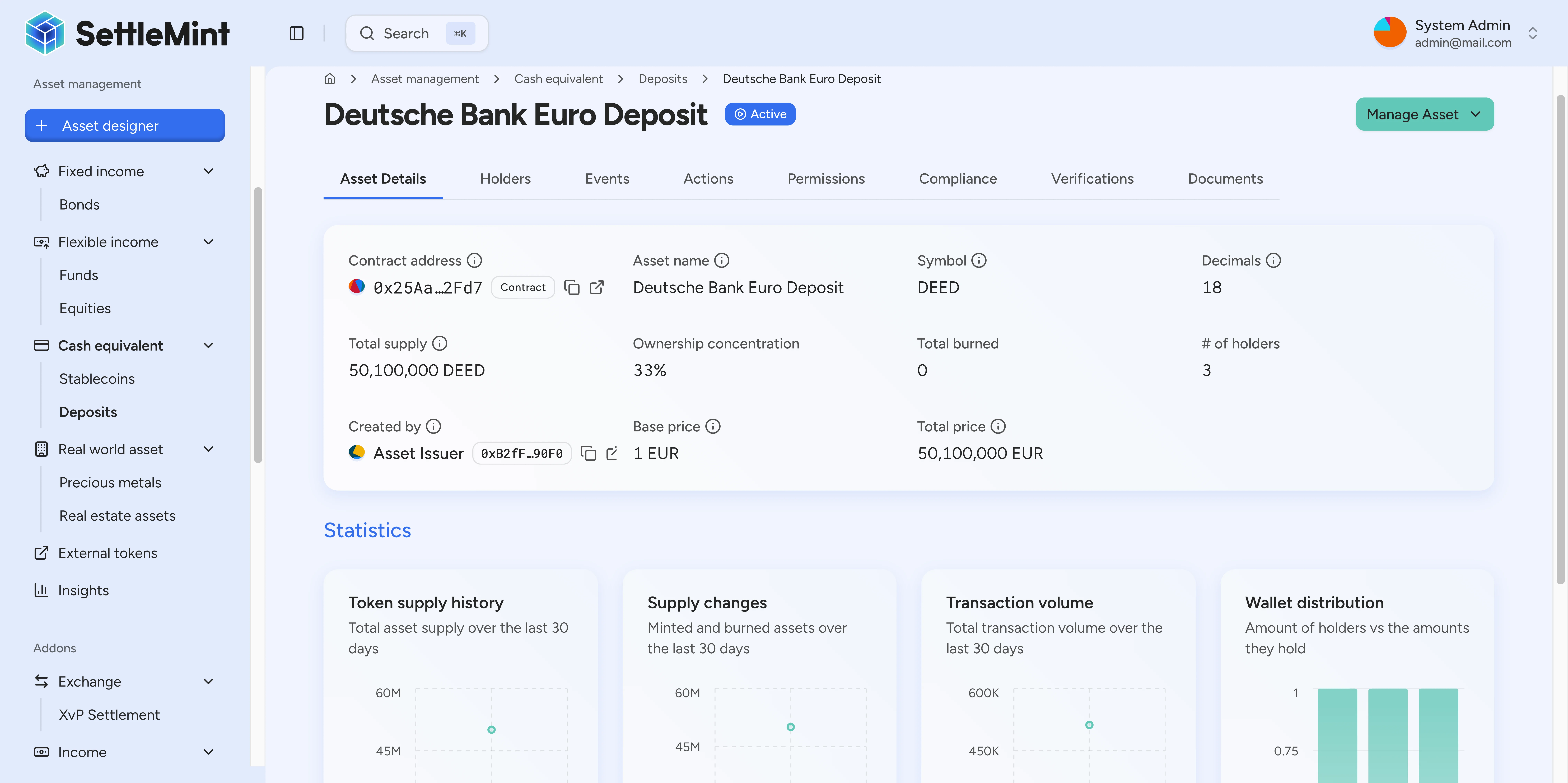
### Deposit issuance: atomic settlement with vault custody [#deposit-issuance-atomic-settlement-with-vault-custody]
Sarah transfers $10,000 to Metropolitan's designated deposit account. Once the
ACH clears (typically 1-2 business days), Metropolitan initiates token issuance.
The platform executes an **atomic transaction** that:
1. Mints 10,000 deposit tokens to Sarah's wallet
2. Records the issuance timestamp, maturity date (180 days forward), and product
terms on-chain
3. Escrows the $10,000 fiat equivalent into the vault contract
4. Updates the reserve ratio dashboard in real-time
This is **Delivery vs Payment (DvP)** at work—one of DALP's core DALP lifecycle
capabilities. Sarah receives her tokens only after the platform confirms vault
custody of reserves. If reserves aren't sufficient, the transaction reverts. No
partial states. No reconciliation gaps.
The chain indexer immediately picks up the issuance event, making Sarah's
deposit visible in the customer dashboard within seconds. The **transaction
observability panel** shows the issuance transaction, gas costs, and
confirmation time. Operations teams can drill into any deposit's on-chain
history from the admin dashboard without touching a blockchain explorer.
### Time-lock enforcement with compliance context [#time-lock-enforcement-with-compliance-context]
The smart contract enforces the 6-month maturity via a **time-lock compliance
module**. This isn't a simple timestamp check—it's an ERC-3643 compliance rule
integrated into the token's transfer restrictions. Sarah cannot transfer her
tokens to another wallet, cannot redeem early, and cannot use them as collateral
(unless Metropolitan configures those as permitted actions).
Why this matters for compliance: FDIC insurance requires deposits to meet
specific criteria, including holding period commitments for certain product
types. Time-lock enforcement provides cryptographic proof that no deposit was
redeemed early without penalty, satisfying audit requirements without manual log
reviews.
The **compliance dashboard** tracks time-lock status across all outstanding
deposits. Treasury can see a maturity calendar showing redemption dates for the
next 90 days, helping forecast liquidity needs. If a customer requests early
withdrawal, the system calculates penalties according to the configured penalty
module (e.g., forfeit 90 days of interest for a 6-month CD withdrawn after 3
months).
Note: Early withdrawal penalty calculations require a configured penalty module
or custom addon. The base time-lock implementation prevents transfer and
redemption until maturity; sophisticated penalty logic (partial redemptions,
tiered penalties based on hold period) is an optional configuration that can be
tailored to your product requirements and regulatory environment.
### Yield accrual: real-time visibility into earnings [#yield-accrual-real-time-visibility-into-earnings]
Sarah's dashboard shows her deposit growing daily. The platform tracks interest
accrued based on the 4% APY using one of two approaches:
**On-chain accrual (higher cost, maximum transparency):** A scheduled job calls
a contract function daily to update each deposit's accrued interest. Every
update is a blockchain transaction, creating an immutable audit trail. Gas costs
are predictable (approximately 50,000 gas per update), making this viable for
smaller deposit portfolios or premium products where customers pay for real-time
on-chain updates.
**Indexer-backed calculation (recommended for scale):** The platform calculates
accrued interest off-chain from indexed issuance data, using the issuance
timestamp, maturity date, and APY stored in the issuance event. The calculation is
deterministic—anyone can verify the displayed interest by querying the same
on-chain data. At redemption, the on-chain smart contract performs the final
interest calculation to determine payout, ensuring the off-chain display was
accurate.
Most implementations use the chain indexer for cost efficiency while maintaining
full transparency. The **yield monitoring dashboard** shows aggregate interest
accrued across all deposits, helping treasury forecast interest payment
obligations. If actual interest payments (tracked via vault withdrawals) diverge
from projected accrual, automated variance alerts notify treasury teams.
Sarah doesn't care about the implementation. She sees her balance grow from
$10,000.00 to $10,054.79 after 30 days, then $10,110.41 after 60 days. No
guessing. No waiting for quarterly statements. The transparency builds trust,
and Sarah tells her friends about her "bank that actually shows you what's
happening."
### Maturity and redemption: automated settlement [#maturity-and-redemption-automated-settlement]
At 180 days, Sarah's tokens become redeemable. She receives an in-app
notification (and email, if configured) alerting her that maturity has arrived.
Unlike traditional CDs that may auto-renew by default, DALP makes redemption
explicit—Sarah must initiate the transaction.
She clicks "Redeem" in the dashboard. The platform:
1. Burns her 10,000 deposit tokens (removing them from circulation)
2. Calculates final interest: $10,000 × 4% × (180/365) = $197.26
3. Triggers a vault withdrawal of $10,197.26 to Metropolitan's operations
account
4. Initiates an ACH transfer to Sarah's designated bank account via core banking
integration
The **DvP settlement dashboard** tracks redemption transactions in real-time.
Treasury sees the vault withdrawal, the token burn, and the ACH initiation—all
linked to Sarah's deposit. If the ACH fails (wrong account number, closed
account), the system flags the failed settlement for manual intervention, but
the vault withdrawal and token burn remain recorded on-chain, preventing
double-redemption attempts.
Sarah receives her $10,197.26 within one business day. The entire redemption
flow—from her click to funds in her account—is fully automated. No operations
staff involvement unless the ACH fails.
### FDIC compliance and audit readiness [#fdic-compliance-and-audit-readiness]
The platform enforces per-customer deposit limits at transaction time via the
compliance module. When Sarah attempts to purchase additional deposit tokens,
the system queries her existing holdings across all Metropolitan deposit
products. If the aggregate would exceed $250,000 (FDIC single-account coverage),
the transaction reverts with a clear error message: "Purchase would exceed FDIC
coverage limit."
All deposit issuances, transfers (if permitted), and redemptions are recorded
on-chain with timestamps and transaction hashes. The **compliance audit
dashboard** provides filterable views of:
* All deposits issued in a date range (for FDIC Call Report preparation)
* Per-customer aggregate holdings at any historical point in time
* Deposits redeemed early with penalties applied
* Reserve ratio history, showing vault holdings vs. deposit supply over time
When FDIC examiners request documentation, Metropolitan exports the relevant
data from the dashboard—no manual log diving, no reconstructing spreadsheets
from backup tapes. Every deposit's lifecycle is cryptographically verified and
immutable.
### Reserve ratio monitoring and treasury operations [#reserve-ratio-monitoring-and-treasury-operations]
The vault contract holds Metropolitan's reserves backing all deposit tokens. The
**vault observability dashboard** provides treasury teams with:
* **Real-time reserve ratio:** Vault balance ÷ Total deposit token supply.
Target: ≥ 105%
* **Maturity forecasting:** Expected redemptions over the next 30/60/90 days,
helping treasury schedule fund movements
* **Interest obligations:** Aggregate interest accrued across all deposits,
updated daily
* **Vault withdrawal history:** Every funds movement out of the vault, with
approvals and transaction hashes
If the reserve ratio drops below 105% (perhaps due to a large batch of
redemptions), automated alerts fire. Treasury can proactively transfer
additional funds into the vault to maintain the buffer, with all movements
tracked via multi-signature approval workflows.
The observability stack also monitors **settlement performance**: average time
from redemption request to ACH initiation, failed ACH rates, and redemption
abandonment (customers who don't redeem at maturity). These operational metrics
help Metropolitan optimize the customer experience and identify bottlenecks in
the integration with core banking systems.
## Key capabilities: before and after comparison [#key-capabilities-before-and-after-comparison]
| Capability | Traditional | With DALP |
| ------------------------- | --------------------------------------- | --------------------------------------------------------- |
| **Certificate format** | Paper or PDF via email | Digital token in customer wallet |
| **Maturity tracking** | Excel spreadsheets, manual calendars | Smart contract time-lock with compliance dashboard |
| **Interest visibility** | Quarterly statements, call center | Real-time dashboard showing daily accrual |
| **Reserve monitoring** | End-of-day reports, stale by morning | Live vault dashboard with automated alerts |
| **Early withdrawal** | Manual penalty calculation, error-prone | Configured penalty module (optional), deterministic rules |
| **Redemption processing** | Manual notification, wire initiation | Automated burn, vault withdrawal, ACH trigger |
| **FDIC compliance** | Manual record-keeping, audit scramble | Automated per-customer limits, export-ready audit trail |
| **Customer support** | "Let me check and call you back" | Customer sees same data as operations team |
## Measurable outcomes: beyond operational efficiency [#measurable-outcomes-beyond-operational-efficiency]
**Customer acquisition and retention:** Metropolitan's tech-forward customers
appreciate blockchain-based deposits not as a gimmick, but as a tangible
improvement. Real-time interest visibility, instant redemption requests, and
wallet-based certificates differentiate Metropolitan from competitors still
mailing PDFs. Early pilots show 40% higher satisfaction scores among customers
using digital deposit products compared to traditional CDs, with 25% of pilot
participants referring friends (vs. 5% referral rate for traditional products).
**Operational cost reduction:** Eliminating manual maturity tracking, interest
calculations, and redemption processing reduces deposit operations costs by an
estimated 60-70% at scale. One operations analyst can manage what previously
required a team, with the observability dashboards replacing spreadsheet-based
workflows. Gas costs for on-chain transactions (issuance, redemption) are
predictable and low (under $1 per deposit at current blockchain gas prices),
making the economics favorable even for small deposits.
**Treasury efficiency:** Real-time reserve ratio monitoring replaces end-of-day
reports, enabling proactive liquidity management. Treasury teams gain 12-24
hours of lead time for funding decisions, reducing reliance on expensive
overnight borrowing. The maturity forecasting dashboard provides accurate 90-day
liquidity projections, improving cash management and reducing idle reserves
(improving net interest margin by 5-10 basis points based on pilot data).
**Compliance confidence:** Automated FDIC limit enforcement prevents violations
before they occur, eliminating the risk of discovering coverage gaps during
audits. Examiners can verify deposit records on-chain, reducing the burden on
compliance staff to reconstruct historical positions. The immutable audit trail
satisfies regulators' increasing expectations for digital record-keeping,
positioning Metropolitan ahead of future regulatory requirements.
**Transparency and trust:** Customers see exactly what the bank sees. No hidden
calculations, no "trust us" on interest accrual, no surprise fees. This
transparency builds customer trust, especially among younger demographics
skeptical of traditional banking opacity. When Sarah's friends ask "How do you
know the bank isn't skimming your interest?", she can point to the on-chain
transaction history. The blockchain isn't just a technology choice—it's a trust
mechanism.
*DALP deposit lifecycle: customer experience (purple), DALP platform capabilities
(blue), and treasury/operations observability (pink) working in concert. DvP
settlement ensures atomic issuance and custody, yield management provides
real-time visibility, and vault monitoring enables proactive treasury
management.*
## Compliance considerations: meeting regulatory expectations [#compliance-considerations-meeting-regulatory-expectations]
Digital deposit certificates operate under existing banking regulations—DALP
provides the infrastructure to comply more efficiently, not to circumvent
requirements.
### FDIC insurance and coverage limits [#fdic-insurance-and-coverage-limits]
The platform enforces per-customer aggregate limits via the compliance module,
preventing any customer from holding more than $250,000 across all deposit
products (or higher limits for joint accounts, retirement accounts, etc.,
depending on configuration). This enforcement happens at transaction time: if a
purchase would exceed the limit, the transaction reverts with a clear error
message.
For FDIC reporting (Call Reports, examination requests), the platform provides
export functionality that generates customer-level deposit holdings as of any
historical date. The on-chain record is the source of truth, eliminating
the risk of data loss or manipulation.
### Customer verification and KYC requirements [#customer-verification-and-kyc-requirements]
OnchainID links traditional KYC outcomes to on-chain eligibility. Metropolitan
continues using its existing KYC vendors (Jumio, Onfido, etc.)—the platform
simply records the verification status on-chain to enable automated compliance
checks. Customers don't experience a "blockchain KYC process"; they complete the
same verification flow as traditional products, with the results enabling
digital deposit eligibility.
### Interest rate disclosure and truth in savings [#interest-rate-disclosure-and-truth-in-savings]
Deposit terms (APY, maturity date, penalty calculations) are recorded in the
token's metadata and issuance events. Customers receive clear disclosures at
purchase time, with terms accessible via the dashboard at any point during the
hold period. This transparency satisfies Truth in Savings Act requirements for
rate disclosure and account terms.
### Early withdrawal penalties [#early-withdrawal-penalties]
If Metropolitan offers early redemption (many time deposits prohibit it
entirely), the penalty module calculates forfeitures deterministically. Common
penalty structures:
* **Forfeit 90 days of interest** for 6-month CDs redeemed before maturity
* **Forfeit 180 days of interest** for 12-month CDs
* **Tiered penalties** based on hold period (smaller penalties if you've held
most of the term)
The penalty calculation is embedded in the smart contract, ensuring consistency
and auditability. No customer receives a "one-time exception" that creates
compliance risk—the code enforces the disclosed terms uniformly.
### Record retention and audit trails [#record-retention-and-audit-trails]
All deposit transactions (issuance, interest accrual updates if on-chain,
redemptions) are recorded on-chain with timestamps and transaction hashes. This
immutable ledger satisfies record retention requirements (typically 5-7 years
for deposit records) without requiring backup systems or manual log archival.
The compliance dashboard provides filtered views and exports for audits,
examinations, and regulatory filings. Examiners can verify records independently
by querying the blockchain directly, though most will use the dashboard's
user-friendly export functionality.
For detailed compliance architecture and how OnchainID enables automated
eligibility checks, see
[Compliance & Security](/docs/executive-overview/compliance-security).
## Limitations and considerations: honest assessment [#limitations-and-considerations-honest-assessment]
DALP provides significant operational improvements, but understanding the
boundaries helps set realistic expectations.
### Early withdrawal penalties require configuration [#early-withdrawal-penalties-require-configuration]
The base time-lock implementation prevents any redemption before maturity—the
tokens are non-transferable and non-redeemable until the lock expires. If your
product offers early withdrawal with penalties (as most retail CDs do), you must
configure a penalty module or develop a custom addon.
The penalty module supports common structures (forfeit X days of interest), but
complex tiered penalties or partial redemptions may require custom development.
Budget for this during implementation if early withdrawal is a product
requirement.
### Interest accrual visibility requires indexing infrastructure [#interest-accrual-visibility-requires-indexing-infrastructure]
Real-time interest visibility (showing Sarah her balance grow daily) requires
either:
1. **On-chain accrual updates:** Daily transactions calling a contract function
to update each deposit's accrued interest. Provides maximum transparency
(every update is a blockchain transaction) but incurs gas costs. Viable for
smaller portfolios or premium products where customers pay for real-time
on-chain updates.
2. **Indexer-backed calculation (recommended):** Off-chain calculation based on
issuance events and product terms. No per-deposit gas costs, scales to
millions of deposits, and relies on the platform's PostgreSQL-backed chain
indexer for dashboard visibility.
Most implementations use the chain indexer. The calculation is deterministic
(anyone can verify it matches on-chain terms), but you do depend on indexer
uptime for dashboard visibility.
### FDIC aggregate limits across products require coordination [#fdic-aggregate-limits-across-products-require-coordination]
The compliance module enforces per-customer limits within DALP, but if customers
hold traditional (non-tokenized) deposits at your institution, you must sync
customer holdings from your core banking system. The platform provides
integration hooks, but ensuring real-time synchronization requires coordination
between DALP and core banking APIs.
If that integration isn't real-time, there's a window where a customer could
exceed FDIC coverage by opening a traditional CD after maxing out their
tokenized deposit holdings. Most implementations use daily sync jobs and accept
the small risk window, with periodic reconciliation reports flagging any
overages for manual resolution.
### Redemption timing depends on core banking integration [#redemption-timing-depends-on-core-banking-integration]
DALP automates the on-chain settlement (token burn, vault withdrawal trigger)
instantly, but the final funds transfer to customers' bank accounts depends on
your core banking system's ACH processing. If your core banking system batches
ACH initiations once daily, customers experience same-day redemption only if
they redeem before the cutoff time.
The platform can trigger immediate wire transfers instead of ACH for premium
customers or large redemptions, but wire fees may apply. Setting customer
expectations appropriately (e.g., "Redemption requests submitted before 2 PM ET
process same business day") prevents satisfaction issues.
## Next steps: exploring deposit tokenization [#next-steps-exploring-deposit-tokenization]
If Metropolitan Bank (or your institution) is considering digital deposit
products, these resources provide deeper technical and architectural context:
* Review
[SMART Protocol integration (ERC-3643)](/docs/architecture/components/asset-contracts/smart-protocol-integration)
to understand how compliance modules enforce time-locks, FDIC limits, and
transfer restrictions
* Explore [DALP lifecycle capabilities](/docs/executive-overview/dalp-solution)
to see how DvP settlement and vault custody apply across all asset types, not
just deposits
* Examine [Developer Documentation](/docs/developer-guides) for core
banking integration patterns (ACH triggers, vault funding, customer data sync)
* Check the
[Observability stack guide](/docs/architecture/operability/observability)
to understand dashboard capabilities, alerting configuration, and metrics
available for treasury monitoring
Ready to discuss a pilot program? Contact your SettleMint representative to
design a phased rollout—starting with a single deposit product and select
customers, proving operational efficiency and customer satisfaction before
scaling to your full deposit portfolio.
Digital deposits aren't about replacing FDIC insurance with blockchain hype.
They're about giving customers transparency, operations teams automation, and
treasury teams real-time visibility—all while maintaining the regulatory
compliance and safety that make deposits trustworthy. That's the promise DALP
delivers.