

Hardened for enterprise security review
Authentication, key material, roles, and deployment, hardened and documented for an enterprise security review in DALP 3.0.
Every platform that moves regulated assets faces four questions before it goes near production: who authenticates, where key material lives, who may do what, and how the thing deploys. In 3.0, you get documented, enforced answers to each one.
Documented, enforced answers: not assurances
Every security review of a platform that touches money asks the same four questions: who can authenticate, where private keys live, who may do what, and how the thing deploys. 3.0 has documented, enforced answers to each one.
- Access domains
- Four, least-privilege
- Secrets on disk
- Zero
- High-risk actions
- Step-up auth
- Deployment
- Air-gap ready
A platform moving assets through regulated workflows earns trust through documentation an auditor can follow and enforcement the platform itself applies. Enterprise security reviewers and external auditors are not looking for assurances. They want evidence: a behavior they can trace, a rule they can verify, a control that does not depend on a caller getting it right. These four questions now have answers in the enforced API layer.
Authentication and admin authorization
The authentication model has two distinct layers. If you are preparing a security review, examine each one separately.
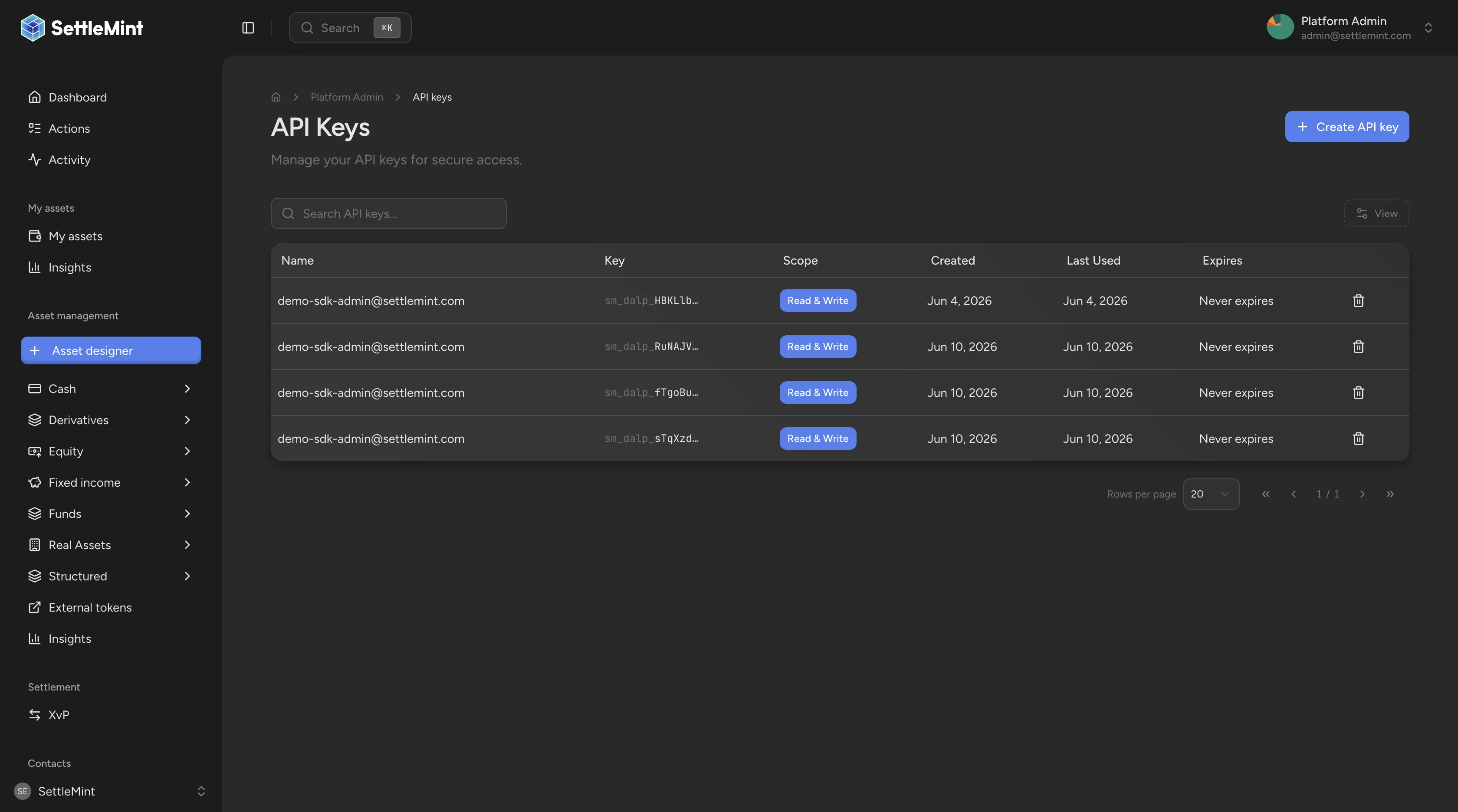
The outer layer is session resolution: it decides whether the caller has authenticated at all. The platform resolves identity from either an interactive session cookie or an API key. It enforces read-only scopes on API-key sessions issued without write permission and rejects API keys entirely on endpoints that require interactive authentication. Neither path is guessable. Middleware checks the resolved principal against the declared endpoint policy before any handler logic runs.
The inner layer is authorization: it decides whether the authenticated principal may perform the requested operation. Every sensitive endpoint carries a gate that fires before the handler runs. A role mismatch returns a structured FORBIDDEN response. The gate cannot be bypassed.
A step-up layer checks whether the principal re-authenticated within a defined freshness window. Stale sessions cannot execute high-impact operations without a fresh credential challenge. That check runs in the same middleware pipeline, with no bypass available. The window is 15 minutes. Structured error responses identify which gate rejected the call and why, so automated controls receive a precise signal rather than an opaque failure. The session age check and the role check are independent: both must pass.
The platform wires multi-factor authentication into the wallet-verification path through an OIDC-backed MFA flow. Wallet operations require proof of identity beyond the session credential itself. Verification middleware resolves the MFA outcome before allowing the on-chain operation to proceed.
Key material and secret management
Key material is where most platforms are loudest in marketing copy and quietest in documentation. In 3.0 we reversed that. Every key and credential the platform uses, including custody API keys, paymaster credentials, and signer material, carries documented scope, permitted operations, and the limit it must not cross. We do not assert properties. The admin operating model reference names each one explicitly so an operator or external auditor can verify them without reading source code.
The zero-on-disk guarantee works through a secrets middleware layer that runs once per request context and never earlier. At service startup, a lazy singleton loader initializes the first time a request context needs it and talks to whichever secrets backend the deployment configures: a cloud key management service, a self-hosted vault, or a local provider for non-production environments. The loader defers initialization until first access, so a service starting with a missing or misconfigured secrets backend fails immediately on first use rather than silently continuing with an empty credential set. Once resolved, the provider is injected into the request context via middleware and consumed there. Raw values never travel through environment variables, do not persist across deployments, and do not appear in log output. A SecretsDestroyedError is raised if a consumer attempts to reach a provider that has been torn down, making lifecycle errors auditable rather than silent.
Custody API-key credentials are documented per sponsored flow. The scope of each key, the operations it authorizes, and the limit it must not cross are stated explicitly. A key issued for paymaster operations cannot authorize custody withdrawals, and vice versa. Scope limits are enforced before any outbound call is made. Key rotation propagates on the next service startup cycle: update the value in your secrets manager, restart the service, and the new value resolves without any change to the deployment artifact.
Role separation
The role model has two distinct planes. Examine each one separately when you conduct a security review.
The first is the platform access plane. A principal is either a platform administrator or they are not. Platform administration covers user management, role assignment, integration configuration, and system settings. It grants no rights over assets, transfers, or compliance decisions. Those belong entirely to the second plane.
The second plane is the on-chain authorization model: asset-scoped and fine-grained. Roles here, covering supply management, token management, compliance management, identity management, custody, funds management, auditing, governance, and several others, resolve per executor wallet against the access-control state of the specific instrument being acted on. A wallet holding the token-manager role on one instrument does not automatically hold it on another. Promoting a wallet to compliance-manager does not grant supply-management rights. These are independent grants, not labels on a shared permission set.
Token permissions live in a single source of truth in the API contract package. Every middleware and route consumer imports from there, so a role definition changed in one place propagates consistently across every enforcement point, with no separate definition a deployment might diverge from.
Account-abstraction paymaster roles are documented per sponsored flow. Signer access is scoped to the specific on-chain operations each signer is authorized for. These roles are described in the admin operating model reference.
The four domains below are mutually exclusive by design. A common gap in multi-role platforms is letting a single principal span administration and asset operations: an administrator who can also issue tokens, or a compliance officer who can also reassign roles. DALP explicitly closes that gap. No single principal can hold rights across domains. Each separation is enforced at the API layer, not negotiated at deploy time, so a misconfigured deployment cannot accidentally collapse them.
Controls who can access the platform, manage users, configure integrations, and alter system settings. Does not grant rights over asset or compliance operations.
Controls who can create, configure, and act on instruments. Separated from administration so a system operator cannot unilaterally issue or transfer assets.
Controls who can approve transfers, manage compliance rules, and act on identity records. Separated from both administration and asset operations.
Scoped to the specific on-chain operations each signer is authorized for. Paymaster and account-abstraction roles are separated per sponsored flow.
Deployment: image supply chain, network isolation, and self-hosting
Enterprise security reviews ask three things about deployment. Is network traffic constrained to known services? Is the image supply chain controllable? Where does the line sit between what DALP runs and what you self-host? The Helm chart layer addresses all three.
Each service pod runs under a security context that prohibits privilege escalation and drops capabilities not required for operation. The chart templates declare those constraints rather than relying on cluster-level defaults. A deployment override does not silently remove controls because the chart itself carries the hardened baseline.
NetworkPolicy templates ship with every service and restrict ingress and egress to declared selectors. A compromised service cannot freely reach other services in the cluster. The health port on the Workflow Engine, for example, accepts connections only from the designated cleanup job, not from arbitrary in-cluster pods. Policies default to disabled to preserve compatibility with clusters that do not enforce NetworkPolicy, but they are documented, tested against the expected traffic shape, and recommended for any production deployment.
The image pull surface gates through a single global registry override. Setting one Helm value, global.imageRegistry, redirects all first-party image pulls to an internal mirror, so air-gapped or private-registry deployments require no per-chart edits and no forked values tree. Ingress supports restriction to a CIDR allowlist at the load-balancer layer. Durable workflow snapshot-store credentials read from the secrets manager rather than from plaintext values.
Helm chart composition, RPC routing, the split between what DALP runs and what you self-host, and what DALP manages versus what your infrastructure team owns are documented so a deployment review does not need to infer topology from configuration values.
Deploy into air-gapped and private-registry environments
A regulated institution rarely pulls container images from the public internet. DALP 3.0 routes its entire image-pull surface through a single global registry override. You redirect every first-party image to your internal mirror with one Helm setting: no per-chart edits, no fork to maintain. Two further controls harden the deployment: you can restrict ingress to a source-CIDR allowlist at the load balancer, and the durable-workflow snapshot store reads object-storage credentials from the secrets manager instead of from plaintext values.
Together, these changes mean an auditor reviewing a DALP 3.0 deployment can work from documentation rather than source exploration. Every load-bearing property name is documented and every required secret path is named in the operating model reference.
All changes in this area are additive enforcement-only. Existing sessions, keys, and role assignments carry forward. The new role separation does not remove previously granted access. It adds enforcement at the API layer for operations that were previously unguarded.
v2 API
The v2 REST API at /api/v2 adds JSON:API filtering and sorting, offset pagination, idempotency keys for safe retries, and headers that control identity, wallet routing, and response timing.
Documentation
DALP 3.0 splits docs into six audience tracks so each role reads pages written for their job, not a shared feature dump.