

Private equity
Model private equity and venture capital fund units in DALP with NAV pricing, fund metadata, management fee parameters, compliance checks, and clear operator responsibilities.
DALP models a private equity vehicle as a fund asset. Use this page to decide whether DALP covers the records and controls your fund unit needs: investor checks, NAV updates, fee settings, and transfer controls. Your legal documents, valuation policy, payment rails, tax process, and fund administrator still remain part of the operating model.
Who this page is for
Read this page if you operate, administer, or evaluate tokenized private equity, venture capital, or closed-end fund units. You will learn what DALP can represent directly, what must be configured around it, and what to check before using it for a production fund.
The private equity operating problem
Private equity operations combine investor eligibility, subscription records, NAV or unit value updates, documents, fee terms, distributions, and transfer restrictions. The hard part is not creating a token. The hard part is keeping the token, the investor record, the compliance state, and the fund documents consistent as the fund changes.
Traditional administration often splits that work across spreadsheets, fund administrator files, investor portals, payment rails, and legal approvals. DALP gives the fund operator one governed asset record for the tokenized fund unit and connects it to platform identity, compliance, lifecycle, and reporting surfaces.
The diagram shows what DALP covers for a fund asset. DALP stores and controls the asset record, token units, identity checks, pricing fields, fee parameters, transfer rules, and transaction records. External systems or operating procedures still decide legal eligibility, valuation methodology, fiat settlement, tax handling, and waterfall calculations.
What DALP represents
| Fund concern | DALP representation | Operator responsibility |
|---|---|---|
| Fund vehicle | fund asset type | The legal fund vehicle and offering documents remain external legal artifacts. |
| Fund category | Optional category such as PRIVATE_EQUITY or VENTURE_CAPITAL | Category values classify the asset. They do not replace legal fund classification. |
| Fund strategy or style | Optional fund class such as early stage, growth focused, diversified, or opportunistic | Fund class is metadata for reporting and discovery. |
| NAV or unit value | basePrice with a fiat priceCurrency | DALP records the value supplied by the operator or integration. The valuation model remains outside the token contract. |
| Formal security identifier | Optional ISIN field | Not every private or internal fund has an ISIN. Add one only when the vehicle uses it. |
| Management fee | Management fee basis points and AUM fee collection where configured | Fee settings must match the fund terms and accounting process. |
| Investor eligibility | Identity and compliance claims attached to investors and transfers | Provider choice, claim policy, legal approval, and evidence retention depend on the operating setup. |
| Documents | Token-linked fund documents | DALP can link documents to the token record. Document content, approval, and distribution obligations remain legal and operational responsibilities. |
How the lifecycle works in DALP
Create the fund unit
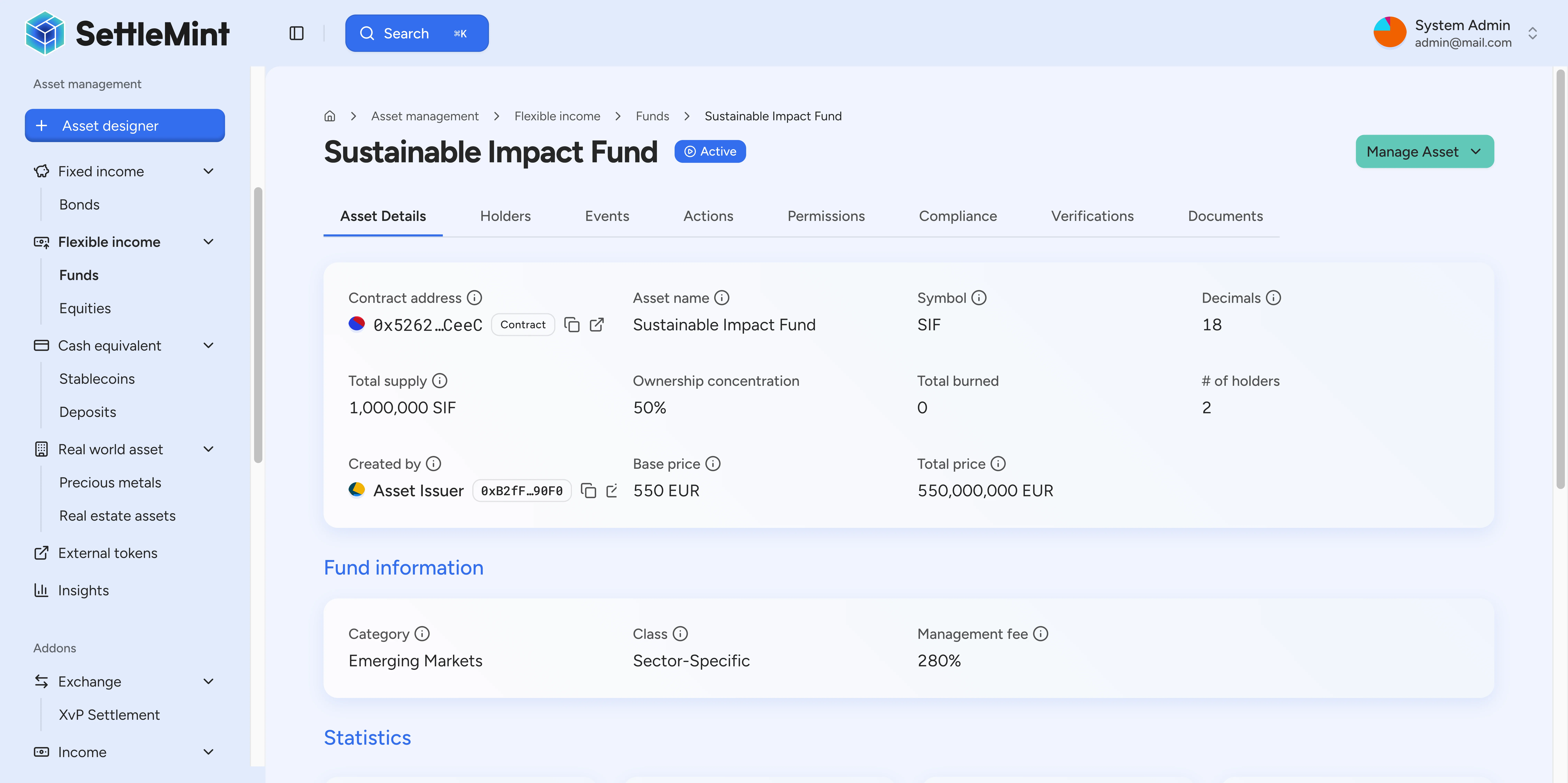
The operator creates a fund asset rather than an equity asset. The fund schema supports NAV pricing through basePrice and priceCurrency, optional fund category and class metadata, optional ISIN, and management fee basis points.
For private equity and venture capital funds, use the fund category to describe the investment strategy. Use the fund class when the selected style, stage, or allocation model helps reporting and discovery.
Attach investor checks
Investor onboarding depends on the identity and compliance setup selected for the fund. DALP can use identity claims to restrict who can hold or receive the fund token. Reuse across funds depends on the identity provider, issuer setup, claim topics, and fund rules.
Record NAV and pricing
DALP records the latest supplied unit value for the fund asset. The platform can expose the recorded value to operators and holders, but it does not calculate a private equity valuation model by itself. Portfolio valuation, audit review, and administrator approval remain part of the fund's process unless they are integrated separately.
Configure fees and distributions
The fund asset can carry management fee parameters. The AUM fee feature can calculate time-based management fees from token supply and mint the fee amount to the configured recipient when the feature is part of the asset setup.
Distribution workflows need the same responsibility split. DALP can represent token holders and support claim-based token distribution patterns where configured. Complex waterfalls, preferred returns, catch-up provisions, carried interest tiers, tax withholding, and fiat wire execution require external calculation, a custom addon, or an integrated operating workflow.
Control secondary transfers
A transfer can be gated by the fund's identity and compliance requirements. DALP can check that the recipient satisfies configured claims before the transfer proceeds. ROFR processes, GP consent, transfer windows, side-letter restrictions, and settlement arrangements still need to match the fund documents and operating policy.
Capability summary
| Capability | What DALP can do | What remains outside DALP |
|---|---|---|
| Fund-unit record | Create and manage a tokenized fund asset. | Legal fund formation and offering approval. |
| NAV visibility | Store and expose the supplied unit value. | Valuation methodology, administrator review, and audit sign-off. |
| Investor eligibility | Apply identity and compliance checks to holders and transfers. | Provider contracts, legal eligibility policy, and evidence-pack design. |
| Fee parameters | Configure management fee basis points and AUM fee collection where enabled. | Fund accounting treatment, invoices, and fiat payment movement. |
| Documents | Link fund documents to the token record. | Document drafting, approval, disclosure duties, and investor notices. |
| Secondary transfer control | Gate transfers through configured compliance rules. | Legal consent, ROFR handling, settlement, and tax treatment. |
Compliance and operating considerations
Private equity fund units usually require controls beyond basic token ownership. Before production, decide which actor owns each control:
- Investor eligibility, such as accredited investor or qualified purchaser status.
- Claim issuer setup, including who can issue, revoke, and audit investor claims.
- Holding periods, lockups, transfer windows, and approval workflows.
- Jurisdiction restrictions and investor-specific side-letter limits.
- NAV approval, valuation evidence, and audit review.
- Distribution calculation, tax handling, fiat settlement, and reconciliation.
- Document versioning, investor notices, and retention.
DALP can enforce configured token and identity controls. It does not make the fund legally compliant on its own. The operator must map the fund documents, regulatory obligations, administrator process, and integration choices onto the DALP setup.
When this use case fits
DALP is a strong fit when the fund operator wants a governed digital record for fund units, holder state, compliance-gated transfers, document links, and token lifecycle events.
DALP is not the whole operating stack when the project needs native private fund accounting, automatic private-company valuation, fiat payment execution, tax reporting, or legal approval workflows without external systems or custom integration.
What to read next
- Instrument templates explains how DALP models reusable asset templates.
- Asset creation covers the developer flow for creating assets.
- Trusted issuers explains how claims can be restricted to approved issuers.
- SMART Protocol integration explains the compliance-aware asset contract layer.
Equities
Model common shares, preferred shares, and employee equity awards on DALP with holder eligibility, transfer controls, template-specific governance features, and balance snapshots for shareholder records.
Real estate
Model tokenized real estate as a capped real-asset instrument with property metadata, controlled issuance, compliance checks, and investor-facing asset details.