

Platform capabilities
DALP combines issuance, compliance, custody controls, settlement, servicing, exception handling, and operating evidence in one platform for regulated digital asset operations after launch.
Key terms
DALP (Digital Asset Lifecycle Platform) is SettleMint's production platform for regulated digital asset operations. ERC-3643 is the token standard for permissioned securities with embedded compliance. The SMART Protocol (SettleMint Adaptable Regulated Token) provides unified compliance across asset types. A multi-signature wallet requires multiple approvals before a transaction executes.
What the digital asset lifecycle platform is
The SettleMint Digital Asset Lifecycle Platform (DALP) is working software for regulated digital asset operations after launch. Institutions use it to create assets, enforce compliance, control approvals, coordinate settlement, service assets, handle exceptions, and retain operating evidence. Issuance is only the starting point: once an asset is live, DALP provides compliance checks before transfers execute, role-based operations, custody-aware approval flows, settlement handling, servicing steps, emergency controls, and audit-ready records.
The full stack covers smart contracts implementing compliance-aware tokens, a modern web application for issuers and administrators, backend APIs and services for integration, and blockchain indexing for real-time ownership registries. Off-chain data management, deployment infrastructure, and SDKs with developer documentation complete the picture.
The platform is opinionated about architecture, unified lifecycle management with embedded compliance, but flexible about deployment. Run it on-premises, in your cloud infrastructure, or as dedicated SaaS. Deploy to Ethereum, Polygon, Hyperledger Besu, Quorum, or any EVM-compatible network. Customize the user interface, integrate with your systems, and extend the smart contracts for asset-specific requirements.
Product and delivery responsibilities
DALP is the licensed product surface for the asset lifecycle. The product scope includes smart contracts, the Console, REST APIs, workflow execution, and the indexing and reporting layer, along with documented integration points that connect custody providers, compliance systems, and network infrastructure. Implementation and support services help deploy and operate the product in the client's chosen environment.
| Responsibility area | DALP product provides | Client, partner, or delivery team decides |
|---|---|---|
| Asset lifecycle | Asset factories, compliance-aware token contracts, servicing steps, settlement workflows, and indexed operating records | Asset terms, business approvals, role assignment, and operating procedures |
| Deployment model | Supported platform components for on-premises, client-cloud, or dedicated SaaS deployment | Hosting choice, environment controls, network access, backup policy, and internal change management |
| Integrations | API and workflow surfaces for custody, compliance providers, EVM RPC access, observability, and downstream systems | Provider selection, contract terms, operating runbooks, credential governance, and escalation model |
| Compliance controls | Technical enforcement points, identity-bound checks, module configuration surfaces, and audit evidence | Legal interpretation, regulatory sign-off, policy ownership, and exception approval |
| Support and operations | Product documentation, platform health surfaces, failure-mode guidance, and supportable integration patterns | Internal incident command, evidence-pack assembly, retention policy, and production support model |
Use this split when evaluating DALP. A feature in the product can still require implementation work to configure it for a specific institution, provider, network, or operating policy. That implementation work stays in scope. The product docs treat legal obligations, custody arrangements, network controls, privacy responsibilities, and support decisions as belonging to the client.
Out-of-box product scope versus implementation scope
DALP provides the product primitives for regulated EVM asset operations. A buyer should separate those product primitives from the configuration, operating decisions, and integration work required for a production deployment.
| Evaluation question | Treat as DALP product scope | Treat as implementation or operating scope |
|---|---|---|
| Can the platform issue and operate regulated assets? | Asset factories, compliance-aware token contracts, lifecycle operations, role-controlled operations, and records | Asset terms, programme approvals, legal documentation, and issuer operating procedures |
| Can compliance rules be enforced technically? | Identity claims, trusted issuers, compliance modules, transfer checks, and audit evidence | Legal interpretation, jurisdiction-specific policy, provider contracts, manual exception approval, and ongoing regulatory sign-off |
| Can external systems connect to DALP? | APIs, SDKs, integration patterns, supported provider surfaces, event data, and deployment interfaces | Provider selection, credential governance, network allowlists, downstream reconciliation, and customer-specific adapters |
| Can DALP run in the target environment? | Supported platform components for managed, dedicated, customer-cloud, or on-premises deployment patterns | Cloud controls, data residency stance, backup policy, monitoring stack, support model, and incident command |
| Can the user interface match an institution's brand? | Console branding controls and documented customisation points | Institution-specific copy, approval of visual identity, customer portal decisions, and custom workflows outside the product |
This distinction gives you a practical rule. If DALP exposes the contract, API, console workflow, configuration surface, or operating record, treat it as product capability. If the requirement depends on a particular legal opinion, provider contract, bank ledger, or custody arrangement, treat it as implementation or operating scope around the product.
For the detailed responsibility map, read the architecture overview. For runtime placement and hosting responsibilities, read deployment topology and self-hosting prerequisites. For asset-specific operating responsibilities, read the use cases overview.
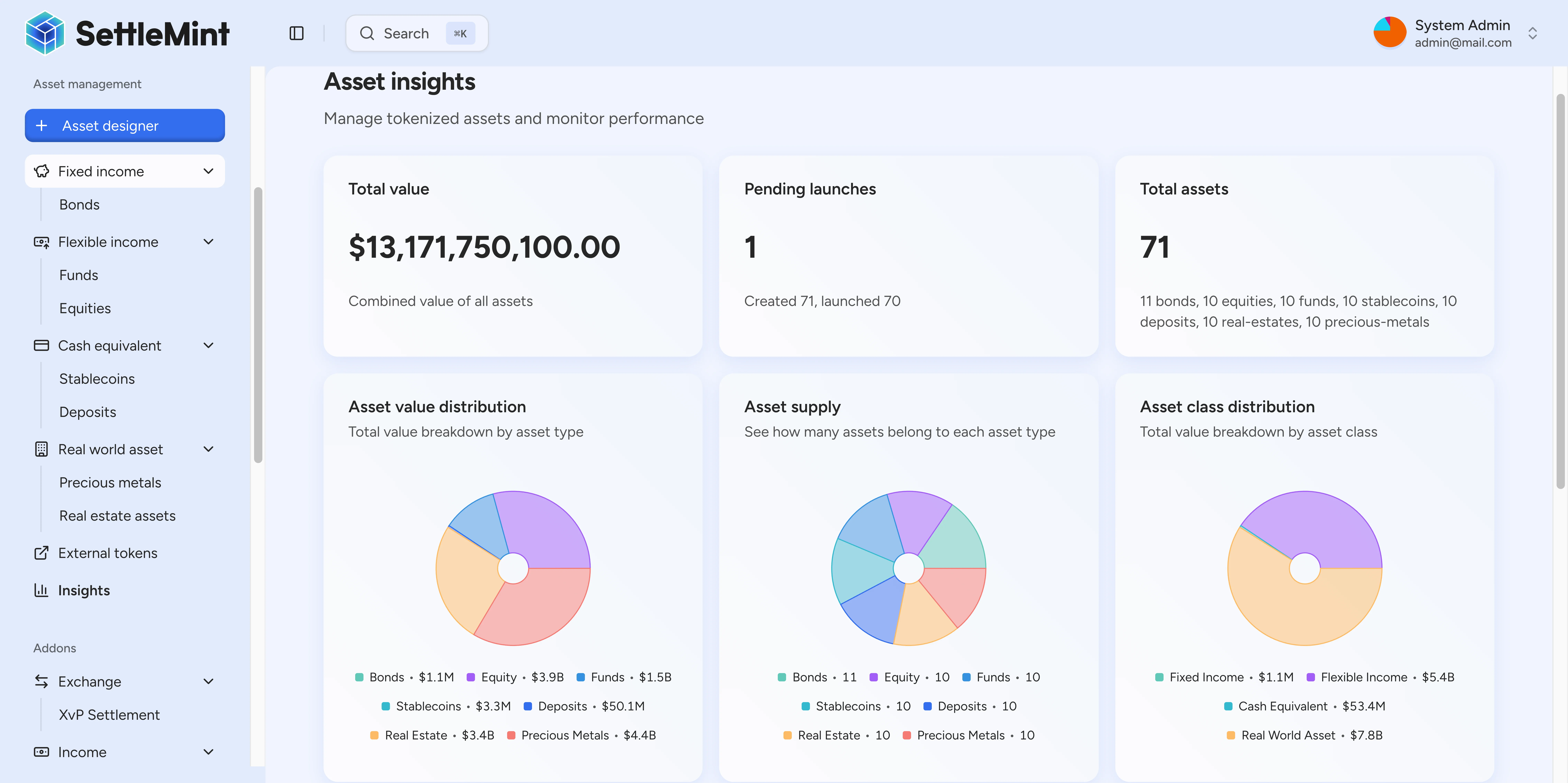
Key features and capabilities
Regulated operations after launch
DALP is designed for the operational phase that begins after an asset is issued. That phase includes transfer approvals, custody-policy boundaries, settlement coordination, servicing events, exception handling, emergency controls, production monitoring, and audit evidence. These controls sit in the same platform as asset configuration and compliance, so operations teams do not have to reconcile separate systems to understand what happened.
For regulated institutions, this matters because most operating risk appears after the first asset goes live. The practical questions are: who can approve a transfer, which compliance rule blocked it, and whether every settlement leg was approved. DALP treats those as platform workflows, not manual back-office work your team has to coordinate separately.
Complete lifecycle management
DALP combines the full lifecycle in one model: issuance with embedded compliance checks, custody-aware approvals, settlement coordination, servicing, and indexed evidence records. These capabilities share one platform context instead of forcing operators to treat every phase as a separate tool:
The asset lifecycle flows through five integrated phases: Issuance creates the token with embedded compliance from deployment. Compliance enforces rules at every transfer, validating identity claims and regulatory requirements. Custody secures assets in multi-signature vaults with maker-checker workflows. Settlement executes local token transfers together or reverts them together. Servicing automates yield calculations, dividend distributions, and redemptions. Each phase references the same control plane. Cash systems, custody providers, market venues, and connected ledger systems each still need their own reconciliation evidence.
Delivery versus Payment (DvP): DALP's XvP settlement capability coordinates multi-party token exchanges. Each local sender approves the settlement and provides allowance before execution begins. If any local token transfer fails, the full settlement transaction reverts so no partial state lingers. External cash, bridge, custody, or payment legs remain the responsibility of the connected workflow, and operators reconcile those legs against the DALP settlement record independently.
Custody-aware approvals: DALP supports multi-signature custody patterns with role-based access control. Configured quorum requirements prevent one operator from moving assets alone. Maker-checker workflows separate proposal from approval and execution. Emergency pause controls give authorised roles a way to stop activity during an incident. Operating records track each step.
Scheduled servicing: Fixed-yield and servicing features can calculate coupon, dividend, and redemption entitlements, along with interest amounts, when the asset is configured for those features. The platform records the servicing workflow, while external payment rails, accounting systems, and issuer procedures remain responsible for cash movement and reconciliation evidence outside DALP.
These capabilities give operators one lifecycle view. DALP records the platform-side state for each workflow. Connected cash systems, market infrastructure, and external ledger systems still require their own reconciliation.
Multi-asset support from day one
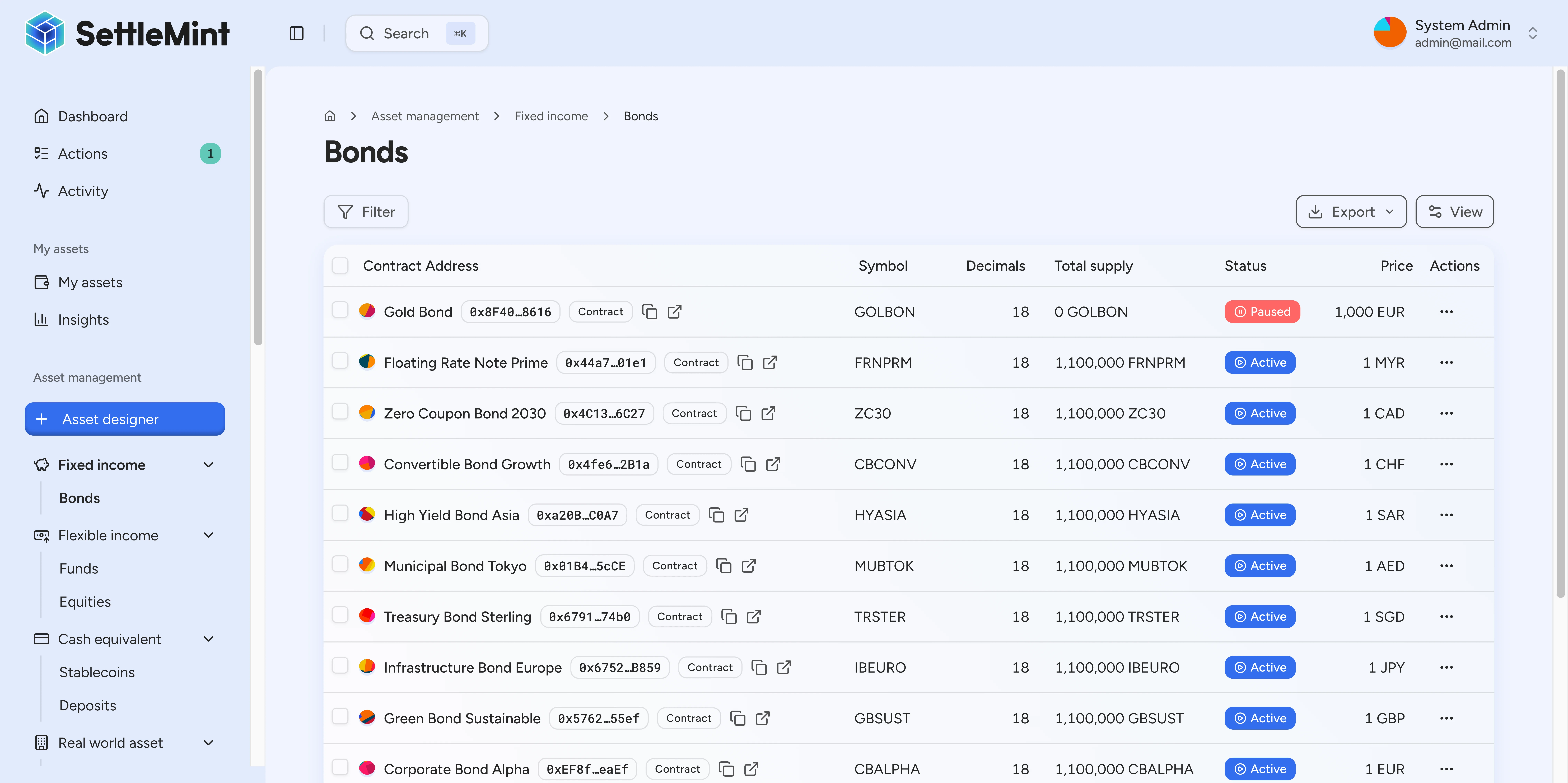
DALP ships a template library across six asset classes: fixed income, equity, funds, cash, real assets, and structured instruments. Operators can start from a system product template, duplicate it for an organisation-specific pattern, or use the Configurable Asset starter when the product does not fit a library template.
| Asset class | Example library templates | What DALP standardises |
|---|---|---|
| Fixed income | Corporate bonds, sovereign bonds, convertible notes, syndicated loans, treasury bills, green bonds, commercial paper | Maturity dates, yield or coupon configuration, denomination assets, redemption mechanics, and compliance controls |
| Equity | Common equity, preferred equity, employee equity awards | Share class setup, holder controls, voting or historical-balance features when configured, and cap-table style records |
| Funds | Mutual funds, ETFs, money market funds, private equity funds | NAV-related fields, fund category metadata, subscription or redemption setup, and holder registry controls |
| Cash | Fiat-backed stablecoins, tokenized bank deposits, certificates of deposit | Controlled minting and burning, deposit or term metadata, and issuer-owned reserve or backing evidence outside DALP |
| Real assets | Gold-backed tokens, commercial real estate, carbon credits, tokenized art | Asset-specific metadata, valuation fields, holder controls, and lifecycle evidence for externally managed assets |
| Structured instruments | Principal-protected notes, autocallable notes, asset-backed tokens | Product terms, payoff or maturity metadata, required token features, and operator review before issuance |
The template library is a starting point, not a legal wrapper. A template can attach token features, metadata fields, defaults, and required inputs to the Asset Designer. The issuer still owns the economic terms, legal classification, external reserve evidence, investor disclosures, and operating procedure for the asset programme.
Each issued asset uses DALP's shared lifecycle controls where those controls are configured for that asset: compliance checks before transfer execution, role-based administration, custody-aware signing or approval flows, settlement coordination, metadata records, and indexed operating evidence. The common platform model is what lets different asset products use the same control plane without pretending they have the same economics.
Regulatory compliance embedded in the architecture
Compliance isn't a dashboard feature you turn on after deploying tokens. It's in the token's DNA through the ERC-3643 standard implementation.
The Identity Registry maintains verified investor profiles with KYC/AML status, accreditation levels, and jurisdictional eligibility. An investor completes verification once, and their identity travels with them across all assets they're eligible to hold.
The Compliance Engine evaluates every transfer before execution, checking whether the sender is verified, whether the recipient meets eligibility requirements, whether the transfer violates holding limits or lockup periods, and whether jurisdictional rules permit the transaction. Non-compliant transfers revert with clear reason codes explaining why.
The Rule Library provides a configurable framework for jurisdiction-specific compliance. The platform supports templates for Regulation D and Regulation S (US), MiFID II and MiCA (Europe), MAS frameworks (Singapore), and FCA requirements (UK). Compliance officers configure rules through UI controls rather than writing smart contract code.
The Audit Trail captures every decision: which rules were evaluated, which identity claims were verified, which administrators approved exceptions, with immutable timestamps and cryptographic proof. Regulators get machine-readable evidence, not manually compiled spreadsheets.
Multi-layer security and custody
Multi-signature wallets require configurable quorum approval for treasury operations. No single person can move assets unilaterally. The platform enforces maker-checker workflows where one admin proposes a transaction and others approve before execution.
Custody-aware signing routes let institutions delegate signing and transaction broadcasting to configured providers instead of relying on a single application hot wallet. Current DALP integrations cover Fireblocks and DFNS provider-native broadcasting, approval polling, and signer operations. Role-based access control defines who can perform which operations: token creation, compliance approval, treasury transactions, and administrative settings. Permissions map to organizational hierarchies with proper segregation of duties.
Institutions can use those provider-side policy controls while DALP coordinates asset lifecycle workflows, transaction state, and confirmation tracking in the platform.
The platform assumes keys will be stolen, employees will make mistakes, and external attacks will occur. Security is defense in depth: multiple layers that must all fail before assets are at risk.

Modern user experience across personas
DALP exposes different working surfaces for different operators. The browser experience helps people configure asset operations, run approvals, and review state, while the API and CLI help technical teams automate the same operating model.
| Surface | Primary user | What they use it for | Where to go next |
|---|---|---|---|
| Console | Issuers and operations teams | Create assets, configure templates, review asset state, run permitted lifecycle operations, and inspect holder or event views. | Create asset |
| Compliance workspace | Compliance officers and provider operators | Manage verification data, trusted issuers, compliance templates, provider setup, and compliance-related operating evidence. | Compliance overview |
| Admin and organisation settings | Organisation administrators | Manage organisation setup, users, wallets, permissions, and operating checks before sensitive operations. | Admin operating model |
| Developer documentation and APIs | Integration engineers | Use REST APIs, generated clients, CLI commands, webhooks, and transaction tracking for system integrations. | API integration guides |
| Read and evidence surfaces | Auditors, reviewers, and support teams with access | Review indexed events, transaction status, reports, exports, and asset records for each allowed program. | Reporting and audit access |
Deploy to testnet first, validate behavior, then repeat the validated operating model on the production EVM network. Testnet transactions, balances, identity registry entries, compliance module state, transaction hashes, confirmations, and indexed history do not become production state. See Promote from testnet to mainnet for the operational checklist.
The Console theme system lets operators match the browser experience to their institutional brand while keeping product workflows unchanged. Detailed branding controls are covered in the Console customization guidance.
Production-grade architecture
The platform uses microservices with independent resource allocation for each component. The web application, API server, blockchain indexer, and database tier grow independently based on load.
TanStack-based frontend provides instant navigation and optimistic updates. Users don't wait for blockchain confirmations to see UI updates; the interface predicts outcomes and updates immediately while settlement completes in the background.
Drizzle ORM with PostgreSQL manages off-chain data with strong consistency guarantees. DALP's native indexer keeps blockchain events queryable within seconds of on-chain finality. Redis caching accelerates frequent queries, so dashboards load instantly even with thousands of assets and tens of thousands of holders.
Kubernetes deployment via Helm charts enables cloud-native operations with autoscaling, rolling updates, health monitoring, and self-healing. Deploy to any Kubernetes environment: public cloud, private cloud, or on-premises.
Deployable observability stack
DALP provides a Helm observability chart for deployments that enable and configure the stack. The chart can deploy VictoriaMetrics for metrics, Loki for logs, Tempo for traces, and Grafana dashboard configuration for common self-hosted operations.
When the observability chart and relevant exporters are enabled, dashboards surface the metrics operations teams rely on. Common views include:
- Transaction throughput and success rates
- Compliance check performance and failure reasons
- System availability and response times
- Asset-level activity and holder statistics
Alert notifications and routing depend on the deployment's notification configuration. Operators can troubleshoot issues by viewing correlated system behavior across enabled telemetry sources in one interface. Using deployable open-source telemetry components can also reduce the need for separate monitoring SaaS contracts, while enterprise integrations and retention policies remain deployment choices.
Banking and payment integration
The platform supports treasury workflows where operators verify fiat deposit evidence, process tokenized-cash issuance, and coordinate redemptions with the off-chain payment systems their institution uses. DALP records the on-chain asset movement and settlement state; payment-file generation and banking-network connectivity remain integration responsibilities unless a deployment connects those systems explicitly.
Multi-currency support handles assets denominated in different fiat currencies with proper tracking. The same platform manages USD bonds, EUR stablecoins, and SGD deposit certificates without requiring separate deployments. Payment versus Payment (PvP) settlement coordinates multi-leg transactions where one token exchanges for another token, with atomicity guarantees ensuring both legs complete or both revert.
How DALP delivers value
DALP is organized around core business functions rather than technical components. User-facing applications provide role-specific interfaces:
- Issuer Portal for creating and managing tokenized assets
- Investor Portal for viewing holdings and claiming distributions
- Console for compliance officers and operations teams
- Developer Platform for technical integrations
The business logic layer coordinates workflows. It handles asset lifecycle orchestration from issuance through redemption, compliance verification before every transaction, and integration with banking systems, KYC providers, and custody services.
Record-keeping infrastructure maintains authoritative data. The immutable ownership ledger is blockchain-based, supported by a fast-access transaction history and reporting database, and real-time indexing for instant portfolio views. External system connections complete the picture. Banking rails handle fiat on/off ramps. KYC and AML providers supply identity verification. Custody services cover HSM-backed key management, and document storage holds offering materials and legal files.
Every component contributes to one or more business outcomes: faster issuance, lower operational costs, regulatory compliance confidence, or better investor experience.
Benefits and tangible outcomes
Faster time to market
You can take an asset from term sheet to live token in days instead of months. Templates handle compliance structure, factory contracts deploy tokens automatically, and the platform eliminates most custom development.
Reduced operational overhead
Corporate events that took teams of people and multiple days now execute with minimal manual work. Dividend entitlements, coupon calculations, NAV updates, and redemptions happen programmatically without manual spreadsheet work or reconciliation. Token holders claim their distributions on-demand.
Compliance confidence
Non-compliant transactions don't execute because eligibility checks happen before execution. Your regulators see a platform built for control. Risk committees approve deployments faster when the architecture demonstrates proper controls.
Better investor experience
Real-time holdings visibility, instant settlement, on-demand yield claiming, and transparent audit trails replace quarterly statements and opaque processes. Investor support tickets drop because the platform provides self-service transparency.
Lower total cost of ownership
One platform replacing multiple vendors means one contract to negotiate, one security review, one integration project, one support relationship. Procurement cycles shrink from months to weeks.
Who's using DALP and for what
Production deployments span multiple use cases. Asset managers tokenize private fund units to automate administration and enable secondary trading. Banks issue deposit certificates as programmable tokens with automated maturity processing. Corporations explore tokenized bonds for direct-to-investor capital raising with embedded compliance.
Geography matters less than regulatory clarity. European institutions under MiCA frameworks, Singapore financial institutions under MAS oversight, and Gulf Cooperation Council markets with clear tokenization guidelines are moving fastest. The US market is more cautious but accelerating as regulatory frameworks solidify.
Programme size varies from pilots managing tens of millions to institutional deployments handling hundreds of millions in tokenized assets. The platform supports both with the same codebase and operational model.
What this means for your organisation
If you are exploring tokenization, DALP gives you a complete platform rather than a set of separate vendors to assemble. If you are already running a pilot on disconnected systems, it gives you a migration path to unified lifecycle management with embedded compliance.
As a developer, you get modern APIs, comprehensive documentation, and working reference implementations. As an operator, you get purpose-built tools for daily workflows rather than generic blockchain explorers. If you are a risk officer, you get defense-in-depth security controls with the audit trails that regulatory frameworks require. Compliance officers get policy embedded in the enforcement path rather than post-transaction checks that catch violations after the fact.
The platform is built for regulated financial instruments with institutional requirements. For tokenized securities, funds, bonds, or deposits with real compliance obligations, DALP provides the technical enforcement points and operating evidence the programme needs.
Where to next
- Use cases: Real-world scenarios across asset classes
- Compliance & security: Regulatory and security architecture details
- Glossary: Key terms and definitions
DALP solution model
Digital Asset Lifecycle Platforms (DALPs) provide regulated digital asset operations infrastructure for asset control, compliance-aware transfers, settlement coordination, and operating evidence.
Use cases
Compare DALP asset classes and instrument templates against the same EVM asset lifecycle: issuance, holder controls, servicing actions, event history, and integration APIs.