

Equities

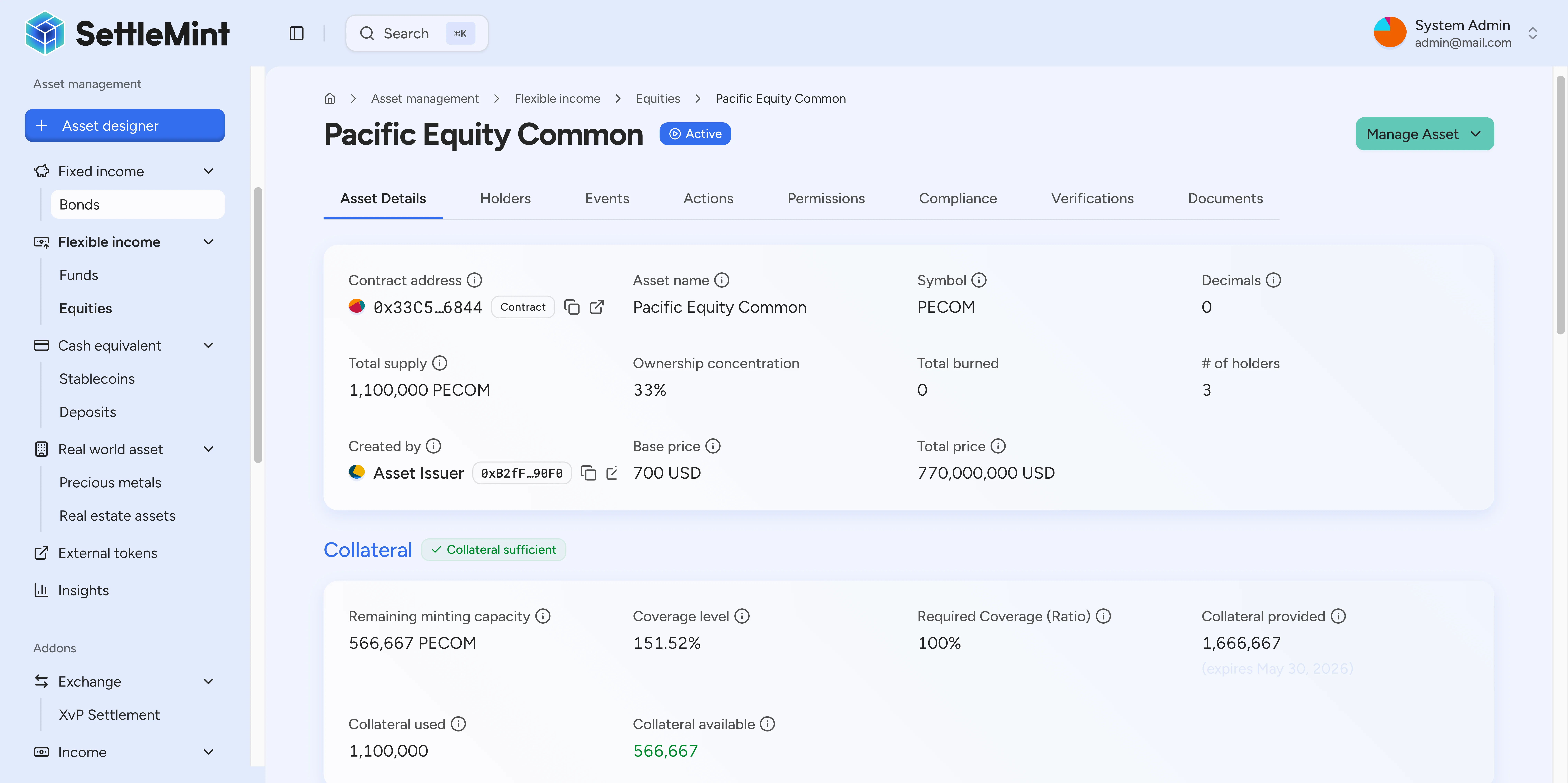
Model common shares, preferred shares, and employee equity awards on DALP with holder eligibility, transfer controls, template-specific governance features, and balance snapshots for shareholder records.
Use DALP to model share-like assets for common shares, preferred shares, and employee equity awards. The platform lets you enforce holder eligibility, record transfers, and attach voting or balance-snapshot features where the selected template includes them. Corporate-law treatment, shareholder-register status, tax, issuer approvals, and cash movement remain external operating responsibilities.
Who should read this: Read this if you are a corporate secretary, legal team member, investor relations lead, or architect deciding whether a share-like instrument fits DALP.
Business challenge
When you manage many shareholders, you need more than a token minting screen. You define the share-like instrument and decide who can hold it. You also record transfers, support governance where configured, and keep operational evidence for audits and reporting.
Traditional share administration often spreads these duties across legal records, investor spreadsheets, transfer-agent workflows, payment systems, and voting tools. DALP provides a controlled EVM execution layer for the instrument and its lifecycle events. The platform does not replace legal counsel, payment rails, or the institution's formal shareholder register unless those responsibilities are explicitly integrated into the target operating model.
DALP equity pattern
What DALP supports
| Area | DALP responsibility | External responsibility |
|---|---|---|
| Instrument setup | Create a share-like asset from the equity profile, including standard token parameters and configured metadata. | Define the legal share class, rights, approvals, charter treatment, and offering restrictions. |
| Holder eligibility | Apply configured identity, country, and investor-count compliance modules where the deployment requires them. | Decide the eligible investor policy and maintain the off-chain KYC, sanctions, and legal review process. |
| Voting | Attach voting-power behavior when the selected configuration includes the module. Holders delegate voting power, and DALP can report current and historical voting power. | Define resolutions, quorum, proxy rules, class rights, and the legally binding effect of each vote. |
| Shareholder records | Use historical balances and indexed token activity as operational evidence for holder views and reconciliation. | Decide whether and how those records update the official shareholder register. |
| Lifecycle controls | Use role-gated minting, burning, pausing, freezing, forced transfer, and recovery operations where granted roles and selected modules allow them. | Approve corporate events, court orders, lost-wallet policy, and required notices before operators act. |
| Distributions | Use configured token features or integrations only when the selected deployment supports the required distribution workflow. | Fund cash or tokenized-cash payments, calculate tax treatment, approve payment files, and reconcile external payment rails. |
Implementation shape
Start with the legal and operational design, then map that design into the DALP asset configuration.
- Define the share class, supply model, decimals, symbol, reference currency, and legal owner.
- Select the equity profile or closest configurable asset template.
- Configure holder eligibility rules, trusted issuers, claim topics, country controls, and investor-count limits where they apply.
- Attach voting power and historical-balance behavior when the share programme needs governance or record-date snapshots.
- Grant only the roles required for asset operation, supply management, emergency controls, and compliance administration.
- Test minting, transfers, restricted transfers, voting delegation, balance snapshots, and any distribution workflow before production use.
Operating boundaries
DALP records token lifecycle activity on EVM infrastructure and exposes indexed records that support platform views, API access, and reconciliation. The platform does not determine whether a token is a legal share, replace required filings, remove transfer-agent duties in every jurisdiction, or prove that an external cash payment has happened.
Treat the DALP record as the execution and evidence layer. Your institution remains responsible for mapping that layer to legal registers, payment instructions, custody, tax reporting, investor communications, and regulator-facing evidence packs.
Production checklist
Before using DALP for a share-like instrument, confirm:
- The instrument fits the current equity profile: common equity, preferred equity, or employee equity awards.
- The legal share class and shareholder rights are final before token deployment.
- Holder eligibility rules match the offering policy and the selected compliance modules.
- Voting behavior is required and configured, or explicitly out of scope for the programme.
- Balance snapshots support the intended record-date and reconciliation process.
- Role assignments follow least privilege: supply management, emergency controls, recovery operations, and compliance administration each get only the required role.
- External systems cover payments, tax, corporate approvals, and official shareholder-register updates.
Read next
- Instrument profiles explains the equity profile and its token features.
- Tokenization modeling shows how templates, features, compliance modules, and lifecycle operations fit together.
- Equity tokenization in the console walks through a UI-led equity scenario.
- Equity tokenization through APIs gives the API-led version of the same scenario.
Corporate bonds
DALP gives fixed-income programmes an EVM foundation with compliant asset creation, atomic settlement, pull-based coupon claims, and maturity redemption controls.
Private equity
Model private equity and venture capital fund units in DALP with NAV pricing, fund metadata, management fee parameters, compliance checks, and clear operator responsibilities.