

Market Data Infrastructure
How DALP market data feeds record issuer-signed prices, exchange rates, and feed adapter data for digital asset operations.
Pricing integrity as an operating control
DALP market data feeds let operators record prices and exchange rates with a clear issuer, subject, topic, timestamp, and update history. Asset valuations can then use the same registered feed data for compliance checks, redemption calculations, yield calculations, and investor reporting.
Feed contracts, adapters, and the trust model are covered in Architecture: Feeds System.
What DALP provides
DALP provides market data through the Feeds system. The model combines issuer-signed feed updates, a feed directory, and Chainlink-compatible adapter contracts for systems that expect the standard aggregator interface.
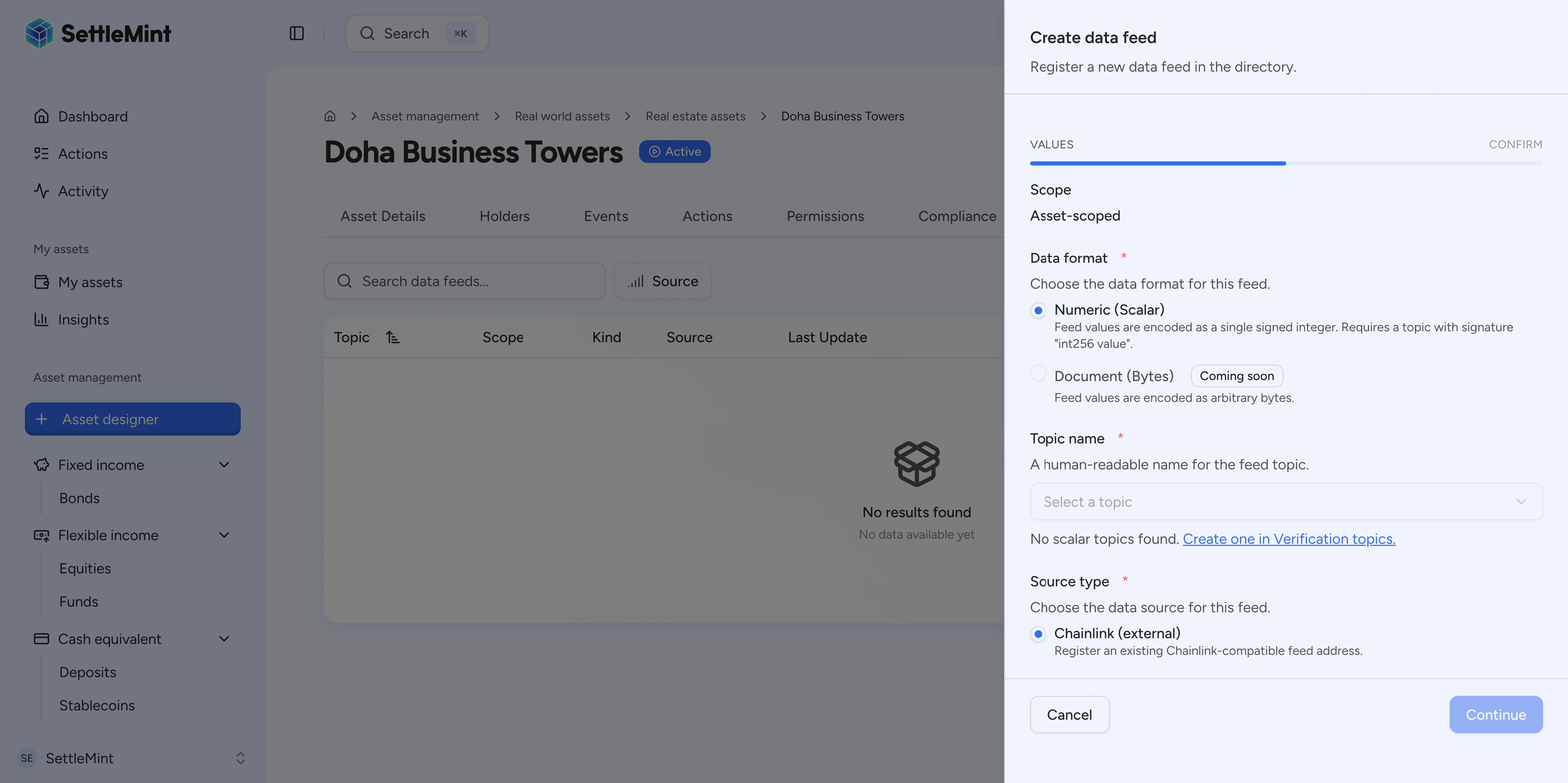
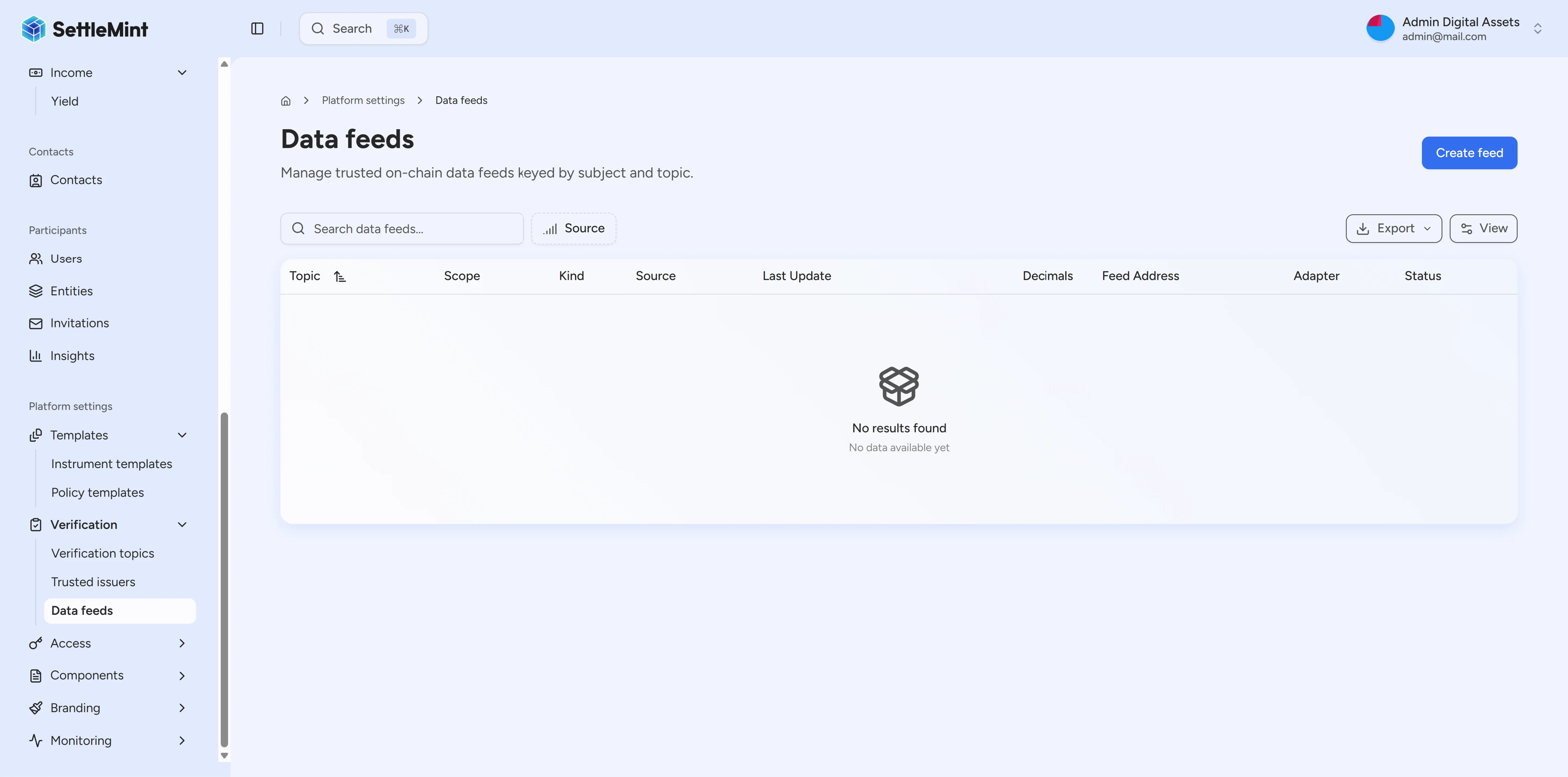
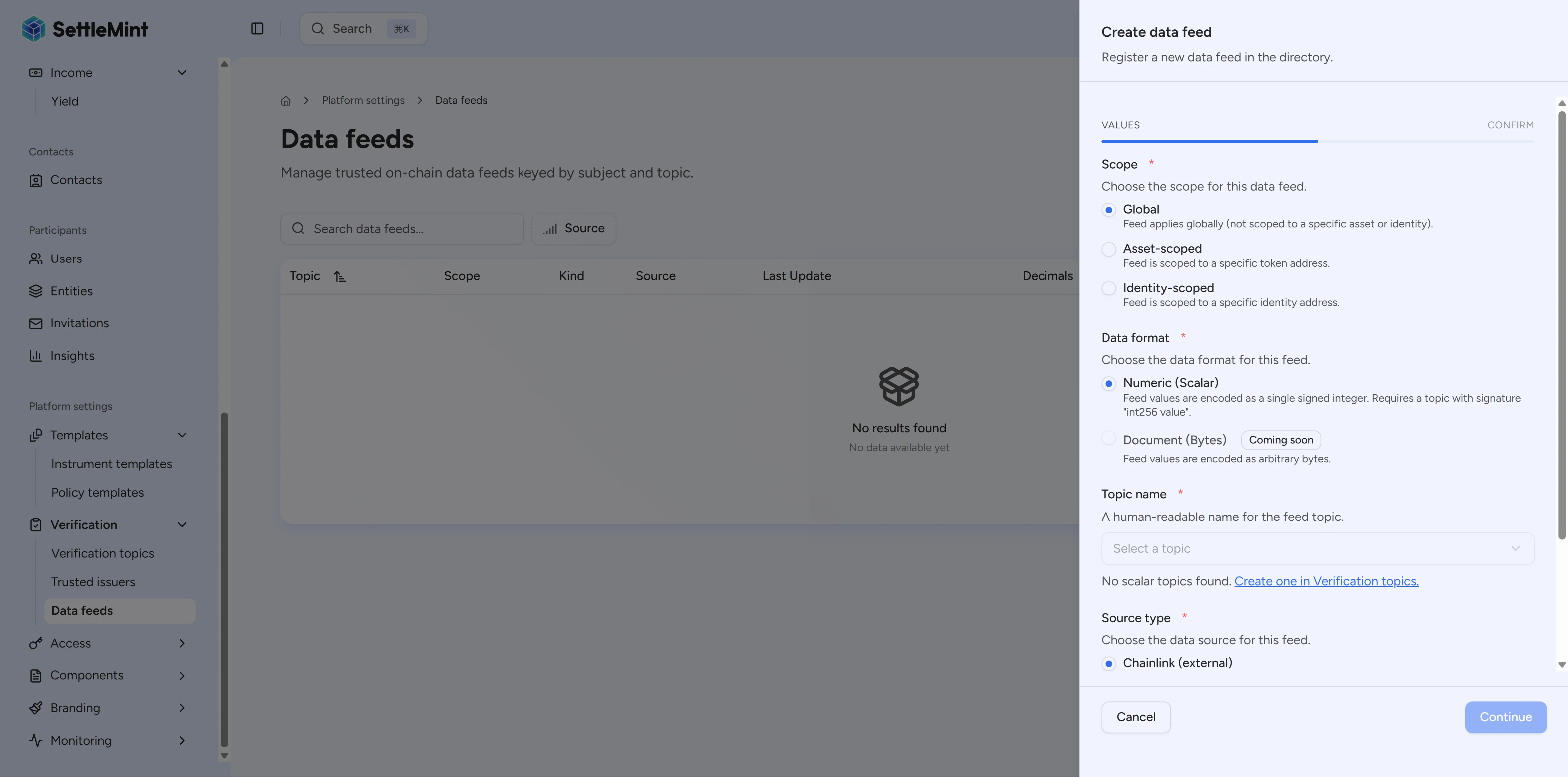
Feed registration Feeds are registered by subject and topic. A subject can be a token address or a global feed, and the topic identifies what the feed represents, such as a price or exchange rate.
Issuer-signed updates Issuer-signed scalar feeds accept EIP-712 signed updates from issuers authorised for the feed topic and subject. Each accepted update records the value, observation time, issuer, signer, and round history.
Adapter stability
Scalar feed aggregator adapters keep a stable address for consumers. Each adapter resolves the current scalar feed for its subject and topic through the feed directory, then exposes Chainlink-compatible methods such as latestRoundData().
Operational safeguards Feed creation is permissioned. Global feeds require the Feeds Manager role, while token-scoped feeds can also be created by an address with governance authority on that token. Feed updates reject stale observations and observations beyond the configured drift allowance.
Valuation model
DALP valuation starts from an indexed token-specific base-price feed.
The feed description carries the price currency, for example TOKEN / USD. DALP normalizes the value to 18 decimals before API consumers read it.
If a PriceResolver is active for the token's system, DALP reads the resolver's configured FeedsDirectory, applies its maximum-staleness rule to the base-price feed, and builds FX conversion paths from active global FX feeds in the same directory. Each FX feed adds a direct edge and an inverse edge. DALP chooses the shortest path to the requested currency, up to three FX hops, and returns the conversion path in the token price response.
If DALP finds the base price but cannot find an FX path to the requested display currency, the API returns the base-price currency with convertible: false. Treat that as a feed-setup signal: the token has a price, but the configured FX graph does not connect the base currency to the requested currency.
For the API fields, conversion-path response shape, and setup checks, see Token price resolution.
Business impact
| Capability | Business impact |
|---|---|
| Issuer-signed pricing | Records who authorised a value and when that value was observed |
| Feed registration | Gives operators one registered source for each subject and topic |
| Base-price resolution | Lets integrations read the current indexed token price and its source currency |
| FX conversion paths | Shows which feed hops DALP used when converting a token price into another fiat currency |
| On-chain price history | Preserves round history for audit, reporting, and reconciliation workflows |
| Stable adapter addresses | Lets external systems consume the current registered feed without hardcoding a changing feed address |
| Drift checks | Rejects stale observations and observations too far in the future |
Who manages market data
The Feeds system uses role-based access control. Feeds Manager can create global feeds and manage feed directory operations. For token-scoped feeds, a token governance authority can also create feeds for that token.
Regulatory alignment
Reliable pricing records help institutions produce evidence for valuation, redemption, NAV, fair-value reporting, and internal risk reviews. DALP supplies the technical record: registered feed identity, signed update provenance, and on-chain history. The institution remains responsible for choosing approved sources and meeting its regulatory obligations.
Related resources
- Architecture: Feeds System: registry, feed types, and trust model
- Token price resolution: API response fields, conversion paths, and no-path behaviour
- Feeds overview: feed concepts, history modes, and operating checks
Compliance & security
DALP embeds regulatory controls into transaction execution so regulated asset programmes can enforce eligibility, identity, and transfer rules before state changes settle.
Glossary
Buyer-friendly definitions for tokenization, regulated assets, compliance, custody, settlement, and DALP platform terms.