

Lifecycle platform approach
Digital Asset Lifecycle Platforms (DALPs) provide regulated digital asset operations infrastructure for post-launch asset control, unified architecture, and production operations.
Key terms
- DALP – Digital Asset Lifecycle Platform providing integrated infrastructure for the complete asset lifecycle
- Atomic operations – Transactions that execute completely or not at all, preventing partial state
- Unified registry – Single authoritative record of ownership and compliance state
- DvP – Delivery versus payment ensuring simultaneous exchange of asset and cash
What makes a platform a DALP
A Digital Asset Lifecycle Platform collapses issuance, compliance, custody controls, settlement, servicing, exception handling, and operating evidence into one integrated system with a single control plane. It is unified infrastructure where the ownership registry, business rules, approvals, and operational records stay synchronized by design.
An asset lifecycle includes creation with specific terms, investor onboarding and verification, primary distribution with eligibility checks, secondary trading with continued compliance enforcement, corporate actions with automated distribution, continuous reporting and audit trails, and eventual maturity, redemption, or sunset. A DALP handles all of these phases on one platform with consistent security, unified data, and coordinated workflows.
Traditional approaches involve different systems, different vendors, different data models, and different points of failure at each phase. Institutions require unified architecture where risk committees can identify one single source of truth, the platform's unified registry, rather than requiring daily reconciliation across multiple databases.
The six laws of a DALP (non-negotiables)
If a platform doesn't implement all six of these principles, it's not a DALP. These principles separate real lifecycle platforms from repackaged point solutions:
1. unified lifecycle core
Issuance, onboarding, compliance, custody, trading, settlement, servicing, and reporting operate on one shared source of truth. Every state change, whether it's a token transfer, a compliance approval, a corporate action, or an access control update, updates a single authoritative registry. No nightly batch reconciliation jobs exist to align different databases.
There's no "eventual consistency" where your trading system thinks someone owns 1,000 tokens but your compliance system thinks they own 900 and your custody provider hasn't updated yet. When a regulator asks "who owned this asset on this date?" there's one definitive answer backed by immutable evidence.
When an auditor asks "how do you know this transfer was compliant?" the platform shows exactly which rules were checked, which identity claims were verified, and which approval workflow executed, all in the same system that managed the transfer itself.
2. compliance by design
KYC, KYB, accreditation checks, and jurisdictional policies are embedded in the asset's transfer path, not bolted on afterward. Every transaction enforces eligibility before it executes. Non-compliant transfers revert immediately rather than requiring cleanup after they've been recorded on-chain.
Identity verification happens once, and the proof travels with the investor across all assets on the platform. A verified accredited investor doesn't need to re-verify for each new fund they invest in. Their credential is reusable, revocable if circumstances change, and auditable at any point.
Compliance rules are configurable by asset and by jurisdiction, executing through a unified policy engine. The rule engine is the single enforcement point. Jurisdictional templates provide starting points for activating controls, but live-asset updates remain governed, asset-scoped changes: updating a template does not mutate existing asset policy state, so teams explicitly review affected assets, re-apply or adjust module parameters, and verify the resulting transfer behavior.
3. custody, settlement, and day-two operations
Token creation is not the hard part for regulated institutions. The hard part is operating the asset after launch: controlling approvals, enforcing custody policies, handling settlement states, servicing holders, managing exceptions, and producing evidence for audit. DALP provides that operating infrastructure inside the asset lifecycle rather than leaving it to disconnected tools.
Vault-based custody: Multi-signature approval workflows with configurable quorum rules and role-based access controls. Compatible with HSM-backed signers (enterprise custody providers can sign with HSM-protected keys). DALP's vault system implements maker-checker workflows where proposals require multiple approvals before execution. Emergency pause capabilities protect against compromised accounts.
Regulated custodian integration lets institutions delegate key management to specialists while maintaining visibility and control through the platform. The platform supports bring-your-own-custodian models rather than forcing institutions to trust platform custody.
Atomic DvP settlement: Delivery versus payment (DvP) where both legs, asset and cash, execute together or both revert. No window exists where one party has received value and the other hasn't. DALP's XvP settlement system extends this to multi-party exchanges where any number of participants can exchange tokens atomically. If any leg fails, the entire settlement reverts. This eliminates counterparty risk and the need for trusted intermediaries.
This requires cash to be on-chain via tokenized deposits, regulated stablecoins, or Central Bank Digital Currency when available. DALP provides the settlement infrastructure that coordinates these atomic exchanges.
Scheduled yield management: Fixed yield schedules eliminate manual calculation of dividends, interest payments, and coupon entitlements. Configure payment schedules once during issuance, and DALP calculates entitlements automatically on payment dates. Token holders claim their yields directly through smart contracts with cryptographic proof of entitlement. No spreadsheets, no reconciliation, no manual wire transfers to thousands of investors.
Payment operations remain bounded by the systems connected to the deployment. DALP coordinates the on-chain asset, tokenized-cash, and settlement state; core banking, payment-network, and reconciliation-message flows are integrated around that state when required by the institution.
4. enterprise deployment and control
On-premises installation, bring-your-own-cloud deployment, or dedicated SaaS with isolated infrastructure, institutions choose what fits their risk and compliance requirements. The platform adapts to enterprise standards rather than dictating architecture.
SSO via SAML or OIDC connects to existing identity providers. MFA enforcement aligns with corporate security policies. Role-based access control (RBAC) or attribute-based access control (ABAC) maps to organizational hierarchies. Employee onboarding and offboarding flows through existing IAM systems.
Audit logging captures every access, every action, every approval with immutable evidence. SIEM integration sends security events to centralized monitoring. Data residency requirements get met by deploying in specific geographic regions or customer-controlled data centers. Disaster recovery and business continuity procedures follow enterprise standards.
Theme customization lets institutions present the Asset Console with their own branding while using the same operational workflows. See the Asset Console customization guidance for the supported controls.
5. developer and operator instrumentation
Modern APIs and SDKs with comprehensive documentation, typed interfaces, sandbox environments, and versioning policies let developers integrate quickly. REST endpoints provide flexible data access. Operations that finish in the request path return immediate data with transaction hashes; operations accepted for asynchronous processing return a transaction ID, current status, and status URL for polling long-running blockchain work.
The platform ships with pre-built UI components and reference architectures, not just APIs. Investor onboarding flows, asset type templates, and reference implementations can be customized rather than built from scratch.
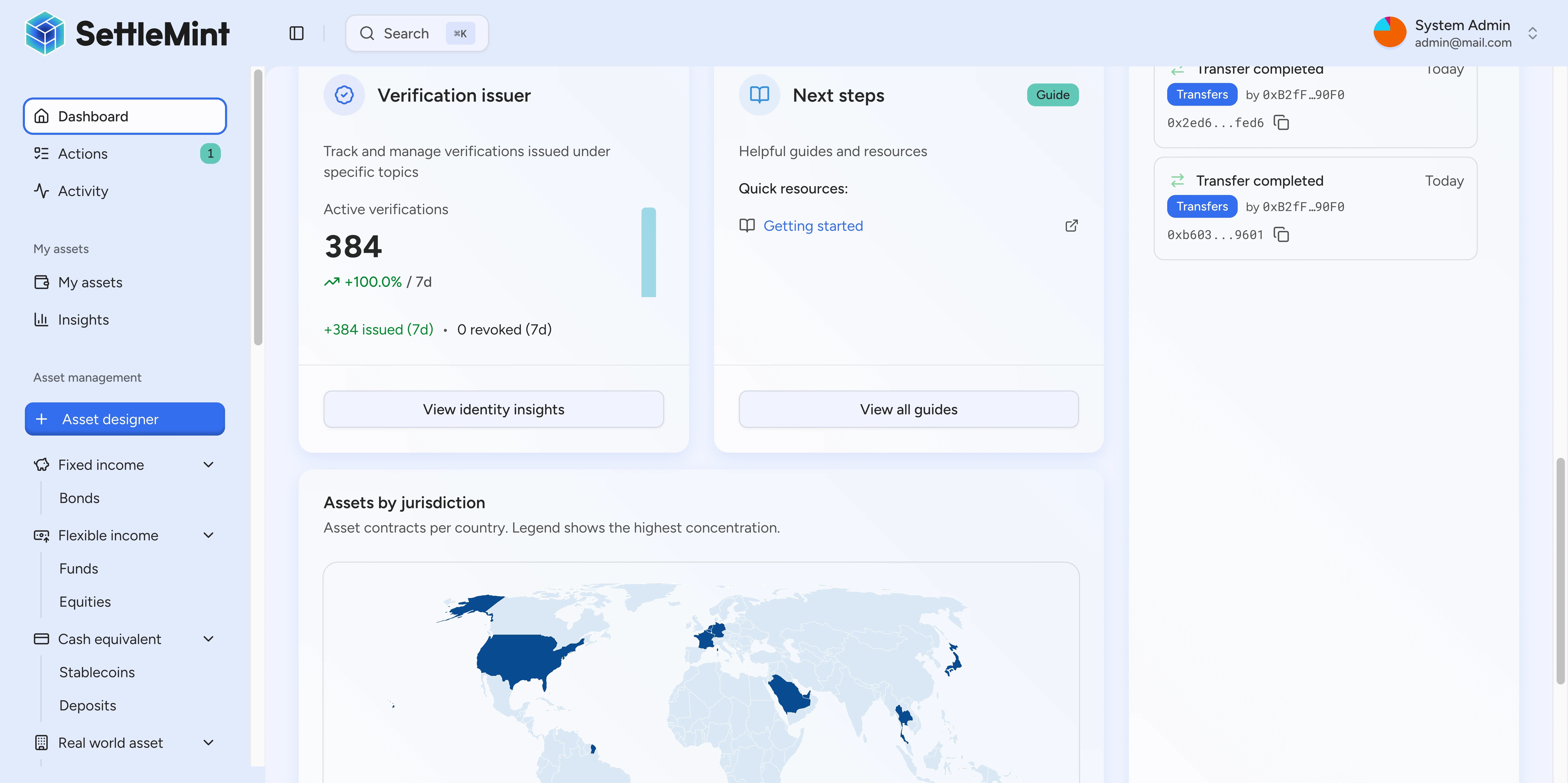
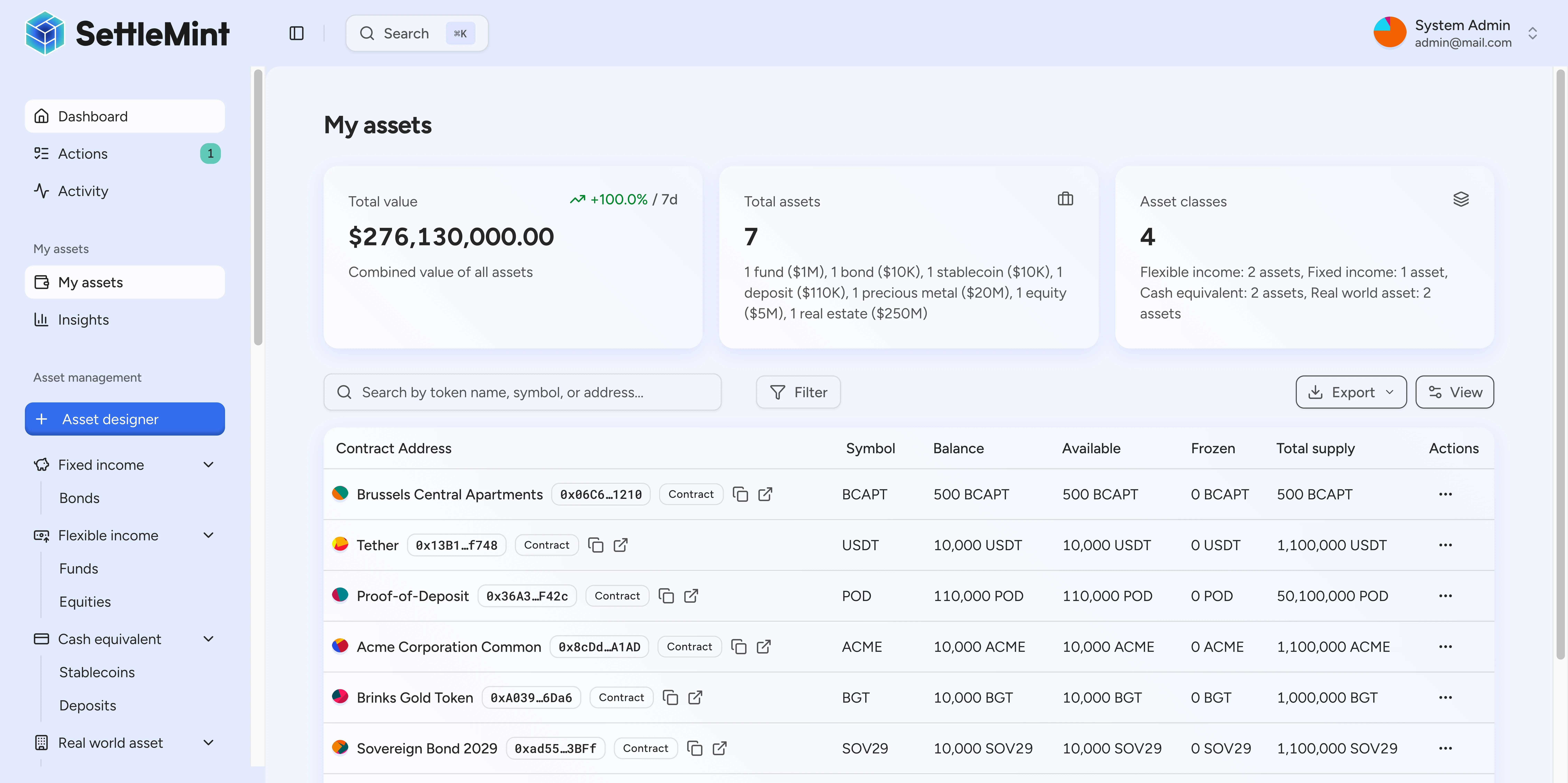
Operational dashboards and monitoring surfaces give teams visibility into API and blockchain activity, pending approvals, blocked transactions with reason codes, custody balances, settlement status, and compliance alerts. Operations teams can monitor daily activity without developer support and can investigate exceptions against the same records that drive the asset workflow.
A rule library with jurisdiction-specific compliance templates reduces policy configuration from months to days. Compliance officers select template modules that experts have already built and vetted rather than translating regulations into smart contract logic from scratch.
6. proof through metrics
Institutions don't invest in infrastructure based on promises. They need measurable outcomes proving the platform delivers on its commitments. Target metrics that matter:
- Near-total T+0 settlement: 99% or more transactions settle same-day with atomic DvP
- Zero compliance breaches: No transactions execute that violate eligibility requirements
- High first-attempt success: 99%+ of legitimate transactions succeed without manual intervention
- Rapid onboarding: KYC turnaround under one business day for standard cases
- Enterprise uptime: 99.9% availability for production operations
These aren't stretch goals. They're minimum acceptable performance for production financial infrastructure. When your platform achieves them consistently, you've built something institutions can depend on.
How unified architecture scales
A DALP provides unified infrastructure where lifecycle phases integrate because they are architected together. External systems still connect through APIs, but the core lifecycle, from issuance through redemption, flows through one coherent platform.
Integration complexity stays flat. Adding a new asset class, compliance rule, or feature happens inside one codebase. There is no cross-vendor API coordination, no waiting for third-party release cycles, no multi-system regression testing.
One source of truth eliminates reconciliation. The trading view of ownership, the custody balance, and the compliance status all reference the same registry. There are no nightly batch jobs aligning different databases and no reconciliation reports consuming full-time resources.
Security boundaries are minimized. One platform means one security review, one set of API credentials, one audit surface. Security teams evaluate one vendor's practices rather than monitoring five platforms' security advisories.
Ownership is clear. When something breaks, there is one support line. There is no vendor blame game, no multi-party incident coordination, no ambiguity about who is responsible for what.
How a DALP architecture works
A DALP stores data in one registry. Every component works against that single source of truth. Compliance checks and ledger updates execute together atomically. Custody, settlement, and asset movement coordinate as workflows where the platform ensures both legs complete or both revert.
Traditional multi-vendor approach
Multiple vendors create multiple integration points, each requiring separate development, testing, and maintenance. Data synchronization happens through API calls, requiring constant reconciliation.
DALP approach: unified architecture
The DALP approach eliminates integration complexity by providing a unified core where all lifecycle phases operate against a single source of truth. Components are architected together, ensuring atomic operations and consistent state across the entire platform.
When to use a DALP
Choose a DALP when:
- Issuing regulated securities requiring audit trails and immutable compliance evidence
- Managing multiple asset types (bonds, equity, funds) on unified infrastructure
- Requiring atomic settlement with delivery-versus-payment guarantees
- Operating under strict enterprise security, audit, and deployment controls
- Needing custody with maker-checker approvals, recovery procedures, and role separation
- Supporting institutional transaction volumes beyond initial deployments
Point solutions may suffice when:
- Building experimental/pilot projects with no regulatory requirements
- Tokenizing single asset types with simple transfer rules
- Operating exclusively on public chains with no custody requirements
- Accepting manual corporate action processes and off-chain reconciliation
What this means for your next tokenization project
When evaluating platforms, ask these questions:
-
Is there a single source of truth for ownership? If the answer involves reconciling multiple systems, it's not a DALP.
-
Are compliance rules enforced before or after transfers execute? If checks happen asynchronously after settlement, it's not a DALP.
-
Can the platform demonstrate atomic settlement where both asset and cash legs succeed together or fail together? If not, it's not a DALP.
-
Does the platform support my deployment requirements? On-premises, bring-your-own-cloud, or dedicated infrastructure with enterprise IAM integration? If you're forced into multi-tenant SaaS on a public chain, it's not a DALP.
-
What's the developer and operator experience? Complete APIs, SDKs, sandbox environments, operational dashboards, and audit tooling? Or sparse documentation and feature requests?
-
Can you point to production deployments with measurable outcomes demonstrating T+0 settlement, zero compliance breaches, and enterprise uptime? Or pilot stage with future promises?
The DALP category exists because institutions need more than token creation. They need integrated lifecycle infrastructure architected specifically for regulated financial instruments with institutional requirements.
SettleMint's Digital Asset Lifecycle Platform is a production implementation of DALP principles, a full-stack platform handling issuance, compliance, custody, settlement, and servicing as one coordinated system.
Key takeaways
- Unified architecture eliminates integration tax - DALPs collapse five+ vendor relationships into one platform with a single source of truth
- Compliance-by-design prevents violations - Ex-ante controls embedded in transfer logic ensure rules execute before transactions settle
- Atomic settlement removes counterparty risk - DvP settlement guarantees both legs complete or both revert, eliminating reconciliation gaps
- Enterprise deployment flexibility - On-premises, bring-your-own-cloud, or dedicated SaaS options meet institutional control requirements
- Measurable outcomes matter - Demand specific results (99%+ T+0 settlement, zero compliance breaches) rather than roadmap promises
The six DALP laws provide a non-negotiable checklist: platforms missing any principle fall short of institutional requirements.
Where to next
- DALP overview – How the Digital Asset Lifecycle Platform implements DALP principles
- Compliance & security – Regulatory and security controls in practice
- Glossary – Key terms and definitions
What institutions require
Institutional digital asset programs require more than issuance. This page explains the operating capabilities needed after launch: embedded compliance, approval governance, custody-policy controls, settlement handling, servicing, exception management, observability, and audit evidence.
Platform capabilities
DALP combines issuance, compliance, custody controls, settlement, servicing, exception handling, and operating evidence in one platform for regulated digital asset operations after launch.