

User onboarding
Register an onboarded wallet in the identity registry, issue KYC verification, and confirm the user is ready for asset rules that require identity claims.
Identity Managers register onboarded accounts in the identity registry. Registered accounts can then be evaluated by DALP compliance rules.
The runbook covers the handoff from account onboarding to registering the account in the identity registry. It then shows where a trusted issuer issues the KYC claim. Asset rules can still require more claims.
Prerequisites
Before you start, confirm these conditions:
- You have the Identity Manager role for registry registration.
- You have the Verification Issuer role for issuing KYC verifications, or you have a verifier ready to take over after registration.
- The issuer identity that will issue the KYC verification is configured as a trusted issuer for the KYC topic.
- The user has completed User Onboarding and has an on-chain identity address.
- The operator wallet used for the transactions has enough native gas for the selected network.
How the workflow fits together
DALP separates creating an account, registering it in the identity registry, and issuing claims. A user can have an account and wallet before the registry recognizes that identity address. Registering the identity records the jurisdiction that compliance rules use. Issuing the KYC verification adds the claim that KYC-aware asset policies can check.
| State | What it means | What to do next |
|---|---|---|
| Pending registration | The user has completed onboarding, but the identity address is not registered yet. | Register the identity with the correct jurisdiction. |
| Registered | The identity address is in the registry. | Issue the required verification claims. |
| Verified | The user has the KYC verification from a trusted issuer. | Check whether the target asset needs any additional claims. |
Onboard the user
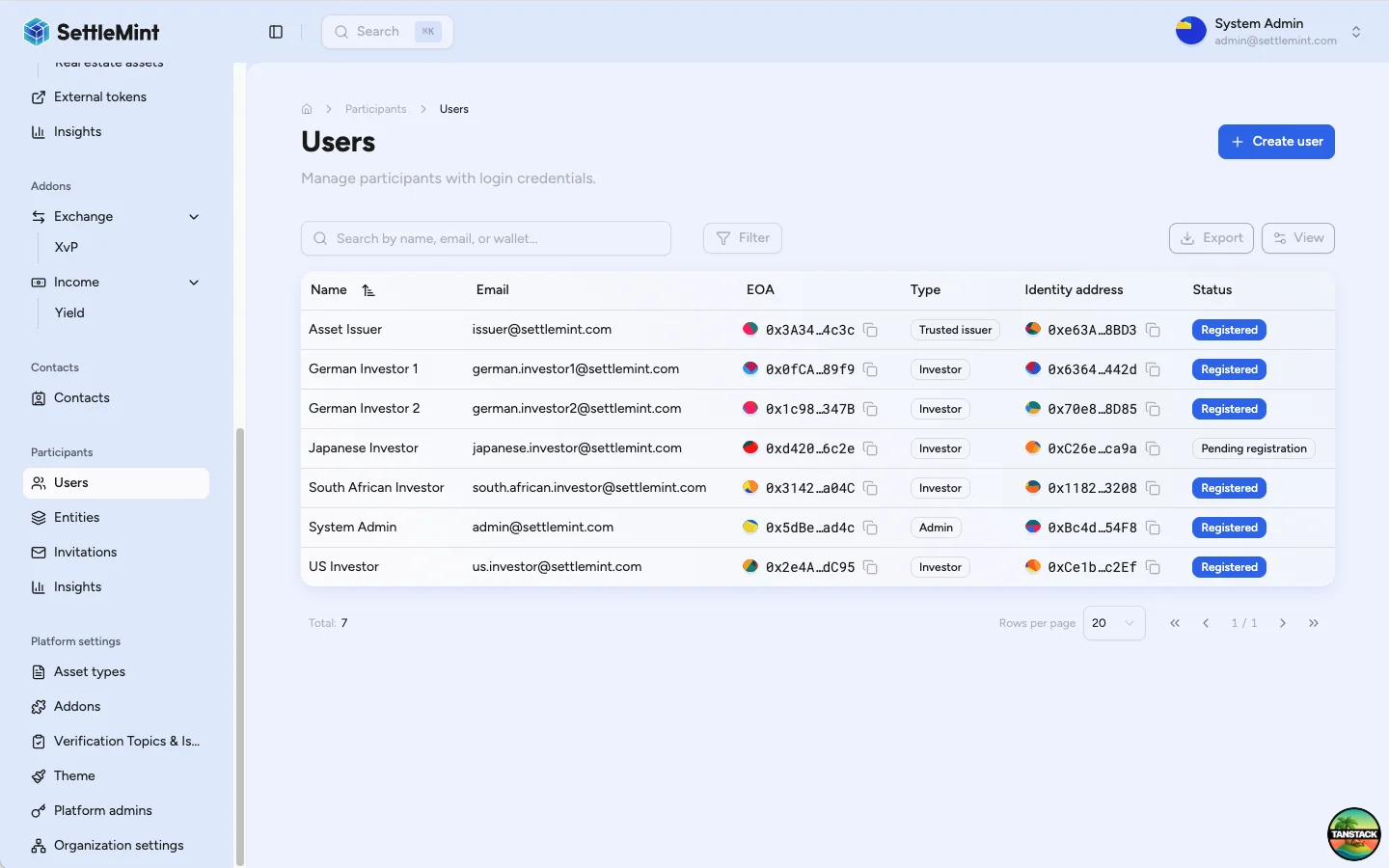
Confirm the user is ready
- Open Participants > Users.
- Find the user.
- Confirm the user has an Identity address.
When no identity address is present, pause this runbook. Ask the user to complete User Onboarding. After onboarding completes, return to the user profile.
Register the identity
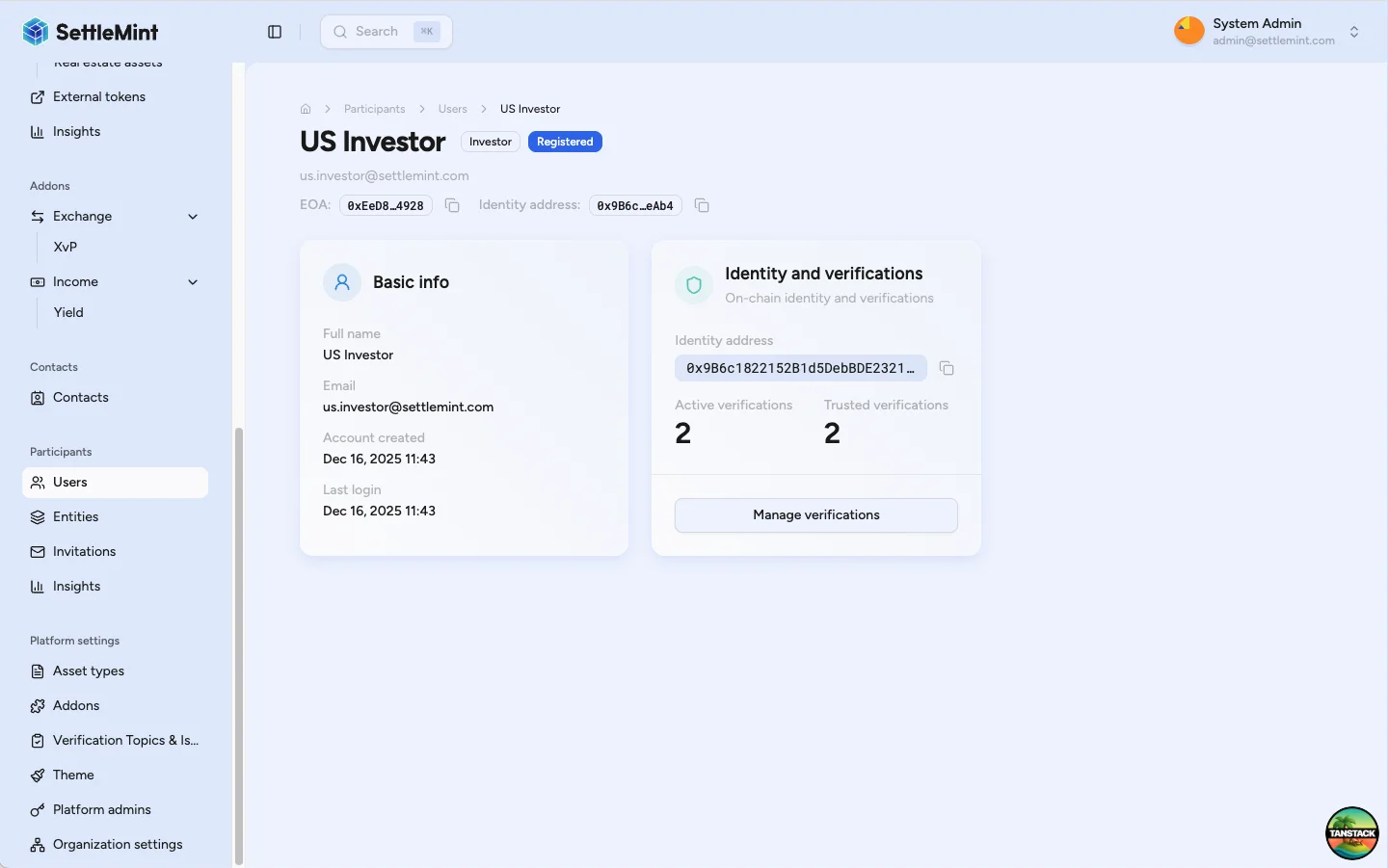
Registering the user adds their identity address to the on-chain identity registry with the jurisdiction that compliance rules use.
Follow Register User to:
- select the user from the Users list;
- click Register Identity;
- choose the jurisdiction from the user's approved documents;
- submit the registration transaction.
After the transaction confirms, reopen or refresh the user profile and confirm the user shows Registered.
Issue the KYC verification
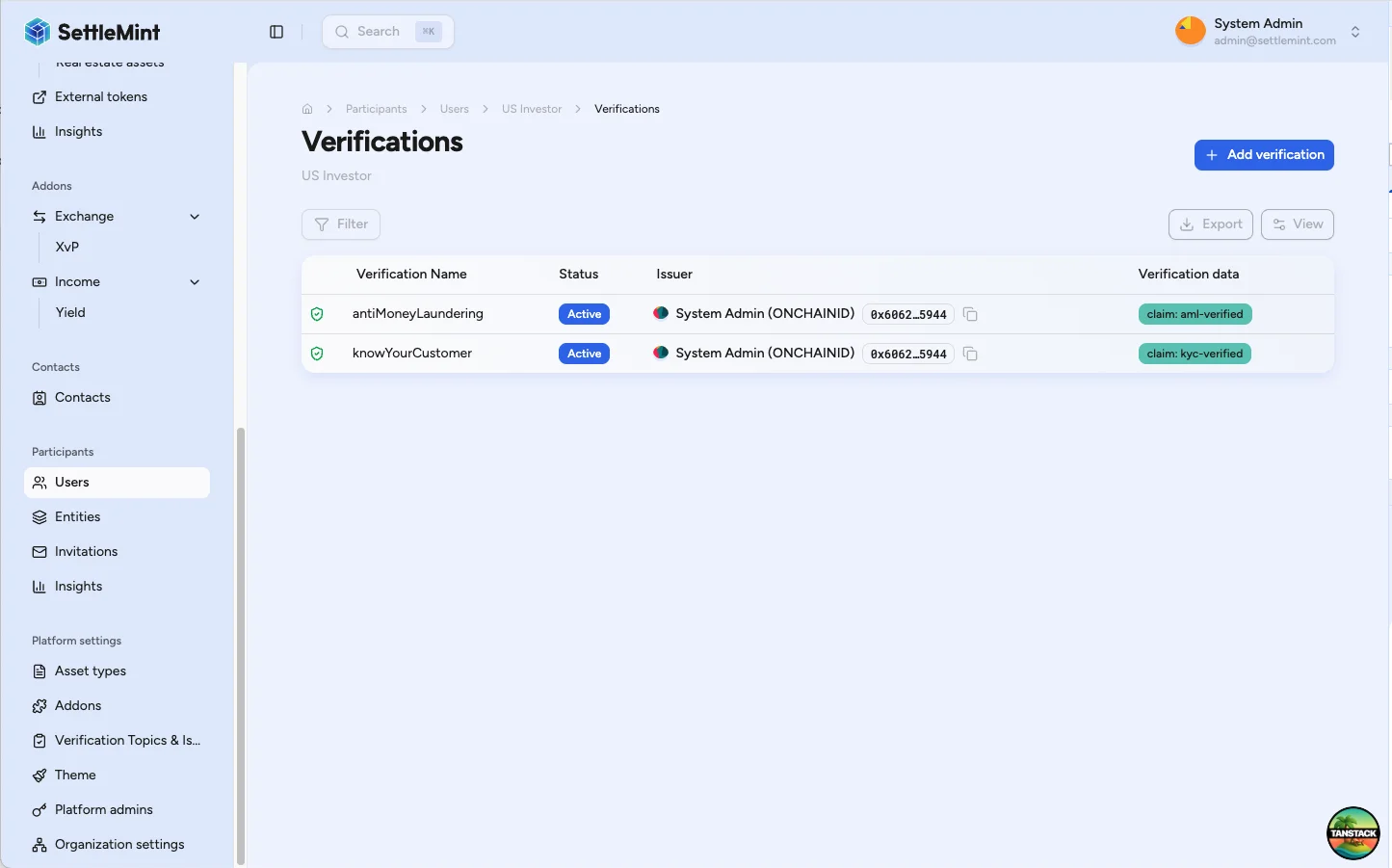
With the identity registered, follow Verify KYC to issue the KYC verification from a trusted issuer identity:
- open the user's profile;
- click Manage verifications;
- choose Issue verification;
- select Know Your Customer (KYC);
- submit the verification transaction.
Check the final state
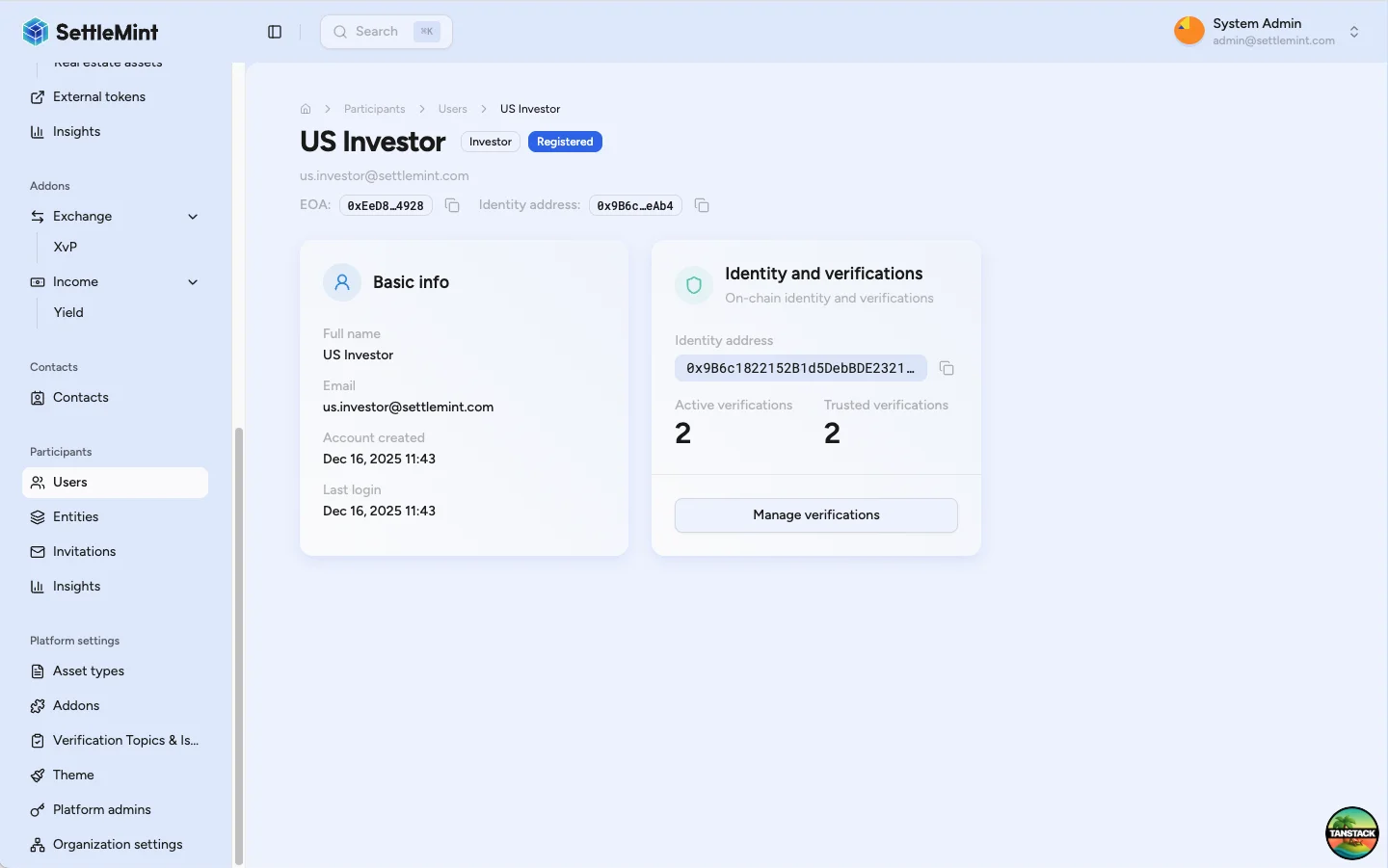
When the KYC verification transaction confirms, the user is ready. Verify that:
- the user's profile shows the KYC verification;
- the verification shows the trusted issuer shield;
- asset rules that require KYC can evaluate the user;
- asset-specific claims still need to be issued separately.
Troubleshooting
| Issue | What to check |
|---|---|
| Register Identity is not visible | Confirm your account has the Identity Manager role and the user has an identity address. |
| Registration transaction fails | Confirm the operator wallet has gas, the selected jurisdiction is correct, and the user identity is not already registered. |
| Issue verification is not visible | Confirm your account has the Verification Issuer role, claim-creation permission, and a registered identity for the user. |
| KYC verification has no green shield | Confirm your issuer identity is configured as a trusted issuer for the KYC topic. |
| User still cannot receive the target asset | Check whether the asset requires more claims, trusted issuers, jurisdiction rules, or investor-status verifications beyond KYC. |
Related guides
- User Onboarding explains the account and wallet setup that must happen before this runbook.
- Register User covers the registry transaction in detail.
- Verify KYC covers issuing verification claims.
- Configure Trusted Issuers explains how to trust issuer identities for specific claim topics.
- Claims and identity explains how DALP evaluates identity claims during token operations.