

Walkthrough
Follow a complete example of a local settlement where a Builder sells property tokens to a Buyer, with a Notary receiving a fee.
This walkthrough demonstrates a complete local settlement from creation to execution. You'll see how assets flow between participants and what happens at each step.
Scenario
Real estate trade with notary fee
- Builder holds 1,000 property tokens (PROP)
- Buyer wants to purchase them for 100,000 EURD (Euro Deposit)
- Notary facilitated the trade and receives a 500 EURD fee
All assets exist on the same blockchain, making this a local settlement.
Starting balances
| Participant | PROP | EURD |
|---|---|---|
| Builder | 1,000 | 0 |
| Buyer | 0 | 100,500 |
| Notary | 0 | 0 |
| XvP Contract | 0 | 0 |
Settlement structure
Flows:
- Builder → Buyer: 1,000 PROP
- Buyer → Builder: 100,000 EURD
- Buyer → Notary: 500 EURD
Configuration:
- Cutoff date: 24 hours from creation
- Auto-execute: Enabled
Step-by-step walkthrough
Notary creates the settlement
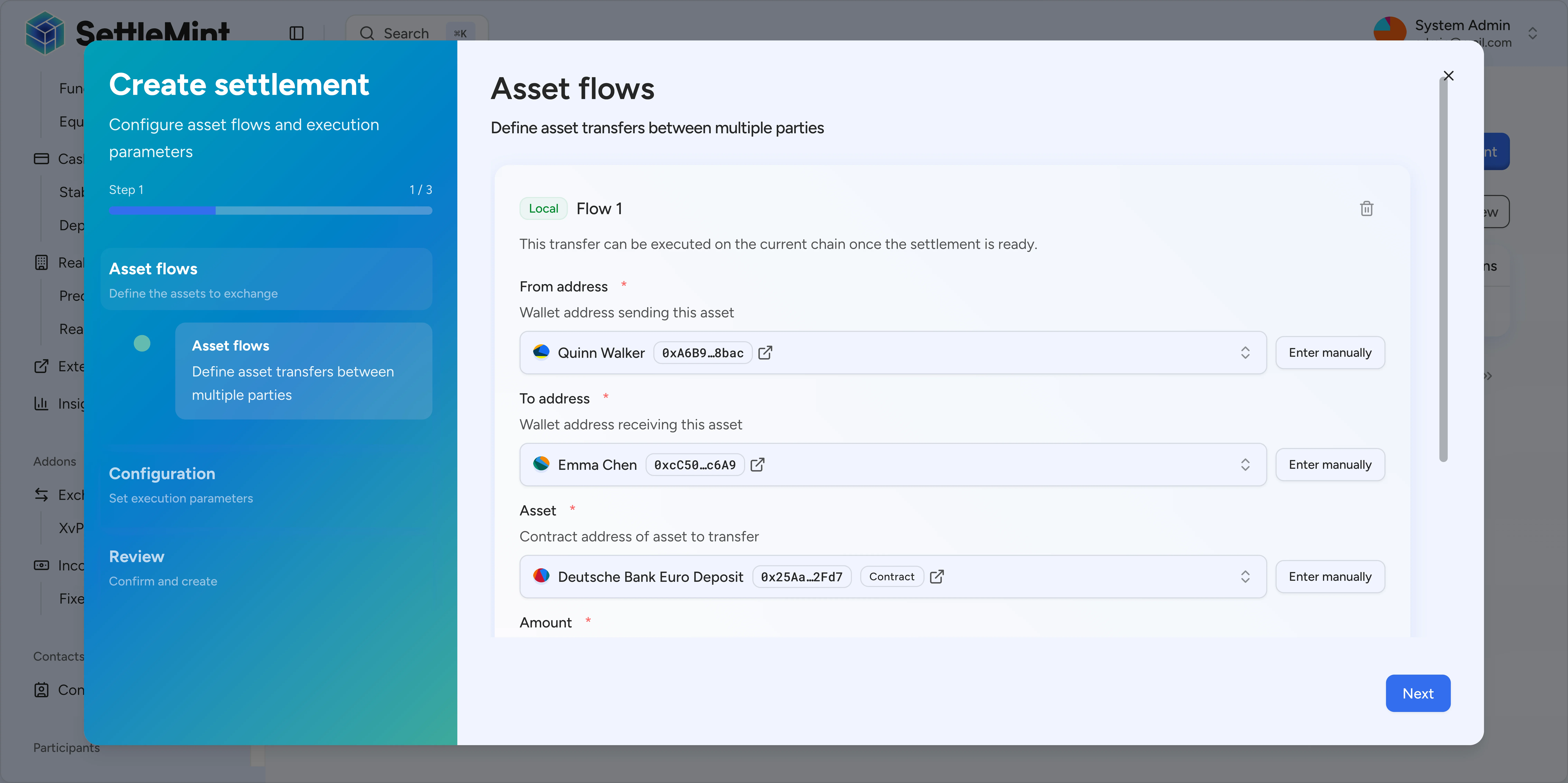
The Notary opens the settlement wizard and configures three flows:
- Flow 1: Builder sends 1,000 PROP to Buyer
- Flow 2: Buyer sends 100,000 EURD to Builder
- Flow 3: Buyer sends 500 EURD to Notary
The Notary sets a 24-hour cutoff and enables auto-execute.
Balances after creation:
| Participant | PROP | EURD |
|---|---|---|
| Builder | 1,000 | 0 |
| Buyer | 0 | 100,500 |
| Notary | 0 | 0 |
| XvP Contract | 0 | 0 |
No assets have moved yet. The settlement is in Pending state.
Builder approves
The Builder reviews the settlement and clicks Approve. Their 1,000 PROP are transferred to the XvP contract as escrow.
Balances after Builder approves:
| Participant | PROP | EURD |
|---|---|---|
| Builder | 0 | 0 |
| Buyer | 0 | 100,500 |
| Notary | 0 | 0 |
| XvP Contract | 1,000 | 0 |
The settlement shows "1 of 2 approvals" and remains in Pending state.
Buyer approves
The Buyer receives notification of the pending settlement. They review all flows, confirm the amounts are correct, and click Approve.
Their 100,500 EURD (100,000 for the property + 500 notary fee) are transferred to the XvP contract. Since auto-execute is enabled and this is the final approval, the settlement immediately executes.
Balances after Buyer approves (and auto-execute triggers):
| Participant | PROP | EURD |
|---|---|---|
| Builder | 0 | 100,000 |
| Buyer | 1,000 | 0 |
| Notary | 0 | 500 |
| XvP Contract | 0 | 0 |
The settlement is now in Executed state.
What happens during execution
When all approvals are received, the settlement:
- Validates all flows (sufficient balances, compliance checks)
- Executes all transfers atomically in a single transaction
- Distributes assets to recipients
- Records the execution on-chain
If any transfer fails (insufficient balance, compliance block, etc.), the entire settlement reverts and all assets remain in escrow.
Alternative scenarios
Manual execution
If auto-execute is disabled, after all senders approve:
- Settlement enters Ready state
- Anyone can click Execute to trigger the settlement
- All flows execute atomically
This allows for a final review before committing.
Buyer doesn't approve
If the Buyer doesn't approve before the cutoff date:
- Settlement enters Expired state when the cutoff passes
- The Builder can click Withdraw to reclaim their 1,000 PROP
- The settlement cannot be executed after expiration
Cancellation before execution
If any local participant decides to cancel before execution:
- The participant clicks Cancel
- All locked assets are returned to their original senders
- Settlement enters Cancelled state
- No assets exchanged
Summary
| Step | Action | Settlement state | Assets moved |
|---|---|---|---|
| 1 | Notary creates settlement | Pending | None |
| 2 | Builder approves | Pending (1/2) | PROP → XvP |
| 3 | Buyer approves | Executed | EURD → XvP, then atomic settlement |
Next steps
Overview
Local settlements execute all asset transfers atomically on a single blockchain. Learn when to use local settlements and how the approval workflow operates.
Overview
HTLC settlements coordinate asset exchanges across EVM networks using hash time-locked contracts. Learn when to use HTLC and what each DALP settlement controls locally.