

DALP documentation
Find the right DALP page for evaluation, architecture review, operator workflows, developer integration, and platform runbooks.
DALP documentation maps the path through regulated tokenised assets on EVM-compatible networks. It routes each reader, whether a sponsor, architect, operator, developer, or compliance reviewer, to the page that answers their question without forcing anyone through the whole set.
Start with the business and control model. Move into architecture when you need ownership splits, then use the operator and developer guides for the workflows and APIs that run the system.
What DALP is
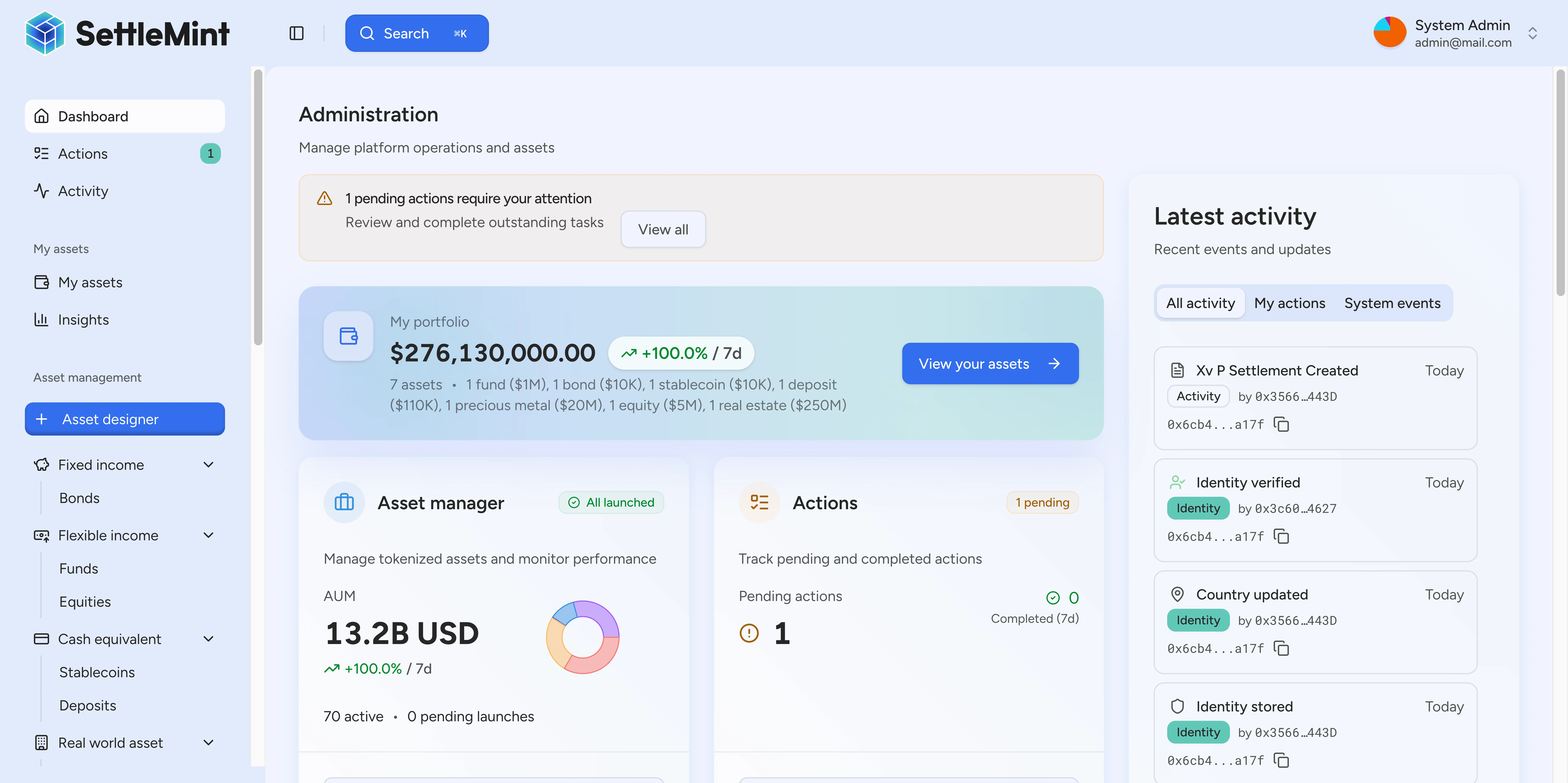
The SettleMint Digital Asset Lifecycle Platform is a control plane for regulated tokenised assets on EVM-compatible networks. It gives institutions one surface for creating assets, enforcing eligibility, submitting lifecycle operations, coordinating settlement and servicing, and reading current operational data.
The docs describe DALP as five cooperating layers:
| Layer | Role in the platform | Review question it answers |
|---|---|---|
| Console | Human operators configure assets, review pending work, manage users, and monitor status | Who performs platform work, and what state do they see? |
| Platform API | External systems call authenticated routes for asset, compliance, servicing, and settlement operations | How do internal systems integrate without bypassing controls? |
| Workflow Engine | Durable workflows prepare, sign, submit, retry, and reconcile blockchain transactions | What happens between request acceptance and confirmed execution? |
| SMART Protocol contracts | On-chain contracts enforce token state, roles, identity checks, compliance modules, and transfer rules | Which controls are enforced on-chain for configured assets? |
| Ledger Index | Chain events become queryable platform state for console screens, API reads, reports, and monitoring | How does on-chain activity become operational evidence and read-side visibility? |
The core mental model is: request, execute, enforce, record. Operators or integrations start work through DALP. The Workflow Engine controls the long-running transaction path and signing handoff. SMART Protocol contracts enforce configured asset and compliance rules on-chain. The Ledger Index turns emitted events into queryable data: dashboards, API reads, monitoring reports, and audit review.
Choose the path for your role
Pick the card that matches the decision you need to make. Each section gives you a short first path and links to the pages another reviewer will need for the same decision.
Evaluate DALP, asset use cases, compliance fit, risk ownership, and the commercial case. Start with the executive overview, then cross-check architecture responsibilities and security controls.
Review platform layers, deployment topology, integration seams, EVM network choices, and production operability. Use developer guides for API details and operator guides for console workflows.
Build API, CLI, event, compliance, feed, and asset-servicing integrations. Use architecture pages for platform boundaries and runbooks for production handoffs.
Run governed work in the console: platform setup, user management, asset creation, compliance operations, servicing, runbooks, and recovery paths.
Inspect controls, privacy, identity, authorization, transfer restrictions, wallet verification, source evidence, and policy boundaries.
When multiple readers are reviewing together, start with the architecture overview. It defines what DALP controls and what the institution, custody provider, EVM network, KYC provider, and downstream systems still own independently.
Cross-audience routes
Use the table below to find the right starting point. Each row also names the pages another reviewer on the same decision will need.
| Decision | Primary root | Cross-check |
|---|---|---|
| Platform fit and asset use cases | Business | Architecture overview and Compliance and security |
| System design and deployment | Architects | Developer guides and Operability |
| API, CLI, and event integration | Developers | Architecture components and Runbooks |
| Console operations and recovery | Operators | Security controls and Developer operations |
| Control, privacy, and evidence review | Compliance and security | Architecture overview and Compliance user guides |
If you have 15 minutes
Use this path when you need a fast view of DALP before a demo, architecture review, or implementation planning session:
- Read Introduction for the tokenisation and lifecycle model.
- Read Digital asset lifecycle platform to connect the lifecycle-platform concept to DALP's product layers.
- Read DALP overview for the platform capabilities and operating evidence DALP exposes.
- Read the Architecture overview for the control plane, state-change path, and responsibility split.
- Choose one working surface: User guides for console operations or Developer guides for API and event integration.
After that path, use the table above to go deeper by reader role rather than reading the docs in page order.
Documentation map
Executive overview
Read these pages first to understand the business problem, the tokenised instrument model, and core platform capabilities before moving into the architecture section.
- Introduction explains asset tokenisation and lifecycle controls: compliance, custody, signing responsibilities, settlement flow, and operating records.
- DALP overview covers platform capabilities for issuance, compliance enforcement, custody-aware approvals, settlement, servicing, exception handling, and operating evidence.
- Use cases maps DALP to common regulated digital asset scenarios.
- Glossary defines product terms, tokenisation vocabulary, compliance terminology, and structural concepts used in the docs.
Architecture
Use this section for the bank-grade control review: layer responsibilities, ownership splits, deployment topology, security model, integration points, data domains, and production limits.
- Architecture overview explains the control model, ownership split, state-change path, and explicit limits.
- Components describes the major platform components and where each responsibility sits.
- Flows traces key platform operations end to end.
- Integrations describes external systems: custody providers, KYC providers, EVM network access, and downstream consumers.
- Security describes authentication, authorisation, identity compliance, wallet verification, and related controls.
- Operability addresses observability, database design, recovery concerns, and production failure modes.
User guides
Use this section when an administrator, compliance officer, or operations team needs to run a governed task in the Console.
- User guides is the operator task index.
- Platform setup starts Console administration.
- Asset creation explains deploying a tokenised instrument through the Asset Designer.
- Compliance covers compliance templates, trusted issuers, KYC verification, and collateral configuration.
- Asset servicing covers minting and burning, forced transfers, token pauses, and administrator replacement.
- System addons describes optional platform capabilities such as XvP settlement and yield schedules.
Developer guides
Use this section when you need to automate DALP workflows, call the API, build against generated types, use the CLI, or connect platform events to other systems.
- Developer guides is the technical integration index.
- API integration getting started starts API key and TypeScript client setup.
- API reference provides the OpenAPI specification and type-safe client generation path.
- Token lifecycle describes how the Platform API handles token creation, minting, transfers, and burns.
- Events catalogue describes lifecycle events: webhook delivery, payload privacy, retry behavior, and audit proofs.
- Transaction tracking explains how integrations follow long-running blockchain transactions.
Runbooks and resources
Use this section for operating procedures that span system, chain, and provider boundaries. Consult the appendices for terminology, deployment requirements, or legal notices.
- Runbooks lists high-control operational procedures.
- Rotate provider claim signer key covers compliance provider signer rotation.
- Self-hosting prerequisites covers deployment prerequisites for self-hosted environments.
- Glossary defines recurring terms.
- Privacy policy provides the public privacy notice.
- SettleMint Trust Center publishes security policies, compliance attestations, and governance materials for procurement and audit reviews.
- SettleMint status page reports current availability and incident history for SettleMint-hosted platform environments.
From evaluation to implementation
For a first bank-grade review, read in this order:
- Introduction to ground the review in asset tokenisation, lifecycle controls, and institutional adoption concerns.
- Digital asset lifecycle platform to understand the lifecycle-platform model and DALP's five layers.
- DALP overview to understand the platform capabilities after launch.
- Architecture overview to review the control plane, ownership responsibilities, state-change path, and limits.
- User guides or Developer guides to move from evaluation into console operations or API integration.
- Runbooks and Operability when the review turns to production procedures and failure handling.
This order keeps the review grounded: business purpose first, then architecture and ownership splits, and finally the operator and developer surfaces where the model runs.