

Collateral requirement
Configure the collateral compliance module so DALP checks the asset identity for a valid collateral claim before minting more supply.
The collateral compliance module checks minting. When you enable the module for an asset, DALP looks for a valid collateral claim on the asset identity before allowing new supply.
That claim must be issued by a trusted issuer. It must also be unexpired and large enough to cover the required amount after the mint.
The module does not screen normal wallet-to-wallet transfers.
DALP also does not prove that money, securities, commodities, or other off-chain reserves exist. Reserve custody and attestations stay in the operator's evidence process.
DALP records the on-chain claim and enforces the configured minting check.
How collateral validation works
When you mint an asset with the module enabled, DALP applies this sequence:
The required amount is calculated from the post-mint total supply and the configured ratio in basis points. A 10,000 bps ratio means 100% backing. A 15,000 bps ratio means the claim must cover 150% of the post-mint supply.
Roles and responsibilities
| Role | Responsibilities |
|---|---|
| Asset issuer | Configures the module during asset creation, including the collateral ratio and trusted issuer setup. |
| Trusted issuer | Issues and manages the collateral claim on the asset identity after reviewing the operator's reserve evidence. |
Separate configuration from proof
The asset issuer configures how DALP checks collateral during minting. The trusted issuer records the claim that DALP can validate on-chain. The documents and approvals behind that claim remain part of the operator's reserve process.
Configuration parameters
| Parameter | Description | Valid values | Example |
|---|---|---|---|
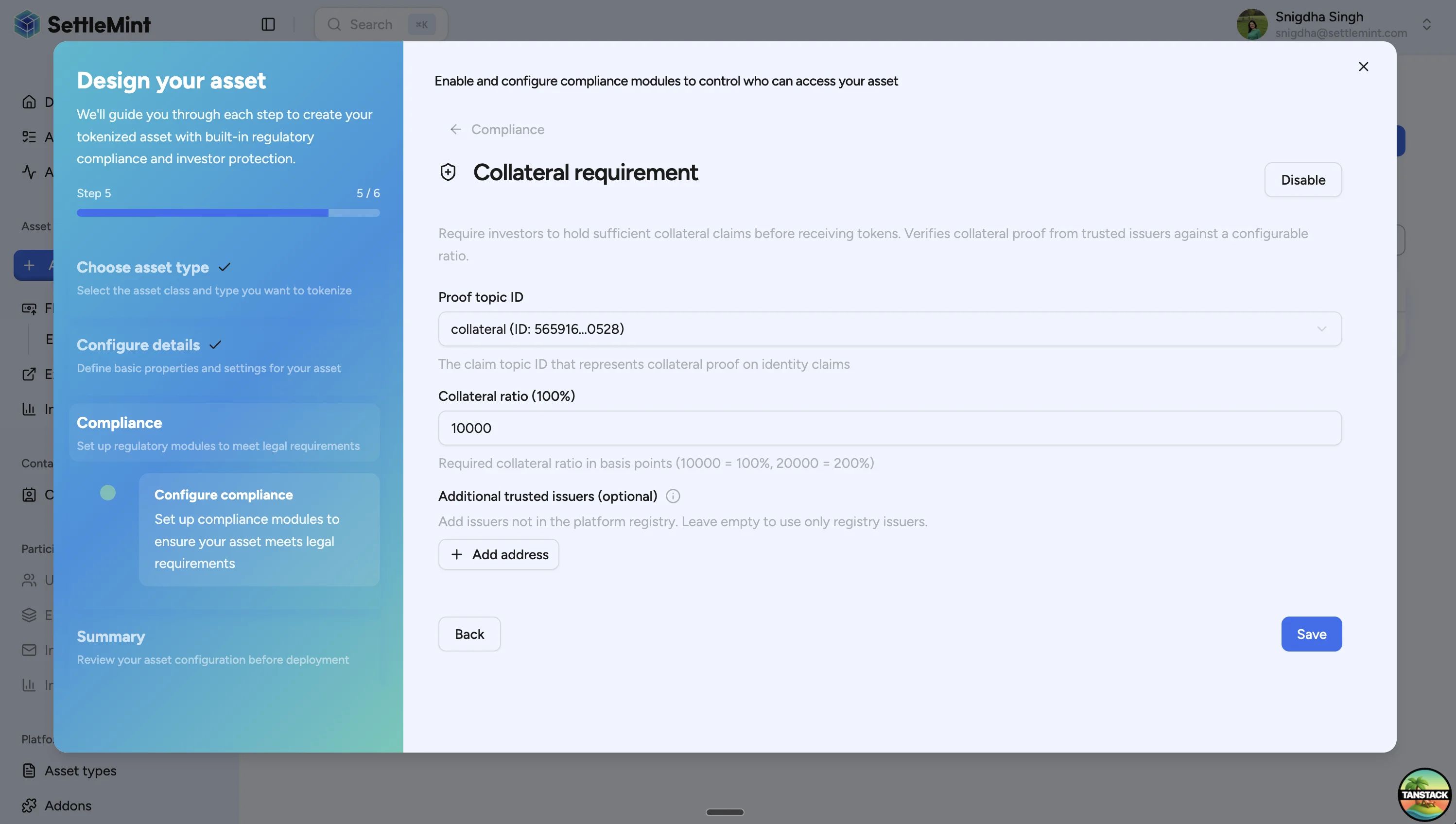
| Proof topic ID | Verification topic DALP checks for the collateral claim. The platform provides the default collateral topic. | System-provided topic ID | collateral (ID: 565916...0528) |
| Collateral ratio | Required backing ratio in basis points. | 0 to 20000 | 10000 for 100%, 15000 for 150% |
| Additional trusted issuers | Issuer addresses accepted in addition to the platform registry. Use only when the issuer is not already registered for the collateral topic. | Wallet addresses | Leave empty to use registry issuers |
Collateral ratios use basis points
0 disables the minting check. 10000 requires 100% backing, so 1,000 minted units require a claim for at least
1,000. 20000 is the maximum ratio and requires 200% backing.
Configure collateral during asset creation
Open the asset designer
Navigate to Asset management > Asset designer in the sidebar.
Complete asset setup
Follow the wizard through asset class, type, and basic configuration. See Create asset for the full asset creation flow.
Enable the module
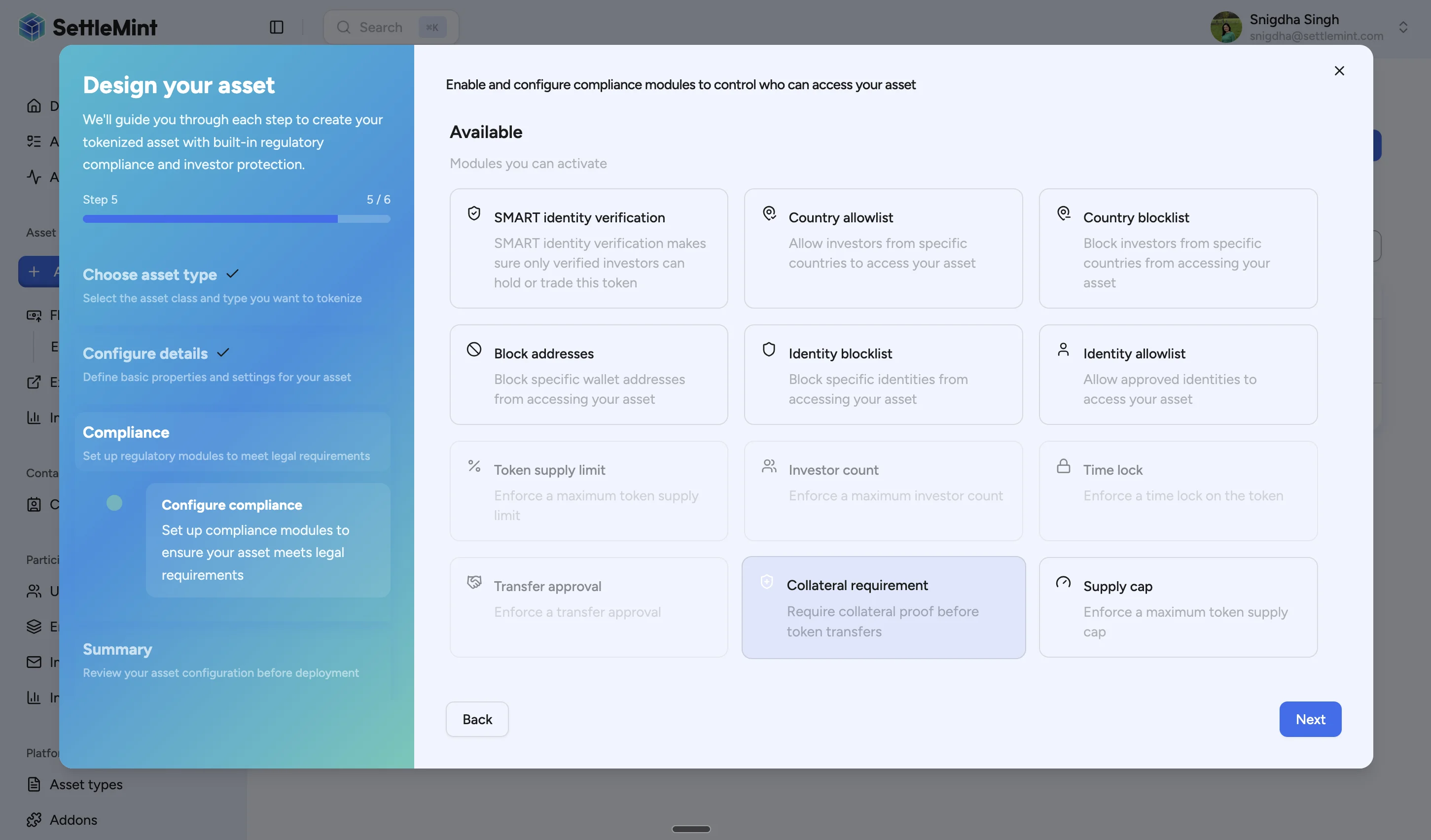
On the compliance modules step, select Collateral requirement. This adds the minting check to the asset.
Complete deployment
Review the configuration and deploy the asset. The module is active after deployment.
Issue a collateral verification
After deployment, a trusted issuer must add a collateral claim to the asset identity before minting can pass the module check.
Prerequisites
You need one of these permissions:
- trusted issuer authority for the collateral topic
- governance authority on the asset
Claim fields
| Field | Description | Format |
|---|---|---|
| Amount | Total value covered by the claim. Use the same unit basis as the asset supply for the minting check. | Asset amount |
| Expiry | Timestamp after which DALP stops treating the claim as valid. | Future date and time |
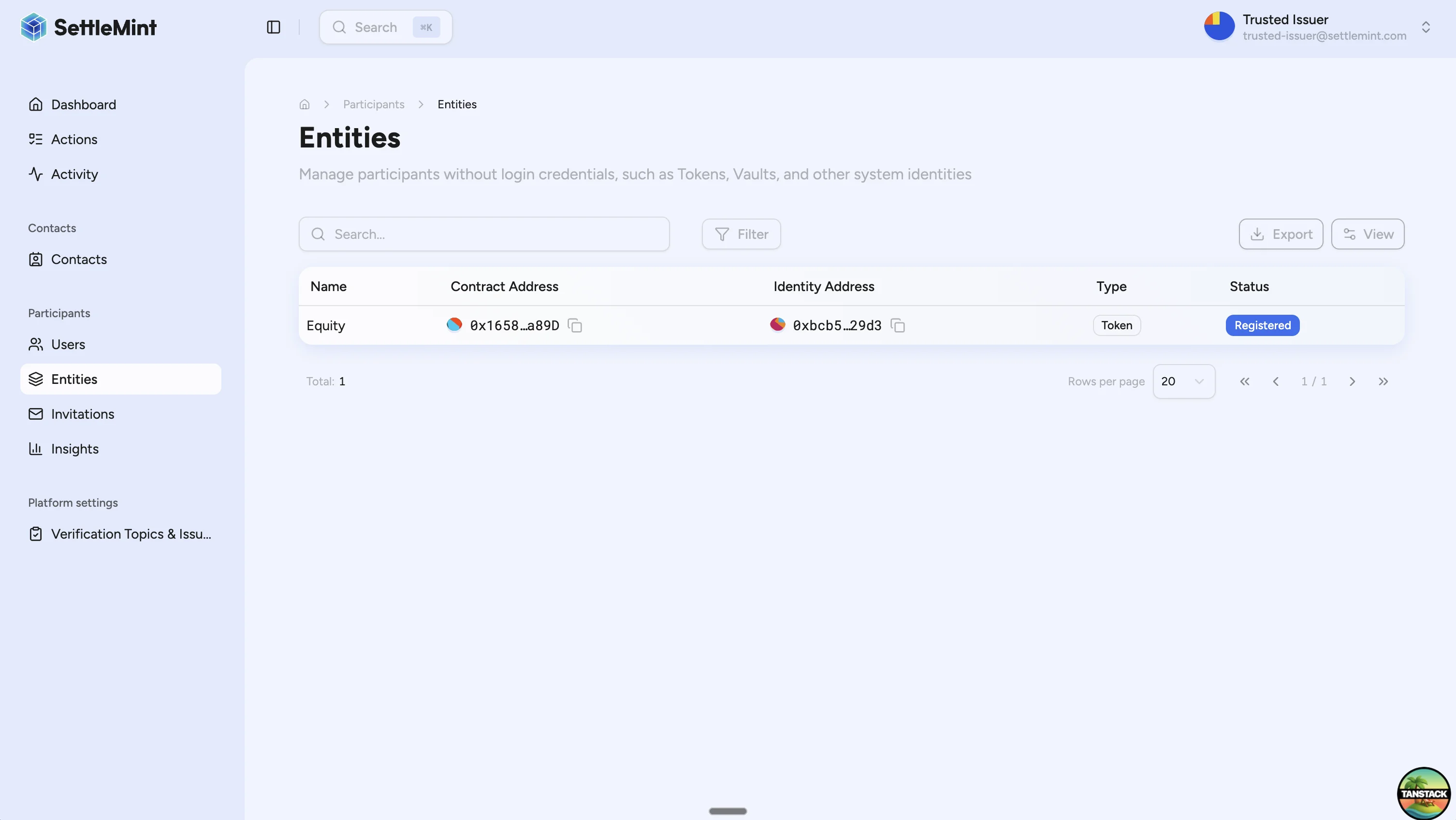
Navigate to Entities
Go to Participants > Entities. Assets appear here because each deployed asset has an on-chain identity. Entity addresses use the Web3 display format, so saved names and avatars can appear beside addresses.
Select the asset
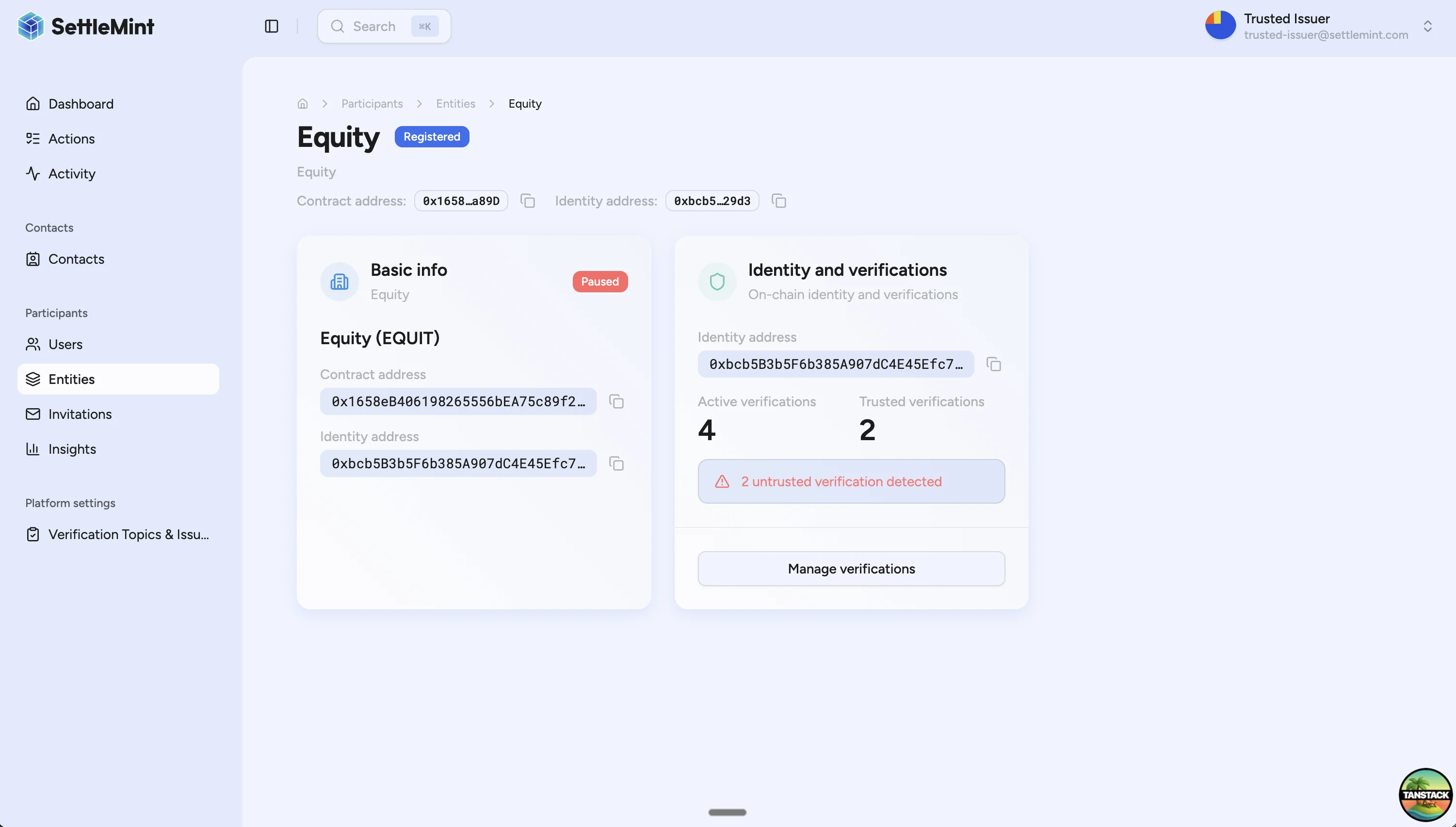
Open the asset that needs the collateral claim.
Open verification management
On the entity detail page, locate the Identity and verifications tile. Click Manage verifications.
Add the claim
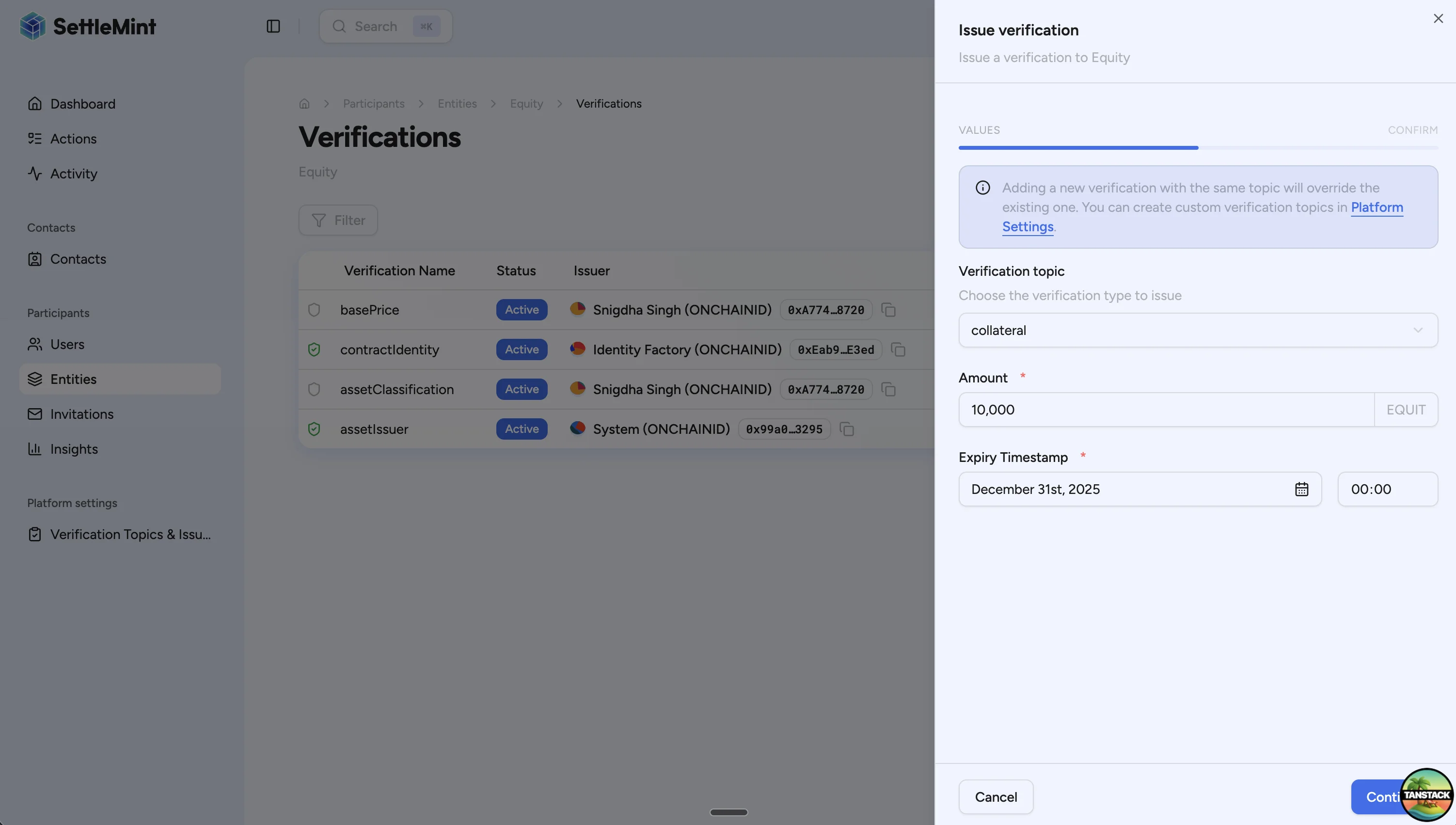
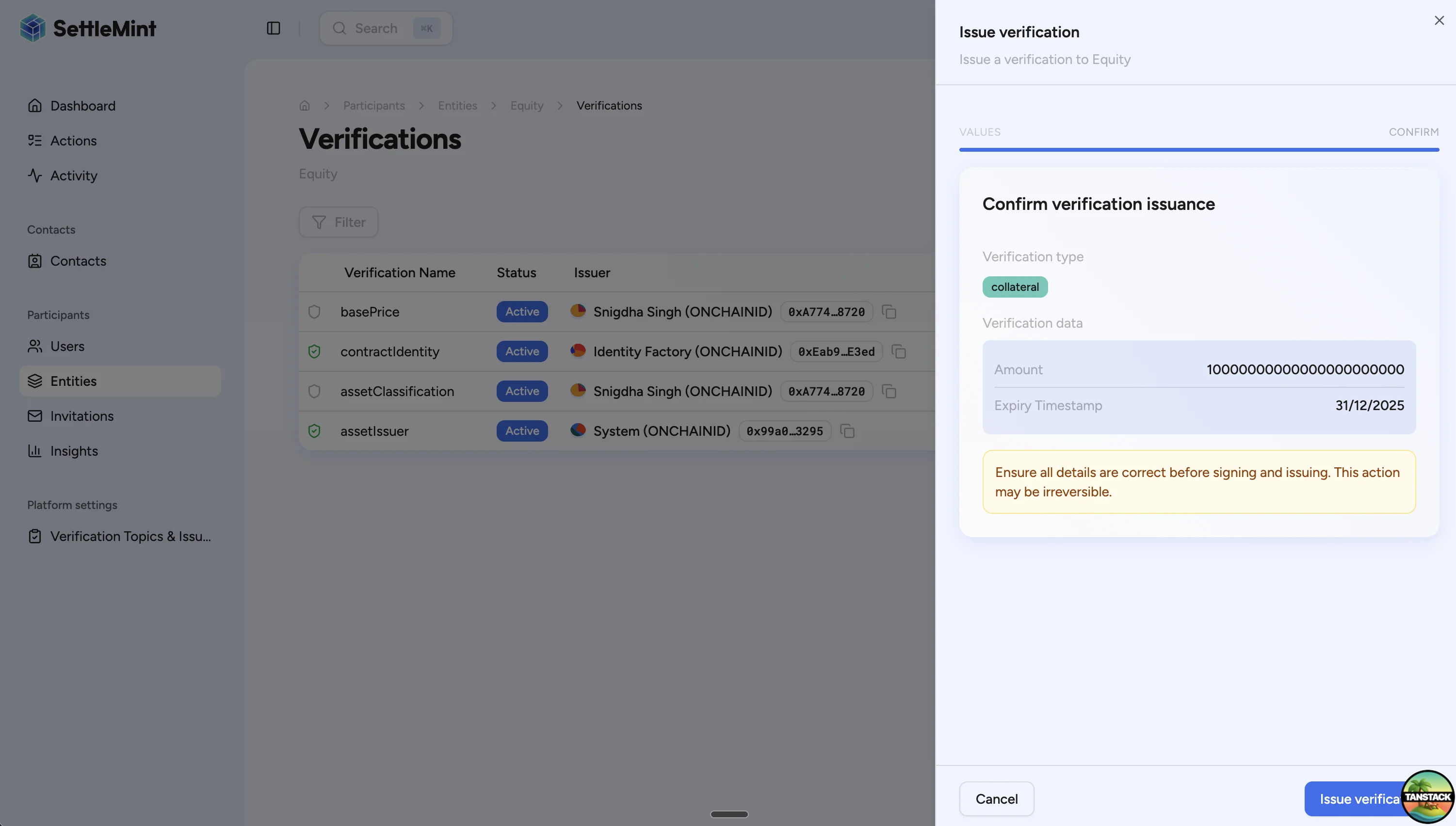
Click Add verification, then enter:
- Verification topic:
collateral - Amount: total covered amount, such as
10000 - Expiry Timestamp: a future expiry date and time
Renew before expiry
Expired collateral claims block future minting. Renew the claim before the expiry timestamp if the asset still needs to mint new supply.
Example calculation
An asset uses a 150% collateral ratio and has a valid claim for 15,000 units.
| Operation | Current supply | Mint amount | Post-mint supply | Required collateral | Available claim | Result |
|---|---|---|---|---|---|---|
| Initial mint | 0 | 5,000 | 5,000 | 7,500 | 15,000 | Allowed |
| Second mint | 5,000 | 3,000 | 8,000 | 12,000 | 15,000 | Allowed |
| Third mint | 8,000 | 5,000 | 13,000 | 19,500 | 15,000 | Blocked |
The third mint fails because the post-mint supply would be 13,000 units. At a 150% ratio, required collateral is 13,000 × 1.5 = 19,500. The current claim only covers 15,000, so the trusted issuer must issue a higher claim before the mint can be retried.
Troubleshooting
| Issue | Cause | Fix |
|---|---|---|
| Minting is blocked with "Insufficient collateral" | The claim amount is lower than the required amount. | Ask the trusted issuer to issue a higher claim, then retry the mint. |
| Minting is blocked with "No collateral verification" | The asset identity has no valid collateral claim. | Ask the trusted issuer to add the claim on the asset identity. |
| Minting is blocked with "Verification expired" | The claim expiry timestamp has passed. | Issue a new claim with a future expiry. |
| You cannot issue the claim | Your account is not a trusted issuer for the topic and does not have governance authority on the asset. | Ask an administrator to grant the required authority or have the designated issuer submit the claim. |